Facts
The 6th Respondent, an Instrumentation Engineer at the University of Calicut, was subjected to disciplinary proceedings for allegedly causing a loss of ₹27,42,116/- during a LAN installation tender process.
Source reference: para. 7The University Syndicate found him guilty and imposed a punishment of reversion to Junior Engineer for five years plus recovery of the loss.
Source reference: para. 13On appeal, the Chancellor (Respondent No. 3) set aside the Syndicate's order and directed reinstatement with full benefits.
Source reference: para. 14The Syndicate initially resolved to challenge the Chancellor’s order in court, but the newly appointed Vice-Chancellor (Respondent No. 5) sought a second legal opinion and subsequently nullified the Syndicate's decision to litigate.
Source reference: paras. 16–18Two Syndicate members filed these writ petitions to challenge the Chancellor's order and the Vice-Chancellor's interference.
Source reference: para. 1Issues
1. Whether members of the Syndicate have the locus standi (status as an "aggrieved person") to challenge an order passed by the Chancellor in his statutory appellate capacity.
Source reference: para. 232. Whether the University Syndicate, as a constituent part of the "body corporate," can legally challenge an order passed by the Chancellor, who is the Head of the University.
Source reference: para. 323. Whether the Chancellor’s order warrants interference under the limited scope of judicial review in departmental proceedings.
Source reference: para. 53Law Applied
Section 3 of the Calicut University Act, 1975, which defines the Chancellor and Syndicate as parts of a single "body corporate".
Source reference: para. 25Statutes 52, 63, and 64 of the Calicut University First Statutes, 1977, establishing the Chancellor as the appellate authority whose orders the Syndicate is statutorily bound to implement.
Source reference: paras. 29–30Regarding locus standi, the Court cited Jasbhai Motibhai Desai v. Roshan Kumar and Ayaaubkhan Noorkhan Pathan v. State of Maharashtra to define "aggrieved persons."
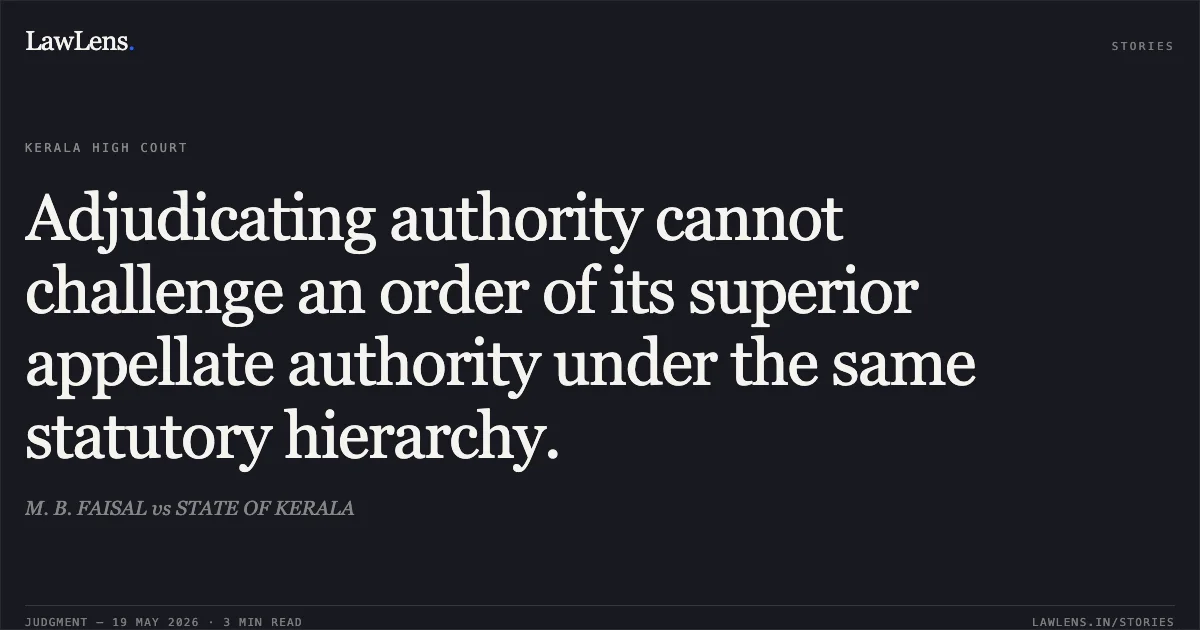
Source reference: para. 44, 47In procedural hierarchy, it followed Administrator, Cosmopolitan Hospitals (P) Ltd. v. RPFC and Bhopal Sugar Industries Ltd. v. ITO, holding that an adjudicating authority cannot challenge the decision of its superior appellate body.
Source reference: para. 33, 34, 39Reasoning
The Court reasoned that since Section 3 of the Act integrates the Chancellor and Syndicate into one body corporate, it is legally improper for one component to sue another unless specifically authorized by statute.
Source reference: para. 32, 41In disciplinary matters, the Syndicate acts as a quasi-judicial adjudicating authority; once its decision is reviewed by the statutory appellate authority (the Chancellor), the Syndicate becomes functus officio and lacks any "legal grievance" to contest the reversal.
Source reference: para. 49The Court noted that the petitioners, as individual members, suffered no personal or legal injury, thus failing the test of "aggrieved persons".
Source reference: para. 47While acknowledging an exception for "patently illegal" orders, the Court found that the Chancellor’s order was a reasoned decision based on a re-appreciation of evidence, which does not meet the threshold for such an exception.
Source reference: paras. 51–53Holding
The Court dismissed the writ petitions, holding that the Syndicate and its members lack the competence and locus standi to challenge the Chancellor's appellate order.
The Court further held that it cannot sit as a "second court of appeal" to re-examine factual findings in disciplinary cases.
Source reference: para. 56The Court directed the State and the University to ensure the pending Vigilance and Anti-Corruption Bureau investigation is completed to identify and punish the actual culprits and recover the lost funds.
Source reference: para. 62Acts & Sections Cited
4 provisions across 1 statute referred to in this judgment. Each provision opens on LawLens.
Electricity Act, 20034
Original Court PDF
M. B. FAISALvsSTATE OF KERALA
Click to open original judgment
Original judgment, available to read, download and summarize on LawLens.in