Facts
The petitioners, various Co-operative Societies in District Gariyaband, were involved in paddy procurement under a tripartite agreement.
Source reference: p.3During the 2020-21 kharif season, shortages were noted, leading the State to propose FIRs against the societies.
Source reference: p.3-4The petitioners previously filed writ petitions (e.g., WPC No. 2515/2021), which the High Court disposed of by directing the Collector to adjudicate the dispute under Clause-14 (Arbitration Clause) of the agreement after evidence was adduced.
Source reference: p.4, para. 7The respondent (Collector) initiated proceedings, accepted documents from both parties, heard arguments, and passed an order on 26.05.2022 rejecting the petitioners' claims.
Source reference: p.6The petitioners filed these contempt petitions alleging that the Collector failed to comply with the court's direction to record oral evidence and instead relied on procedures from other districts.
Source reference: p.4, para. 3-4Issues
1. Whether the failure to record oral evidence, despite a direction to adjudicate after evidence is adduced, constitutes "willful disobedience" under the Contempt of Courts Act.
Source reference: p.5, para. 6; p.7, para. 102. Whether the passing of an allegedly erroneous or procedurally flawed order by the Collector gives rise to a fresh cause of action rather than a contempt proceeding.
Source reference: p.8, para. 13-15Law Applied
The court applied the "willful disobedience" standard under the Contempt of Courts Act, noting that proof of such intent is sine qua non for punishment.
Source reference: p.5, para. 6It relied on Chaduranga Kanthraj Urs v. P. Ravi Kumar (2024), which establishes that deliberate, conscious, and intentional disregard for an order is required.
Source reference: p.7, para. 11Under Ashok Paper Kamgar Union v. Dharam Godha (2003), "willful" implies an act done with bad purpose or evil motive to disregard the law.
Source reference: p.7, para. 12Furthermore, per J.S. Parihar v. Ganpat Duggar (1996), even if an executive action (like a seniority list or an adjudication) is wrong or non-conforming, it constitutes a fresh cause of action for judicial review, not necessarily contempt.
Source reference: p.8, para. 13Reasoning
The Court observed that the Collector did comply with the core mandate of the writ order by registering the case and initiating adjudication.
Source reference: p.6, para. 9While the writ court mentioned "evidence," the High Court noted that "evidence" encompasses both oral and documentary forms.
Source reference: p.7, para. 10Since the petitioners appeared through advocates, submitted documents, and filed written arguments—all of which were considered by the Collector—the lack of oral testimony did not equate to a "willful" or "intentional" disregard of the Court's authority.
Source reference: p.6-7, para. 9, 14The Court reasoned that if the resulting order was erroneous or followed incorrect procedures (such as referencing orders from Dhamtari), the remedy lies in challenging the order on its merits through a fresh writ petition rather than seeking contempt.
Source reference: p.8, para. 13-15Holding
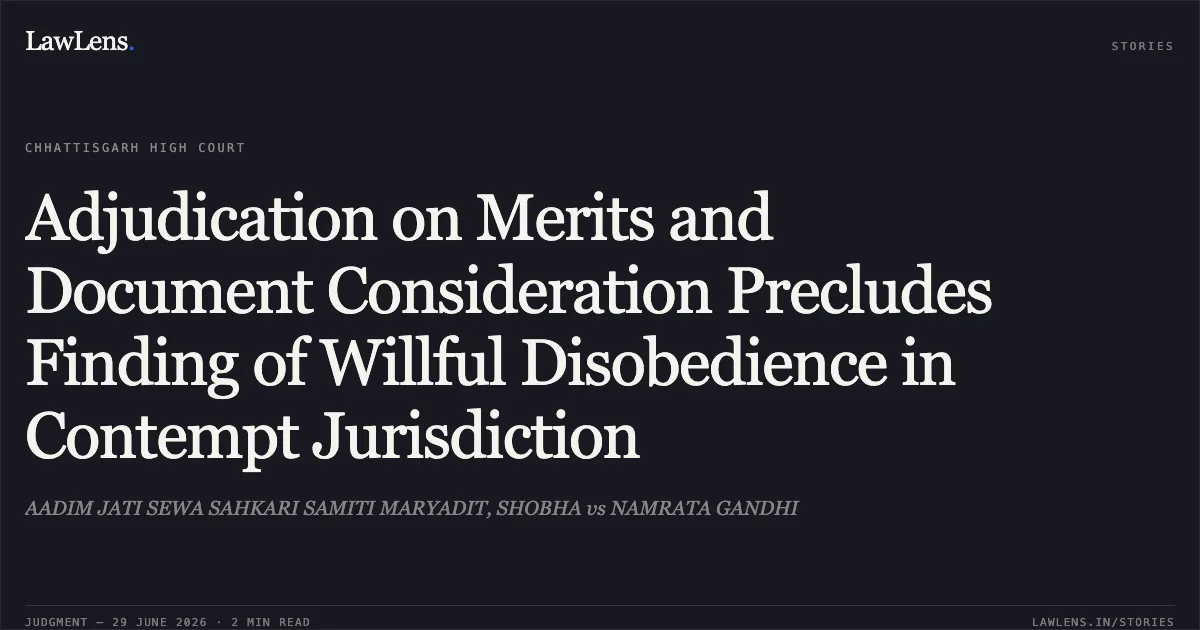
The Court held that there was no "willful and deliberate" disobedience by the respondent.
The contempt proceedings were dropped, notices were discharged, and the petitions closed.
Source reference: p.9, para. 17The Court granted the petitioners liberty to challenge the Collector’s order dated 26.05.2022 in accordance with the law, acknowledging that they had delayed such a challenge due to the pendency of these contempt petitions.
Source reference: p.9, para. 19Original Court PDF
AADIM JATI SEWA SAHKARI SAMITI MARYADIT, SHOBHAvsNAMRATA GANDHI
Click to open original judgment
Original judgment, available to read, download and summarize on LawLens.in