Facts
The second respondent (complainant) admitted his mother to Narayana Multispecialty Hospital for surgery in February 2021
Source reference: p. 2Post-discharge, the complainant alleged billing discrepancies, specifically a charge of ₹2,500 for an HRCT test that was never performed
Source reference: p. 3While the hospital admitted the error and offered a refund via email, the complainant filed a criminal complaint alleging offences under Sections 406, 420, and 120B of the IPC, and Section 34 of the West Bengal Clinical Establishments Act, 2017
Source reference: p. 3-4The Magistrate issued process
Source reference: p. 4On appeal, the High Court set aside the summoning order due to jurisdictional procedural lapses but remarked that a prima facie case was made out, remanding the matter for reconsideration
Source reference: p. 5The appellants moved the Supreme Court seeking to quash the proceedings in their entirety
Source reference: p. 5Issues
1. Whether the allegations in the complaint, taken at face value, disclose the commission of a criminal offence under Sections 406, 420, and 120B of the IPC or Section 34 of the 2017 Act
Source reference: p. 1-22. Whether the High Court erred in remanding the matter instead of quashing the proceedings under Section 482 of the CrPC
Source reference: p. 4-5Law Applied
The Court applied the criteria for quashing criminal proceedings established in State of Haryana v. Bhajan Lal, specifically where allegations do not constitute a prima facie offence or are inherently improbable
Source reference: p. 6-7For Section 405 IPC (Criminal Breach of Trust), it required "entrustment" and "dishonest misappropriation" (Sadhupati Nageswara Rao v. State of AP)
Source reference: p. 7For Section 420 IPC (Cheating), it required "dishonest intention" at the inception of the transaction (Joseph Salvaraj A. v. State of Gujarat)
Source reference: p. 8Regarding Section 120B IPC, it held that conspiracy cannot stand if foundational offences are not disclosed (R.K. Vijayasarathy v. Sudha Seetharam)
Source reference: p. 9It also considered the regulatory and penalty framework for billing "deficiencies" under Sections 29, 35, and 36 of the West Bengal Clinical Establishments Act, 2017
Source reference: p. 11-12Reasoning
The Court found the IPC charges unsustainable as the ₹2,500 billing error lacked the "fiduciary obligation" required for criminal breach of trust
Source reference: p. 7-8the "dishonest intention" required for cheating, especially since the hospital proactively offered a refund
Source reference: p. 8The Court criticized the High Court for suo motu suggesting an offence under Section 504 IPC without a factual basis
Source reference: p. 9-10Regarding the 2017 Act, the Court reasoned that the legislative scheme distinguishes between "deficiencies" (billing/records), which are subject to civil/regulatory adjudication under Sections 29, 35, and 36, and "offences" under Section 34
Source reference: p. 11-13Since the dispute was essentially a service-related grievance, invoking criminal jurisdiction was deemed an abuse of process
Source reference: p. 13Holding
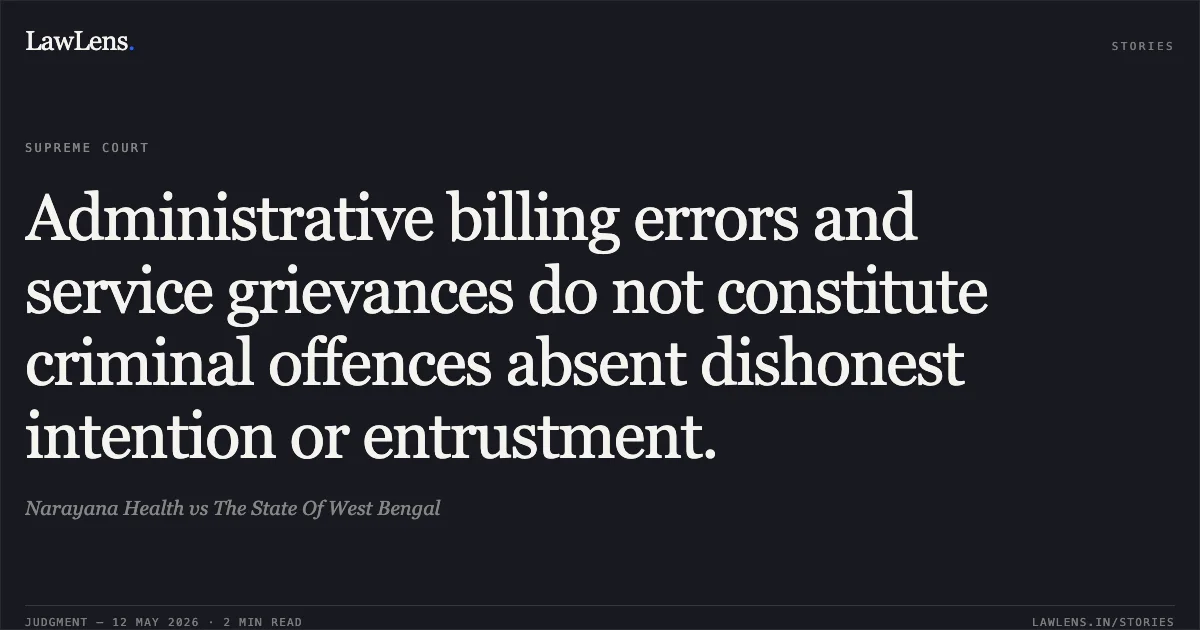
The Supreme Court allowed the appeal and quashed Complaint Case No. C-533 of 2021
The Court held that the allegations failed to disclose any criminal offence and that the dispute was of a civil/statutory nature
Source reference: p. 10, 13The Court set aside the High Court’s remand order, clarifying that the quashing of criminal proceedings does not bar the complainant from pursuing civil or statutory remedies for service deficiencies in accordance with law
Source reference: p. 13-14Acts & Sections Cited
16 provisions across 3 statutes referred to in this judgment. Each provision opens on LawLens.
Indian Penal Code, 18606
Code of Criminal Procedure, 19735
West Bengal Clinical Establishments ( Registration, Regulation And Transparency ) Act, 20175
Original Court PDF
Narayana HealthvsThe State Of West Bengal
Click to open original judgment
Original judgment, available to read, download and summarize on LawLens.in