Facts
The applicant’s father, a Warder in the Prisons Department, died in harness on July 17, 2000.
Source reference: para. 01-02The widow applied for compassionate appointment within one year.
Source reference: para. 03In 2005, the department asked if another family member could be considered, leading the mother to nominate her son (the applicant).
Source reference: para. 04-05Although the applicant was a minor (15 years, 7 months) at the time, the Prisons Department repeatedly recommended his case to the Home Department for age relaxation between 2005 and 2009.
Source reference: para. 05-10The applicant underwent a medical fitness exam and was found fit.
Source reference: para. 11Despite years of active correspondence and recommendations, no formal order of appointment or rejection was issued, leading the applicant to file this O.A. in 2022.
Source reference: para. 13, 21Issues
1. Whether the applicant is disentitled from consideration under SRO-43 merely because he attained majority beyond the stipulated period prescribed under the scheme.
Source reference: para. 22(i)2. Whether the respondents, after continuously processing and recommending the case for years, can deny the claim on technical grounds.
Source reference: para. 22(ii)3. Whether the Original Application is barred by limitation under Section 21 of the Administrative Tribunals Act, 1985.
Source reference: para. 22(iii)Law Applied
Jammu & Kashmir Compassionate Appointment Rules, 1994 (SRO-43), which governs appointments for dependents of employees dying in harness.
Source reference: para. 01The court relied on Sushma Gosain & Ors v. Union of India, establishing that compassionate claims must be decided without undue delay to mitigate financial hardship.
Source reference: para. 14The court cited Malaya Nanda Sethy v. State of Orissa, holding that authorities cannot frustrate the object of the scheme by delaying a process for years and then rejecting it on technical grounds.
Source reference: para. 12The court noted the principle from MGB Gramin Bank v. Chakrawarti Singh that while not a matter of right, such claims require promptitude and expedition.
Source reference: para. 15Reasoning
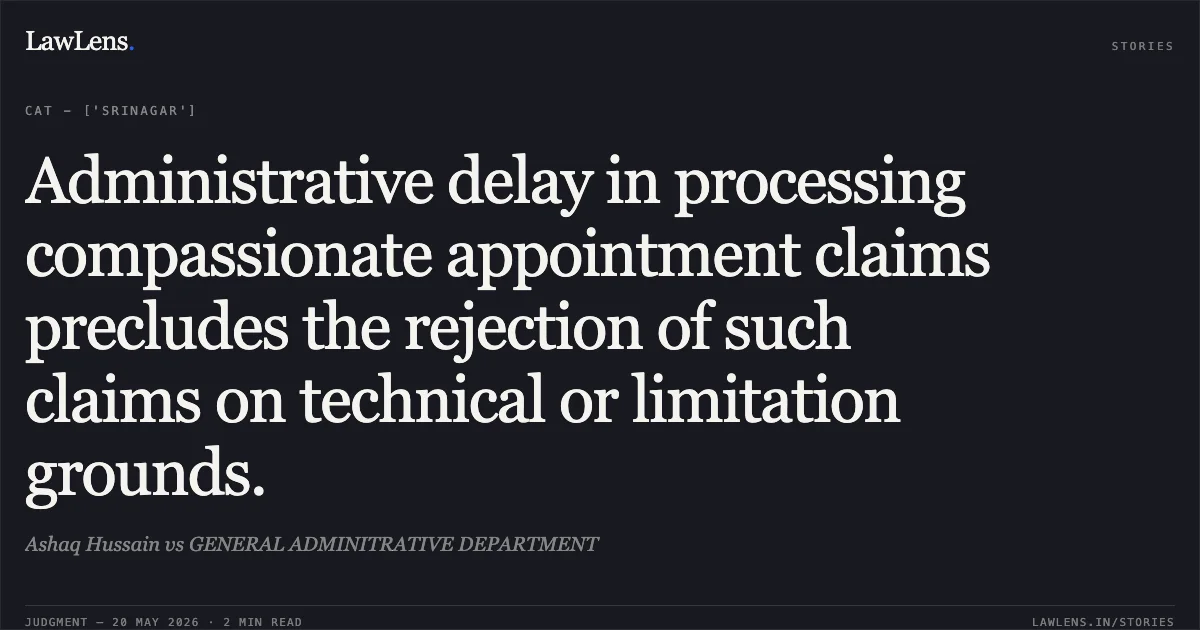
The Tribunal found that the respondents’ conduct significantly altered the typical application of SRO-43. Although the applicant was a minor, the respondents did not reject the claim at the threshold; instead, they consciously invoked the mechanism of relaxation and kept the file active for over five years.
Source reference: para. 31-32The court reasoned that the delay was entirely attributable to administrative inaction rather than the applicant’s lapse.
Source reference: para. 16, 37Regarding limitation, the Tribunal held that since the matter remained under "active administrative consideration" and no final rejection order was ever communicated, the cause of action survived, and a rigid application of the limitation bar was inappropriate.
Source reference: para. 33-34The court determined that fairness and consistency prevent an authority from overlooking technical bars for years only to later invoke them to defeat a claim.
Source reference: para. 35Holding
The Tribunal disposed of the O.A. by directing the respondents to consider or reconsider the applicant’s claim in light of the repeated departmental recommendations for age relaxation (Annexures III, IV, VI, and VIII).
The respondents are ordered to pass a reasoned and speaking order within twelve weeks, specifically addressing the implications of their prolonged internal processing and the absence of a communicated rejection.
Source reference: para. 40-41No order as to costs.
Source reference: para. 43Acts & Sections Cited
2 provisions across 1 statute referred to in this judgment. Each provision opens on LawLens.
Administrative Tribunals Act, 19852
Original Court PDF
Ashaq HussainvsGENERAL ADMINITRATIVE DEPARTMENT
Click to open original judgment
Original judgment, available to read, download and summarize on LawLens.in