Facts
The petitioners challenged orders dated 05.01.2021 passed by the Sub-Divisional Magistrate (SDM), Preet Vihar, directing them to pay Environmental Damage Compensation ranging from Rs. 2,00,000 to Rs. 20,00,000
Source reference: p. 3These orders were based on alleged violations of the Air Act 1981, Water Act 1974, and the Delhi Municipal Corporation Act 1957, initiated by the DPCC and EDMC
Source reference: p. 3-4While the impugned orders noted that the petitioners' replies were considered, they were summarily dismissed as "unsatisfactory" without further elaboration
Source reference: p. 4The High Court had previously stayed these orders pending a final hearing
Source reference: p. 4Issues
1. Whether the impugned orders imposing environmental compensation are legally sustainable if they lack specific reasoning and fail to address the contentions raised in the petitioners' replies
Source reference: p. 42. Whether a composite order for violations under both the Air Act and Water Act is permissible if it potentially prejudices the petitioners' statutory appeal remedies
Source reference: p. 7Law Applied
The Court applied the fundamental principle of Natural Justice, specifically the requirement for a "speaking order."
Source reference: no citationUnion of India v. Ibrahim Uddin, which establishes that judicial and administrative orders must be supported by reasons to ensure transparency and proper application of mind
Source reference: para. 5Ratan Lal Patel v. Dr. Hari Singh Gour Vishwavidyalaya, holding that cryptic orders are indefensible in higher forums
Source reference: para. 6Siemens Engg. & Mfg. Co. of India Ltd. v. Union of India, which mandates that authorities must explicitly deal with arguments advanced by the aggrieved party rather than offering a mere "pretence of compliance"
Source reference: para. 7-8Reasoning
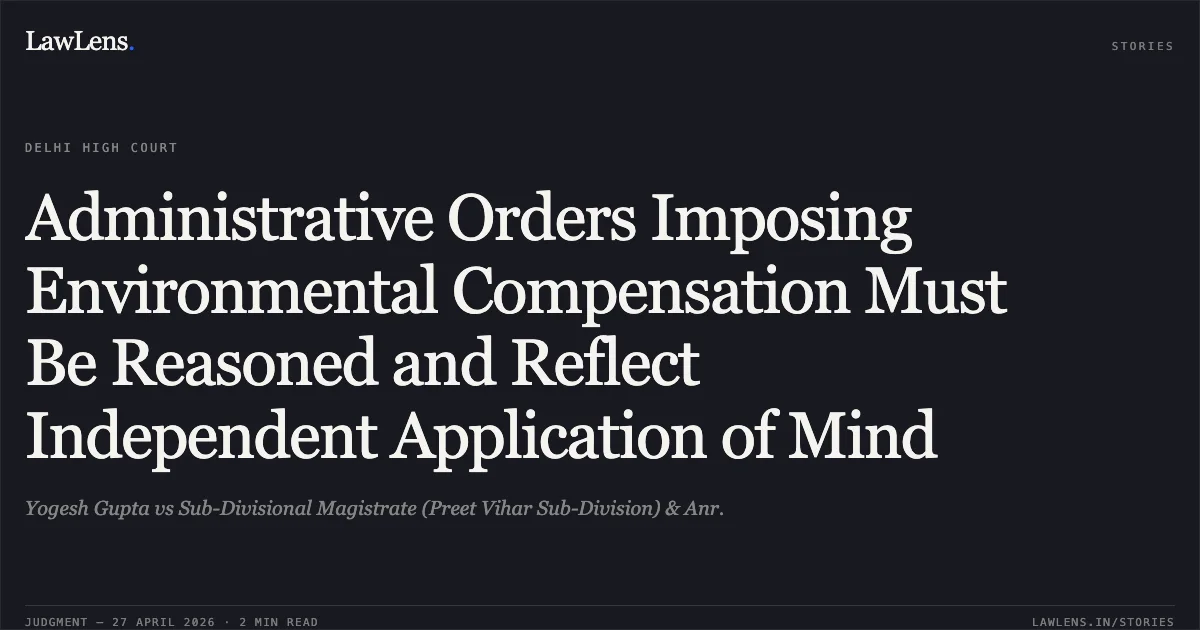
The Court found the impugned orders to be "bereft of any reasoning"
Source reference: p. 4Although the SDM claimed to have considered the petitioners' replies, the Court noted that no cogent reasons were recorded to explain why those replies were found unsatisfactory.
Source reference: no citationApplying the "heartbeat" metaphor from Ibrahim Uddin, the Court reasoned that without recorded justifications, it could not appreciate the veracity of the decision or the basis for the compensation amounts
Source reference: p. 4-5The Court emphasized that for an order to be valid under the principles of natural justice, it must substitute subjectivity with objectivity through written reasons
Source reference: para. 5the Court observed that a failure to distinguish between violations under the Air Act and Water Act in the final order could impede the petitioners' ability to seek specific remedies provided under those distinct statutes
Source reference: para. 10Holding
The Court set aside the impugned orders imposing environmental compensation
The DPCC was granted liberty to pass fresh orders after providing the petitioners an opportunity for a hearing. The Court specifically directed the DPCC to pass separate orders for alleged violations of the Air Act, 1981 and the Water Act, 1974, as applicable, to preserve the petitioners' distinct statutory appeal remedies. The petitions were disposed of accordingly.
Source reference: para. 9, 10, 12Acts & Sections Cited
3 provisions across 3 statutes referred to in this judgment. Linked provisions open on LawLens.
Air (Prevention And Control Of Pollution) Act, 19811
Water (Prevention and Control of Pollution) Act, 19741
Delhi Municipal Corporation Act, 19571
Original Court PDF
Yogesh GuptavsSub-Divisional Magistrate (Preet Vihar Sub-Division) & Anr.
Click to open original judgment
Original judgment, available to read, download and summarize on LawLens.in