Facts
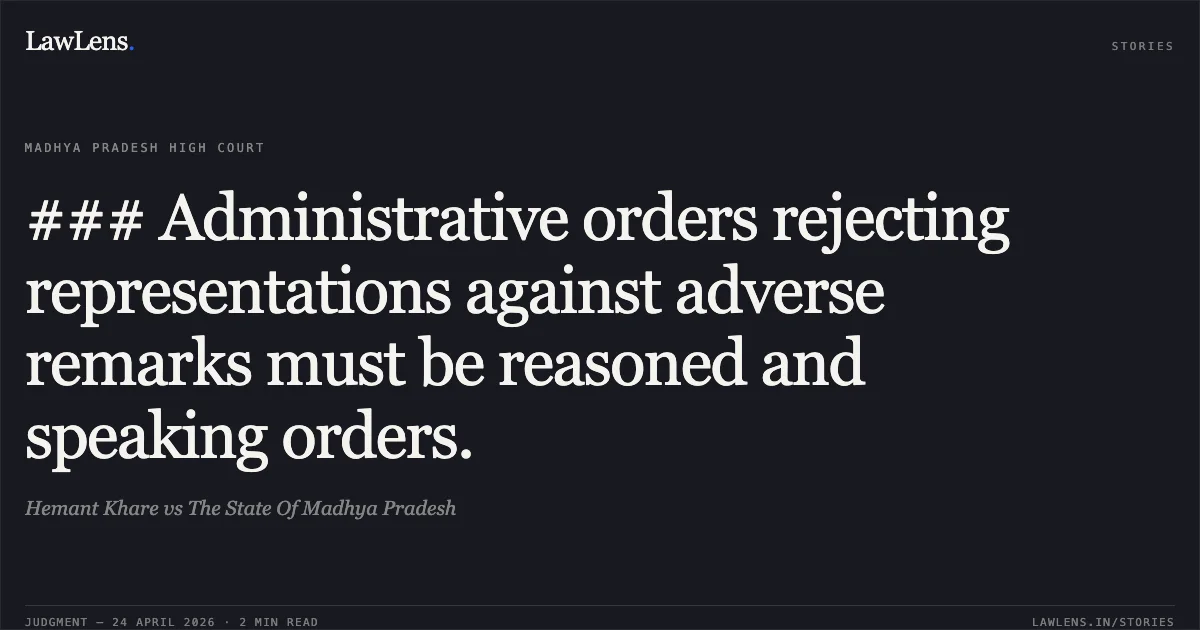
The petitioner, an employee potentially eligible for promotion to Superintending Engineer or Chief Engineer, challenged the orders dated 22.03.2012 and 30.12.2017.
Source reference: p. 1-2These orders rejected his representations regarding adverse Confidential Report (CR) entries for the period 01.04.2010 to 31.03.2011.
Source reference: para. 2The petitioner contended that the representations were dismissed via non-speaking and unreasoned orders, failing to consider the specific grounds raised.
Source reference: para. 2The State defended the orders, asserting that all facts were considered prior to rejection.
Source reference: para. 3Issues
1. Whether the administrative orders dated 22.03.2012 and 30.12.2017 rejecting the petitioner’s representation against adverse CR entries were legally sustainable as "speaking orders".
Source reference: para. 62. Whether the failure of an administrative authority to record valid and justifiable reasons in an order affecting a party's rights violates the principles of natural justice and Article 14 of the Constitution.
Source reference: para. 7-10Law Applied
The court primarily applied the principle that administrative and quasi-judicial orders affecting the rights of parties must be "speaking orders" supported by clear reasons.
Source reference: para. 7M/s. Kranti Associates Pvt. Ltd. v. Masood Ahmed Khan (2010) 9 SCC 496, which established that recording reasons is an indispensable component of natural justice and constitutional governance.
Source reference: para. 10State of Punjab v. Bandip Singh (2016) 1 SCC 724, holding that executive decisions must be self-sustaining and impregnated with reasons to avoid being arbitrary or capricious.
Source reference: para. 8-9Oryx Fisheries Pvt. Ltd. v. Union of India (2010) 13 SCC 427, which emphasized that a "pretence of reasons" or "rubber-stamp reasons" cannot equate to a valid decision-making process.
Source reference: para. 11Reasoning
Upon perusing the impugned rejection orders, the court observed that the respondents failed to apply their minds to the entire facts and circumstances of the case.
Source reference: para. 4-6The court noted that the orders did not record any valid or justifiable reasons regarding the grounds mentioned by the petitioner in his representation; instead, they essentially just communicated a conclusion.
Source reference: para. 6By evaluating the text of the orders against the standard set in Kranti Associates, the court determined the orders were "inscrutable" and lacked the "lifeblood of judicial decision-making"—reasoning.
Source reference: para. 10The court reasoned that since the petitioner's rights regarding future promotion were affected, the administrative authority was legally obligated to demonstrate that relevant factors were objectively considered.
Source reference: para. 10-12Holding
The Court answered the issues in the negative, holding that the impugned orders were non-speaking and arbitrary.
The High Court set aside the orders dated 30.12.2017 and 22.03.2012.
Source reference: para. 12The petitioner was directed to submit a fresh, detailed representation within one month. The competent authority was directed to re-consider the same and pass a reasoned, speaking order after providing an opportunity for a personal hearing within three months, with consequential orders for promotion if found entitled. The petition was allowed.
Source reference: para. 13-14Original Court PDF
Hemant KharevsThe State Of Madhya Pradesh
Click to open original judgment
Original judgment, available to read, download and summarize on LawLens.in