01Facts
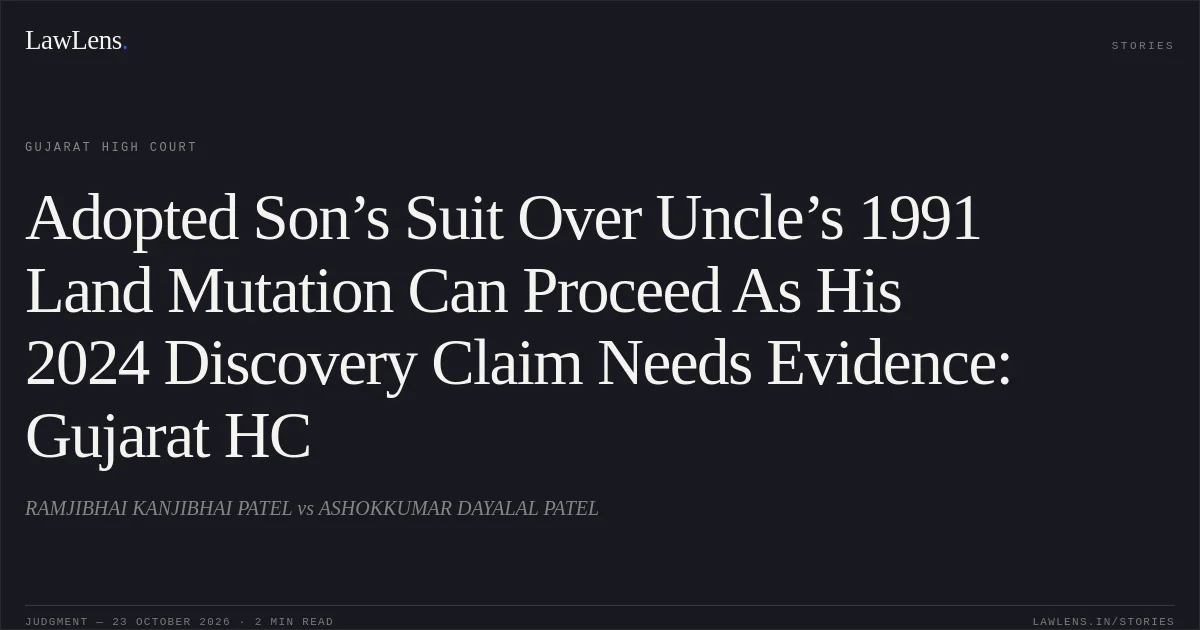
The respondent-plaintiff brought a suit seeking declaration and permanent injunction concerning land owned by his adoptive father, alleging that the petitioner-defendant, his uncle, had fraudulently mutated his name in the revenue record in 1991.
¶ 2, 4The plaintiff pleaded that he discovered the entry on 12 August 2024, after retirement, and had previously relied on the defendant because of their family relationship.
¶ 2, 4The defendant sought rejection of the plaint under Order 7 Rule 11 CPC, contending that the suit was time-barred and that the plaintiff’s adoption was invalid.
¶ 2–3, 7The trial court rejected that application, prompting this revision under Section 115 CPC.
¶ 2–3, 702Issues
i.Whether the plaint was liable to be rejected under Order 7 Rule 11 CPC as time-barred, given the 1991 revenue entry and the plaintiff’s pleaded discovery in 2024.
¶ 3, 5ii.Whether the defendant’s contention that the plaintiff’s adoption was invalid could be considered in this revision when it had not been raised before the trial court in the Order 7 Rule 11 application.
¶ 7–803Law Applied
Under Order 7 Rule 11 CPC, the court determines whether a plaint is liable to rejection by considering the plaint’s averments as a whole; the defendant’s defence is not germane to that inquiry.
¶ 5Limitation is ordinarily a mixed question of law and fact where the pleaded date of knowledge is material, and may therefore require evidence rather than rejection at the threshold.
¶ 5The Court applied Chhotanben v. Kiritbhai Jalkrushnabhai Thakkar, (2018) 6 SCC 422, which holds that where the plaintiffs plead that they learned of the challenged transaction only later, limitation may be a triable issue.
¶ 5Section 115 CPC permits revision where the subordinate court has committed a jurisdictional error; the Court found none here.
¶ 2, 9Provisions in the judgment · 7 · Linked ones open on LawLens
Code of Civil Procedure, 1908 Section 115Section 7
Limitation Act, 1963 Section 56Section 58Section 59Section 65Section 110
04Reasoning
The plaint alleged that the plaintiff learned of the 1991 mutation only in 2024. Whether he knew of the entry earlier, or only when pleaded, could not be resolved from the plaint alone and required evidence; applying Chhotanben, the Court held that the suit could not be rejected as time-barred at this stage.
¶ 4–6The adoption challenge had not been raised in the application before the trial court and was therefore not determined on its merits in the revision.
¶ 7–8The Court left open the possibility of raising it before the trial court through an appropriate application, if permissible in law.
¶ 7–805Holding
The Court found no jurisdictional error in the trial court’s refusal to reject the plaint and dismissed the revision application in limine, with no order as to costs.
¶ 9It did not decide whether the adoption was valid, but stated that the defendant could raise that issue before the trial court by an appropriate application, if permissible in law; any such application must be decided after hearing the parties and in accordance with law.
¶ 8Original Court PDF
RAMJIBHAI KANJIBHAI PATELvsASHOKKUMAR DAYALAL PATEL
Click to open original judgment
Original judgment, available to read, download and summarize on LawLens.in