01Facts
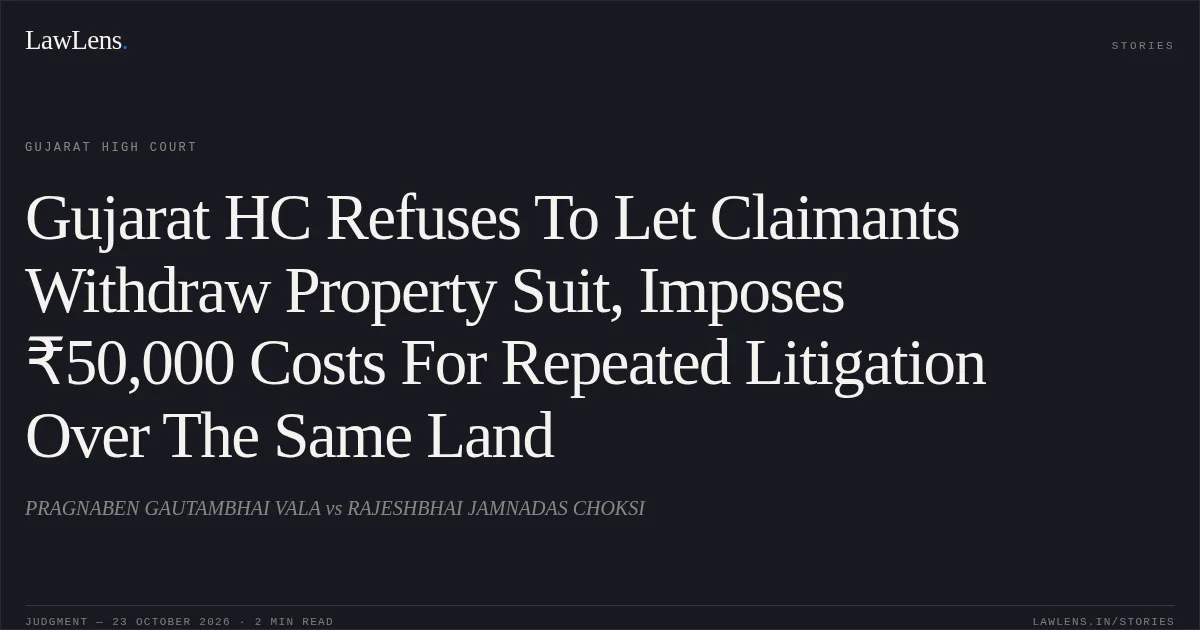
The plaintiffs’ Regular Civil Suit No. 59/2023, seeking specific performance of an alleged agreement to sell dated 4 November 1996, was rejected under Order VII Rule 11(d) CPC.
¶ 2The plaintiffs challenged that decision and filed a purshish seeking withdrawal of both the appeal and the suit; the First Appellate Court permitted withdrawal of the appeal but not the suit.
¶ 2, 4The defendants relied on an earlier suit concerning the same property, in which the plaintiff had claimed rights on a partnership basis, and alleged that the subsequent claim based on the agreement to sell was fabricated.
¶ 3–4The plaintiffs sought revision, arguing that rejection of the plaint had not followed a full trial and that withdrawal of the suit would cause the defendants no prejudice.
¶ 5, 702Issues
i.Whether the First Appellate Court erred in refusing to permit withdrawal of the suit after the plaint had been rejected under Order VII Rule 11(d) CPC
¶ 2, 5ii.Whether rejection of a plaint under Order VII Rule 11 constitutes a decree for the purpose of assessing the defendants’ claimed lack of prejudice from withdrawal
¶ 803Law Applied
Section 2(2) CPC defines a “decree” to include rejection of a plaint; the definition does not limit this treatment to rejection following a full-fledged trial.
¶ 8The Court considered K.S. Bhoopathy v. Kokila, (2000) 5 SCC 458, and Kantilal Ambalal Patel (Deceased) Through Legal Heirs v. Nakulal S. Paniker, 2024 (0) AIJEL-HC 250185, concerning discretionary permission to withdraw a suit, but distinguished them because those cases involved suits that had been decreed.
¶ 6, 9The Court treated permission to withdraw the suit as discretionary and assessed whether the circumstances justified that relief.
¶ 7, 11Provisions in the judgment · 1 · Linked ones open on LawLens
Code of Civil Procedure, 1908 Section 2
04Reasoning
The Court rejected the argument that the defendants could not be prejudiced because the suit had not gone to trial: rejection of the plaint itself falls within the statutory definition of a decree.
¶ 8It also found the cited authorities distinguishable, as they concerned decreed suits.
¶ 9On the facts, the Court considered that the plaintiff had pursued successive claims concerning the same property on materially different bases—first as a partnership claim and later under an alleged agreement to sell—and accepted the defendants’ contention that the later claim was fabricated.
¶ 3–4, 10It concluded that the plaintiff had abused the process of law and that the circumstances did not justify discretionary permission to withdraw the suit.
¶ 1105Holding
The Court dismissed the revision application, upholding the refusal to permit withdrawal of the suit.
¶ 11–12It also ordered the revisionists to pay compensatory costs of Rs. 50,000 within four weeks of receipt of the order, failing which the amount would be recovered as arrears of land revenue.
¶ 12Original Court PDF
PRAGNABEN GAUTAMBHAI VALAvsRAJESHBHAI JAMNADAS CHOKSI
Click to open original judgment
Original judgment, available to read, download and summarize on LawLens.in