01Facts
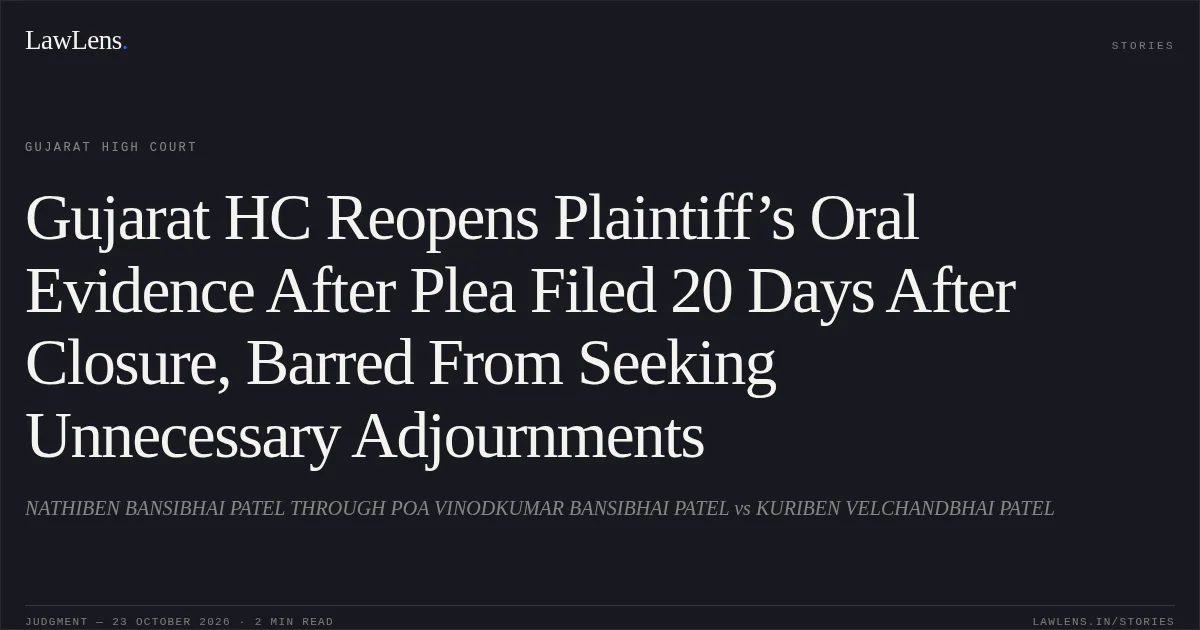
The petitioner, plaintiff in Regular Civil Suit No. 49 of 2022, had her right to lead oral evidence closed on 15 April 2026.
pp. 1–4, 6She applied below Exhibit 23 to reopen that right; the Trial Court rejected the application by order dated 5 May 2026.
pp. 1–4, 6The petitioner challenged that order under Article 227, submitting that the delay was not due to gross negligence and that the change of power of attorney had contributed to the circumstances.
pp. 1–4, 6The respondent opposed the petition, arguing that the plaintiff had been given reasonable opportunities and had delayed the trial.
pp. 1–4, 6The petitioner had deposited ₹15,000 as costs pursuant to an interim direction of the High Court.
pp. 1–4, 602Issues
i.Whether the Trial Court erred in refusing to reopen the petitioner’s right to lead oral evidence
pp. 4–6ii.Whether reopening that right should be allowed subject to costs and conditions to prevent further delay in the suit
pp. 4, 6–703Law Applied
Article 227 of the Constitution of India empowers the High Court to exercise supervisory jurisdiction over subordinate courts.
p. 1The Court applied the principle that procedural rules are handmaids of justice and should not obstruct substantial justice where the procedural default does not cause serious prejudice to the opposing party.
p. 5 · ¶ 11It relied on Sugandhi (Dead) by LRs v. P. Rajkumar, (2020) 10 SCC 706, which states that courts should prefer substantial justice over procedural or technical compliance where appropriate.
p. 5 · ¶ 1104Reasoning
The Court accepted that the plaintiff was responsible for ensuring the suit was not delayed, but found no gross negligence or mala fides indicating an attempt to prolong the trial.
p. 6 · ¶ 9, 12The application to reopen the evidence right was filed within a short time after that right was closed, supporting the conclusion that the plaintiff intended to participate in the proceedings.
p. 6 · ¶ 9, 12Applying the preference for substantial justice, the Court held that the Trial Court had taken an unduly technical approach and that any prejudice to the respondent could be addressed through costs and conditions requiring the petitioner to proceed without unnecessary adjournments.
pp. 5–6 · ¶ 10–14, 1605Holding
The High Court quashed the Trial Court’s order dated 5 May 2026 and allowed the application below Exhibit 23, permitting the petitioner to lead oral evidence in accordance with law.
p. 7 · ¶ 17The respondent may withdraw the ₹15,000 deposited with the High Court.
pp. 6–7 · ¶ 15–17The petitioner must participate without delay and must not seek unnecessary adjournments; if she attempts to delay the trial, the respondent may apply to the Trial Court to close her right to lead evidence or cross-examine, for decision in accordance with law.
pp. 6–7 · ¶ 15–17The petition was partly allowed and the Rule made absolute to that extent.
pp. 6–7 · ¶ 15–17Original Court PDF
NATHIBEN BANSIBHAI PATEL THROUGH POA VINODKUMAR BANSIBHAI PATELvsKURIBEN VELCHANDBHAI PATEL
Click to open original judgment
Original judgment, available to read, download and summarize on LawLens.in