01Facts
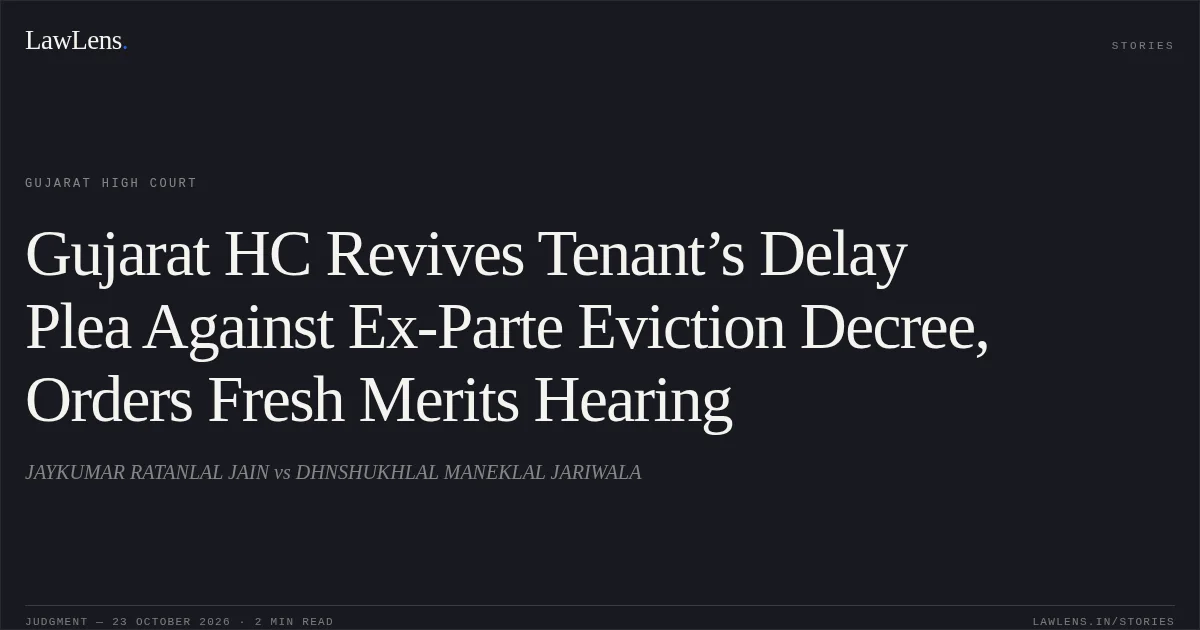
The petitioner’s suit for eviction had proceeded ex parte and resulted in an eviction decree.
¶ 3–8He filed an application under Order IX Rule 13 of the Code of Civil Procedure to set aside the decree, together with an application seeking condonation of delay.
¶ 3–8The Small Cause Court rejected the delay application solely on the ground that the restoration application was not maintainable.
¶ 3–8The petitioner challenged that rejection under Article 227 of the Constitution.
¶ 3–8The respondents did not dispute the precedent relied on by the petitioner, but alleged that he had not complied with the High Court’s earlier direction to deposit mesne profits of ₹1,200 per month; the petitioner said he had deposited the amount regularly.
¶ 3–802Issues
i.Whether the Small Cause Court could reject the delay application solely because it considered the underlying restoration application not maintainable, without deciding the delay application on its merits.
¶ 4.1–4.2, 7–8ii.Whether the petitioner’s compliance with the direction to deposit mesne profits should be verified before the delay application is adjudicated.
¶ 5.1–6, 11–1303Law Applied
The petition was brought under Article 227 of the Constitution of India.
¶ 3The petitioner’s application to set aside the ex parte decree was under Order IX Rule 13 CPC.
¶ 4.2The Court referred to Prakash Chander Manchanda & Anr. v. Smt. Janki Manchanda, AIR 1987 SC 42, whose legal proposition the respondents did not dispute; the judgment does not set out that proposition in detail.
¶ 4, 5, 8The Court’s operative procedural rule was that the delay application should be adjudicated on its own merits, rather than rejected solely on the stated ground that the restoration application was not maintainable.
¶ 7–1004Reasoning
The Trial Court had not examined the merits of the delay application and had rejected it solely because it considered the restoration application legally not maintainable.
¶ 7–8The High Court regarded that approach as an egregious error, particularly since the underlying suit had proceeded ex parte and the parties did not contest the petitioner’s reliance on Prakash Chander Manchanda.
¶ 7–8The High Court therefore set aside the rejection but left the merits of the delay application open for determination by the Trial Court.
¶ 9–14Separately, because the parties disputed compliance with the mesne-profit deposit direction, the Trial Court was directed to verify the deposits first and allow one week to clear any shortfall before proceeding with the delay application.
¶ 9–1405Holding
The petition was partly allowed.
¶ 9–16The order dated 9 July 2021 was quashed and the delay application was restored to the Trial Court’s file for a fresh decision on its merits, after a reasonable opportunity of hearing and without being influenced by the earlier order or the High Court’s observations.
¶ 9–16The Trial Court must first verify compliance with the mesne-profit deposit direction; if there is a shortfall, the petitioner must be given one week to pay it.
¶ 9–16The delay application was to be decided as early as possible, preferably within three months of receipt of the High Court’s order.
¶ 9–16The connected civil application was disposed of as no longer surviving; no order as to costs.
¶ 9–16Original Court PDF
JAYKUMAR RATANLAL JAINvsDHNSHUKHLAL MANEKLAL JARIWALA
Click to open original judgment
Original judgment, available to read, download and summarize on LawLens.in