Facts
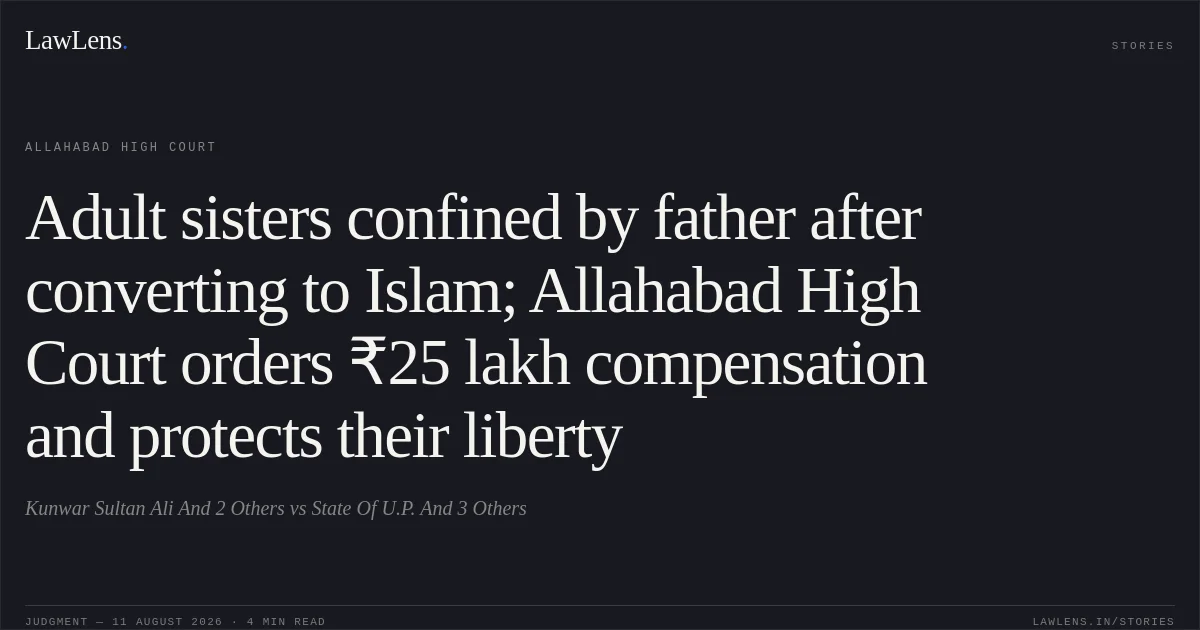
The petitioners sought a writ of habeas corpus for production and release of Ms. Anshu Bhatia @ Amina Anshu Bhatia, aged approximately 35 years, and Ms. Diya Bhatia @ Zoya Diya Bhatia, aged approximately 20 years, alleging that they were unlawfully confined by their father, respondent no. 4, because they had voluntarily embraced Islam in 2020 and 2021 respectively.
Source reference: para. 2Both corpus were produced before the Court pursuant to its order dated 30 July 2026.
Source reference: para. 2During separate interactions, both stated that their conversion was voluntary, based on personal faith, conscience and spiritual belief, and was not caused by force, fraud, coercion, inducement or undue influence.
Source reference: paras. 3–16They alleged that their father had forcibly confined them in the parental home and retained their passports, educational certificates, identity documents, bank documents, conversion-related papers and other belongings.
Source reference: paras. 7–11The State opposed the petition, relying on an investigation in Case Crime No. 228 of 2025 concerning alleged unlawful and organised religious conversion, invoking provisions of the Bharatiya Nyaya Sanhita, 2023 and the Uttar Pradesh Prohibition of Unlawful Conversion of Religion Act, 2021.
Source reference: paras. 18–30The Court independently interacted with both corpus and found their statements spontaneous, coherent and unequivocal.
Source reference: para. 45Issues
Whether the two major women were unlawfully detained or confined by their father, thereby warranting issuance of a writ of habeas corpus?
Source reference: paras. 40–46, 56–59Whether their alleged religious conversion, or the pending criminal investigation into that conversion, justified their continued confinement or prevented their release?
Source reference: paras. 47–55Whether the Court could grant constitutional compensation for the alleged violation of their fundamental rights under Articles 21 and 25 of the Constitution?
Source reference: paras. 60–66Law Applied
The Court held that habeas corpus lies against unlawful detention, including private detention, but not where confinement is authorised by law, relying on Home Secretary (Prison) v. H. Nilofer Nisha, (2020) 14 SCC 161.
Source reference: para. 40An adult possesses decisional autonomy and is entitled to choose her residence and associations; courts cannot act as parens patriae merely because parents disapprove of that choice, as held in Soni Gerry v. Gerry Douglas, (2018) 2 SCC 197.
Source reference: para. 41The Court also relied on Rajamohan MS v. State of Kerala, which recognises that parental authority extends to advice and guidance but not to confinement of a major woman against her will.
Source reference: para. 43The Court also relied on Shafin Jahan v. Asokan K.M., (2018) 16 SCC 368, concerning autonomy in matters of faith, personal choice and life decisions.
Source reference: para. 38Article 25 protects freedom of conscience and the right to profess and practise religion, while Article 21 protects life, personal liberty, dignity and decisional autonomy.
Source reference: paras. 46–47The legality of conversion and the legality of detention are distinct questions; alleged non-compliance with the Uttar Pradesh Prohibition of Unlawful Conversion of Religion Act, 2021 must be examined by the competent forum and cannot, by itself, authorise private confinement.
Source reference: paras. 48–50Finally, under Rudul Sah v. State of Bihar, (1983) 4 SCC 141, and Nilabati Behera v. State of Orissa, (1993) 2 SCC 746, constitutional courts may award public-law compensation for established and egregious violations of Article 21.
Source reference: paras. 62–64Reasoning
The Court found that both corpus were majors with full legal capacity and had clearly and consistently asserted that they had converted voluntarily and wished to exercise independent control over their faith, residence and personal lives.
Source reference: paras. 45–47, 53–57Nothing in the Court’s interaction suggested coercion, fear, inducement or undue influence in their statements.
Source reference: no citationThe State’s reliance on the FIR, the pending investigation and alleged national-security implications was held insufficient because mere allegations and apprehensions could not displace the corpus’s unequivocal assertion of autonomy or constitute lawful authority for detention.
Source reference: paras. 51–55The Court treated the validity of the conversion as separate from the legality of the confinement and held that even an allegedly irregular conversion could not justify continued restraint by the father.
Source reference: paras. 48–50Since the father had no legal authority to confine adult women and the State had failed to secure their liberty, the detention was held illegal and violative of Articles 21 and 25.
Source reference: paras. 56–61Given the prolonged confinement, alleged coercion and failure of the State machinery to protect their liberty, the Court considered the case appropriate for constitutional compensation.
Source reference: paras. 60–66Holding
The writ petition was allowed.
The Court declared that Ms. Diya Bhatia @ Zoya Diya Bhatia and Ms. Anshu Bhatia @ Amina Anshu Bhatia were free to reside at any place and with any person of their choice, without interference from their father, the State or its authorities.
Source reference: para. 70(1)The father and the State of Uttar Pradesh were held jointly and severally liable to pay compensation of ₹25,00,000, to be equally divided between the corpus, within eight weeks; the State was permitted to recover the specified shares from the father and delinquent public servants in accordance with law and after due hearing.
Source reference: para. 70(2)The father was restrained from interfering with their liberty, movement, residence, profession or religious choices, and the State authorities were directed to provide protection if required.
Source reference: para. 70(3)–(4)The father was further directed to return their passports, certificates, identity and banking documents, conversion-related papers and other belongings within seven days, with the State authorities directed to ensure compliance if necessary.
Source reference: para. 70(5)The Court clarified that its observations did not determine the merits of the criminal investigation or the legality of the alleged conversions.
Source reference: para. 68Acts & Sections Cited
4 provisions across 1 statute referred to in this judgment. Each provision opens on LawLens.
Bharatiya Nyaya Sanhita, 20234
Original Court PDF
Kunwar Sultan Ali And 2 OthersvsState Of U.P. And 3 Others
Click to open original judgment
Original judgment, available to read, download and summarize on LawLens.in