Facts
Respondent No. 1 filed a civil suit seeking declaration of title, partition, possession and injunction, impleading his father, Defendant No. 7.
Source reference: para. 2–3Defendants No. 1 to 5 challenged the suit’s maintainability under Order VII Rule 11 CPC, contending that the plaintiff had no independent right to sue during his father’s lifetime; their revision against the rejection of that application remained pending.
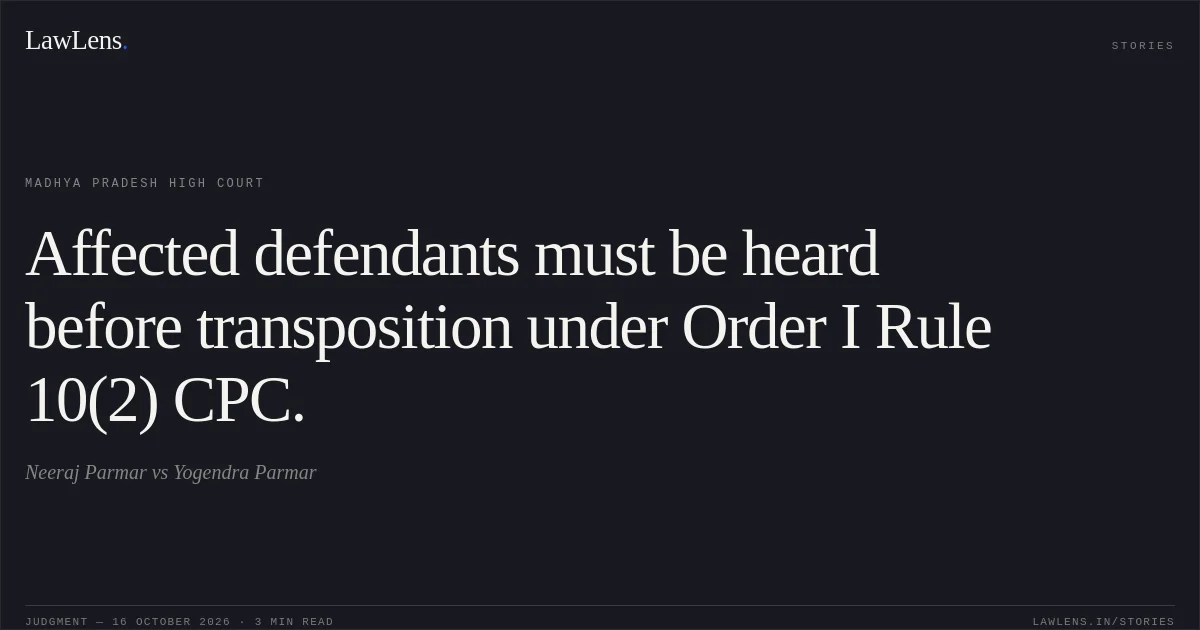
Source reference: para. 2–3Defendant No. 7 later applied to be transposed as Plaintiff No. 2 under Order I Rule 10(2) CPC.
Source reference: para. 2–3The trial court allowed the application, although its order did not record that a copy had been supplied to Defendants No. 1 to 5 or that their objections had been heard.
Source reference: para. 2–3The defendants’ review application was dismissed, prompting this petition under Article 227
Source reference: para. 2–3, 6, 8Issues
1. Whether Defendant No. 7 could be transposed as Plaintiff No. 2 under Order I Rule 10(2) CPC without notice to, and an opportunity to be heard for, Defendants No. 1 to 5
Source reference: para. 62. Whether the failure to provide that opportunity constituted an error apparent on the face of the record warranting review under Order XLVII Rule 1 read with Section 114 CPC
Source reference: para. 8Law Applied
Order I Rule 10(2) CPC gives the court discretionary power to add or transpose parties, to be exercised in the interests of justice; the court held that notice and an opportunity to be heard are required for parties whose legal rights or substantive interests may be affected by the proposed transposition
Source reference: para. 6The court relied on the Delhi High Court’s decision in Vijay Verma v. Indira Warman and Others, FAO (OS) No. 71/2024, for the principle that a party directly affected by transposition may oppose it and that the court must consider such objections on their merits
Source reference: para. 7Under Order XLVII Rule 1 read with Section 114 CPC, review is not an appeal, but a failure to afford a hearing that causes procedural injustice may constitute an error apparent on the face of the record; the court referred to Kamlesh Verma v. Mayawati and Others, (2013) 8 SCC 320
Source reference: para. 8Reasoning
Defendants No. 1 to 5 had already challenged the plaintiff’s right to maintain the suit and alleged collusion between him and Defendant No. 7. The transposition could therefore affect their interests and alter the complexion of the suit.
Source reference: para. 6, 8Although their counsel’s appearance was recorded, the order allowing transposition did not show that the application had been supplied, that time to respond had been given, or that their arguments had been considered. The court found that this omission denied an effective hearing and amounted to a procedural illegality causing failure of justice; the review court should therefore have recalled the transposition order.
Source reference: para. 6, 8Holding
The High Court allowed the petition, set aside both the order dismissing the review application and the order transposing Defendant No. 7 as Plaintiff No. 2, and remanded the transposition application to the trial court.
The trial court was directed to supply the application to Defendants No. 1 to 5, allow them a reasonable opportunity to file objections, hear all concerned, and decide the application afresh on its merits without being influenced by its earlier orders or the High Court’s observations. The Court expressed no opinion on the merits of transposition and made no order as to costs
Source reference: para. 8–9Acts & Sections Cited
1 provisions across 1 statute referred to in this judgment. Each provision opens on LawLens.
Code of Civil Procedure, 19081
Original Court PDF
Neeraj ParmarvsYogendra Parmar
Click to open original judgment
Original judgment, available to read, download and summarize on LawLens.in