01Facts
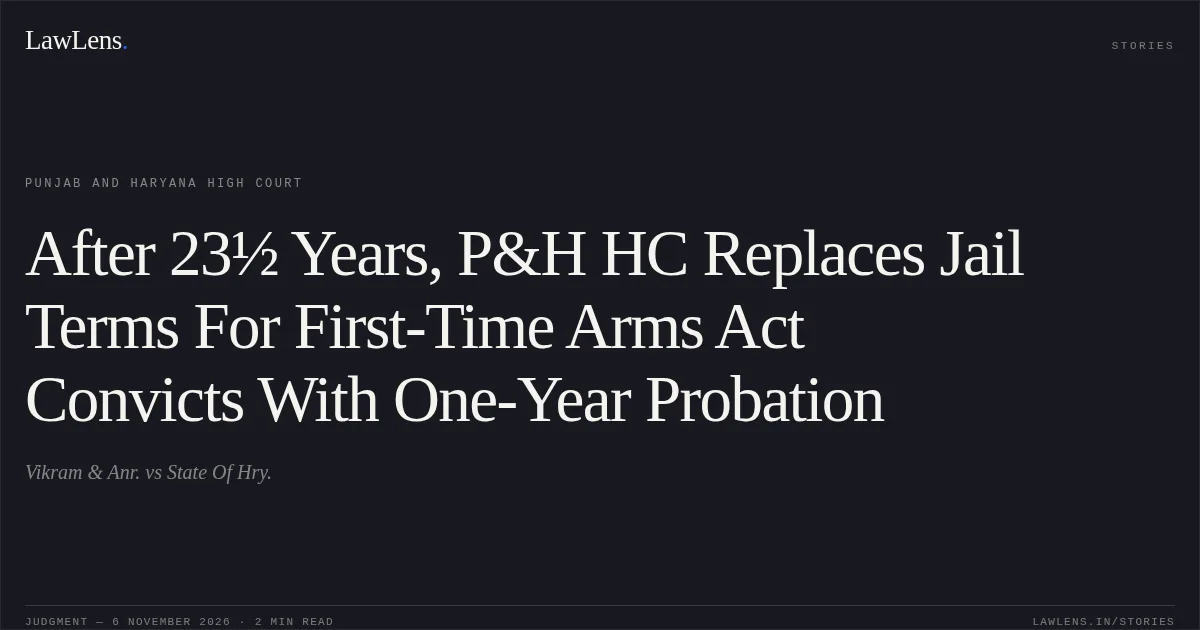
The appellants were convicted by the Additional Sessions Judge, Sonepat, under Section 25 of the Arms Act and sentenced to one year’s rigorous imprisonment and a fine of ₹500 each.
pp. 1, paras 1–3The prosecution case arose from a police raid following secret information that armed persons were assembling to plan a dacoity.
pp. 2–3, paras 4–5In appeal, the appellants expressly did not challenge their conviction and confined their challenge to sentence, seeking probation on the grounds of the passage of more than 23½ years, their status as first offenders, and the absence of subsequent prosecutions.
pp. 4–5, paras 9–11A Probation Officer’s report was received and taken on record.
p. 6, para 1602Issues
i.Whether the appellants’ conviction under Section 25 of the Arms Act warranted appellate interference, despite their stated decision not to challenge it.
p. 5, paras 9, 15ii.Whether the appellants could be released on probation despite the court’s observation that the offence carried a minimum sentence of seven years.
pp. 9–10, paras 20–2403Law Applied
Section 25 of the Arms Act governed the offence of conviction; the judgment records that it carried a minimum sentence of seven years and a maximum sentence of life imprisonment.
p. 9, para 20The court relied on Jugal Kishore Prasad v. State of Bihar, (1972) 2 SCC 633, concerning the reformative purpose of probation and the avoidance of imprisonment in appropriate cases.
pp. 6–7, para 18It also relied on Chellammal v. State, 2025 SCC OnLine SC 870, for the proposition that, where Section 4 of the Probation of Offenders Act applies, the court must consider probation and give reasons if it declines to grant it.
pp. 7–9, para 19The court further cited Lakhvir Singh v. State of Punjab, AIR 2021 SC 555, and Amit Singh v. State of Rajasthan, Criminal Appeal Nos. 4860–4861 of 2024, in support of probation being available in cases involving offences with minimum sentences, including an Arms Act offence.
pp. 9, paras 22–23The judgment ultimately ordered release on probation under Section 360 CrPC.
p. 10, para 24Provisions in the judgment · 11 · Linked ones open on LawLens
Indian Penal Code, 1860 Section 399Section 402Section 397
Arms Act, 1959 Section 25
Code of Criminal Procedure, 1973 Section 161Section 173Section 360Section 361
Probation of Offenders Act, 1958 Section 6Section 3Section 4
04Reasoning
The court affirmed the conviction after finding the prosecution evidence consistent and sufficient, notwithstanding the appellants’ decision not to contest it.
p. 5, para 15On sentence, it considered the long period since the 2002 incident, the prolonged litigation, the appellants’ first-offender status, and the absence of any later prosecution.
p. 6, 10, paras 17, 24It rejected the State’s argument that the stated minimum sentence precluded probation, relying on authorities recognising probation in cases involving minimum sentences.
pp. 9–10, paras 21–23In light of the circumstances and the Probation Officer’s report, it concluded that probation would better serve the ends of justice.
p. 6, 10, paras 16, 2405Holding
The appeal was dismissed insofar as it challenged conviction, and the finding of guilt under Section 25 of the Arms Act was affirmed.
p. 6, para 15The appeal was partly allowed on sentence: the custodial sentence was modified, and the appellants were released on probation for one year upon furnishing bonds and undertaking to keep the peace and maintain good behaviour.
p. 10, para 25The court directed that they would be liable to receive sentence if they defaulted on the probation conditions.
p. 10, para 25Original Court PDF
Vikram & Anr.vsState Of Hry.
Click to open original judgment
Original judgment, available to read, download and summarize on LawLens.in