01Facts
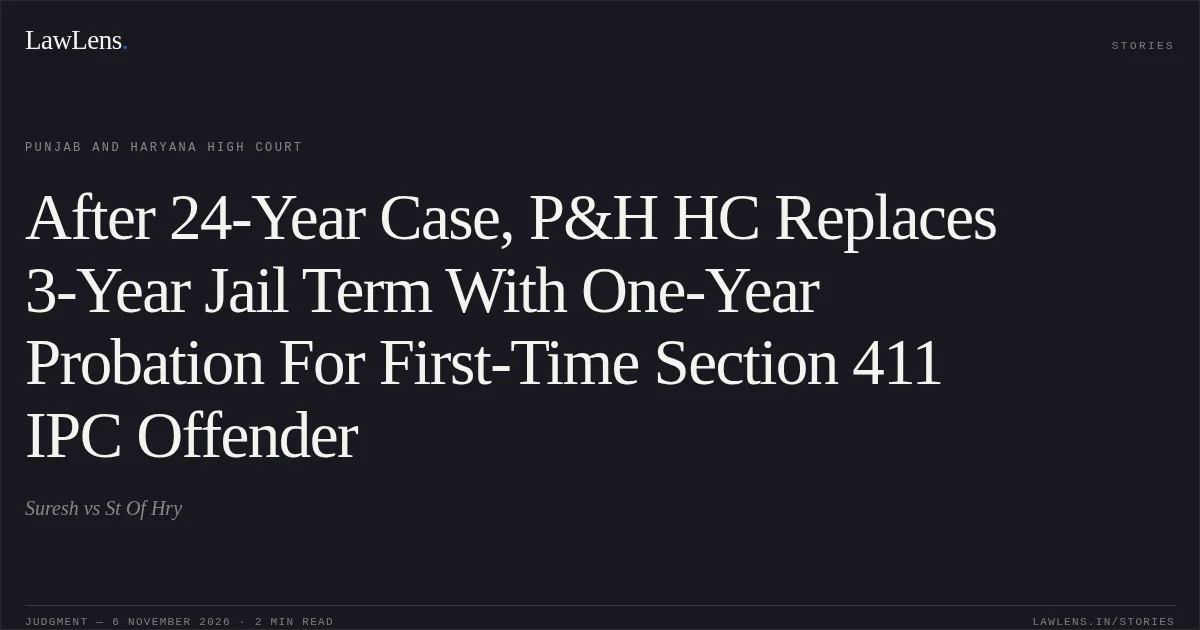
The appellant was convicted under Section 411 IPC and sentenced to three years’ rigorous imprisonment for dishonestly receiving stolen property.
pp. 1–3The trial court had acquitted his co-accused of the charge under Sections 392 and 328 IPC.
pp. 1–3In appeal, the appellant expressly confined his challenge to the sentence, relying on the passage of more than 24 years, his status as a first offender, and the absence of any subsequent criminal conduct; the State opposed reducing the sentence.
pp. 4–5The Court affirmed the conviction and considered whether probation was appropriate.
pp. 6, 9–1002Issues
i.Whether the appellant’s conviction under Section 411 IPC warranted appellate interference, despite his decision not to challenge it.
p. 6ii.Whether, having regard to the circumstances and the principles governing probation, the three-year sentence should be modified by releasing the appellant on probation.
pp. 6–903Law Applied
Section 411 IPC provides the offence of dishonestly receiving or retaining stolen property.
pp. 7–8Section 4(1) of the Probation of Offenders Act permits release on probation for an offence not punishable with death or imprisonment for life; the Court, relying on Jugal Kishore Prasad v. State of Bihar, (1972) 2 SCC 633, noted the rehabilitative purpose of probation.
pp. 7–8It also relied on Chellammal v. State, 2025 SCC OnLine SC 870, for the principle that, where Section 4 applies, the court must consider probation and give reasons if it declines to grant that benefit.
pp. 8–9The judgment also referred to Section 361 CrPC in discussing the duty to record reasons when probation is not granted.
p. 8Provisions in the judgment · 10 · Linked ones open on LawLens
Indian Penal Code, 1860 Section 392Section 328Section 411
Code of Criminal Procedure, 1973 Section 161Section 173Section 360Section 361
Probation of Offenders Act, 1958 Section 3Section 4Section 6
04Reasoning
The Court found the prosecution evidence sufficient to sustain the Section 411 IPC conviction and saw no basis to interfere with that finding.
p. 6On sentence, it considered that the offence occurred more than 24 years earlier, the appellant was a first offender, he had no criminal history, and he had not been prosecuted for any further offence during that period.
pp. 6–7Applying the probation principles it had discussed, the Court concluded that the ends of justice would be better served by probation than imprisonment.
p. 905Holding
The appeal was dismissed insofar as it challenged the conviction, which was affirmed; it was partly allowed on sentence.
pp. 6, 9–10The three-year term of rigorous imprisonment was modified, and the appellant was ordered to be released on probation for one year upon furnishing bonds before the trial court and undertaking to keep the peace and maintain good behaviour.
p. 10In the event of default, he would be liable to receive sentence as and when called upon to do so.
p. 10Original Court PDF
SureshvsSt Of Hry
Click to open original judgment
Original judgment, available to read, download and summarize on LawLens.in