01Facts
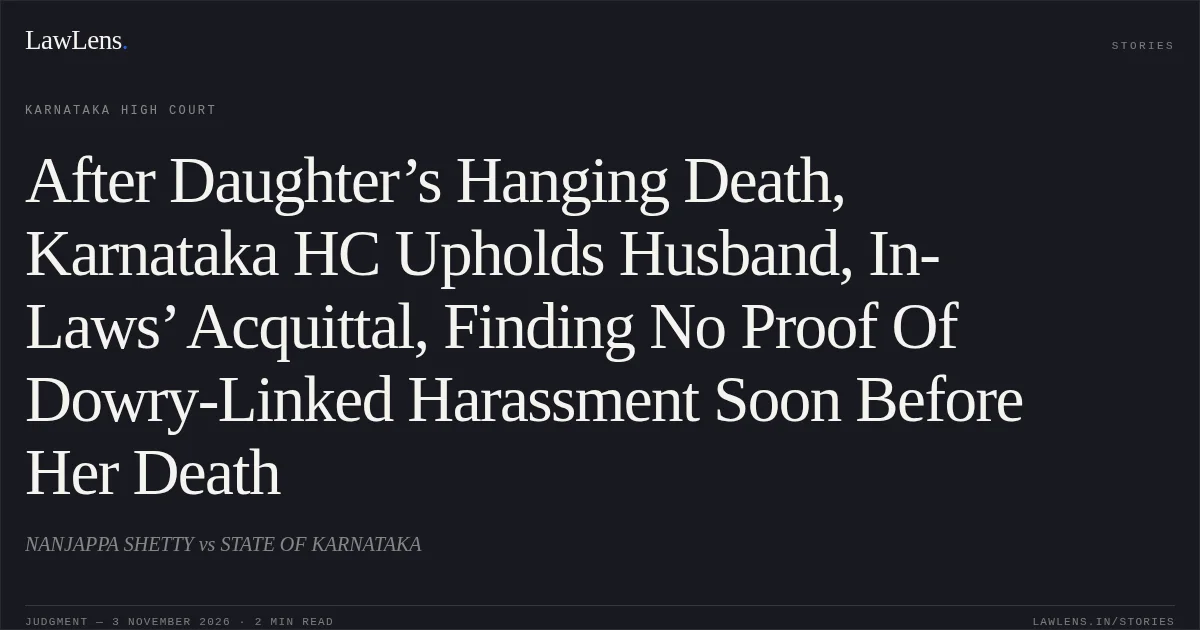
The appellant, father of the deceased, challenged the acquittal of her husband and in-laws of offences under Sections 498-A, 304-B and 306 read with Section 34 of the Indian Penal Code (IPC), and Sections 3 and 4 of the Dowry Prohibition Act, 1961.
p. 3The deceased married Accused No. 1 in August 2012 and died by hanging in May 2014. The prosecution alleged dowry demands and harassment, including a demand for money towards Accused No. 1’s Ph.D. course.
pp. 3–4The Sessions Court acquitted the accused after trial; the father appealed under Section 372 CrPC.
pp. 1, 4–502Issues
i.1. Whether the Sessions Court’s acquittal was perverse or unreasonable, warranting interference in an appeal against acquittal.
pp. 6–7, 12ii.2. Whether the prosecution established the foundational facts required to invoke the presumptions under Sections 113-A and 113-B of the Indian Evidence Act, 1872.
pp. 11–1303Law Applied
Under Chandrappa v. State of Karnataka, (2007) 4 SCC 415, and Murugesan v. State, (2012) 10 SCC 383, an appellate court may reappreciate evidence in an appeal against acquittal, but should not ordinarily disturb a reasonable view favouring the accused; an acquittal further strengthens the presumption of innocence.
p. 6Section 304-B IPC requires proof that a woman died otherwise than under normal circumstances within seven years of marriage and was subjected, soon before her death, to cruelty or harassment by her husband or his relative in connection with a dowry demand. Section 113-B of the Evidence Act raises a presumption of dowry death only after those foundational facts are proved.
pp. 11–12Section 113-A permits a presumption of abetment of suicide where its statutory conditions are established. As explained in Shoor Singh v. State of Uttarakhand, (2025) 2 SCC 815, the Section 113-B presumption does not dispense with proof, by ordinary rules of evidence, of the essential ingredients of dowry death.
pp. 11–12Provisions in the judgment · 6 · Linked ones open on LawLens
Code of Criminal Procedure, 1973 Section 372Section 313
Indian Penal Code, 1860 Section 306Section 34
04Reasoning
The High Court found the first complaint did not allege dowry demands; the more detailed allegations appeared in a later complaint and were reasonably treated as improvements.
pp. 7–8The evidence did not reliably establish payment of the alleged dowry or specific acts of cruelty, and the medical evidence concerning the deceased’s facial injuries did not establish assault by the accused.
pp. 8–11Although the death occurred within seven years of marriage and was unnatural, the prosecution had not proved dowry-related harassment soon before death or the other necessary foundational facts. The statutory presumptions therefore did not arise.
pp. 11–13The Sessions Court’s assessment was a possible and reasonable view, not a perverse one.
p. 1205Holding
The Court answered the issues against the appellant, holding that the prosecution had not established the facts necessary to invoke Sections 113-A or 113-B of the Evidence Act and that no basis existed to interfere with the acquittal.
pp. 11–13The appeal was dismissed, the acquittal confirmed, and the accused’s bail bonds discharged.
p. 14Original Court PDF
NANJAPPA SHETTYvsSTATE OF KARNATAKA
Click to open original judgment
Original judgment, available to read, download and summarize on LawLens.in