01Facts
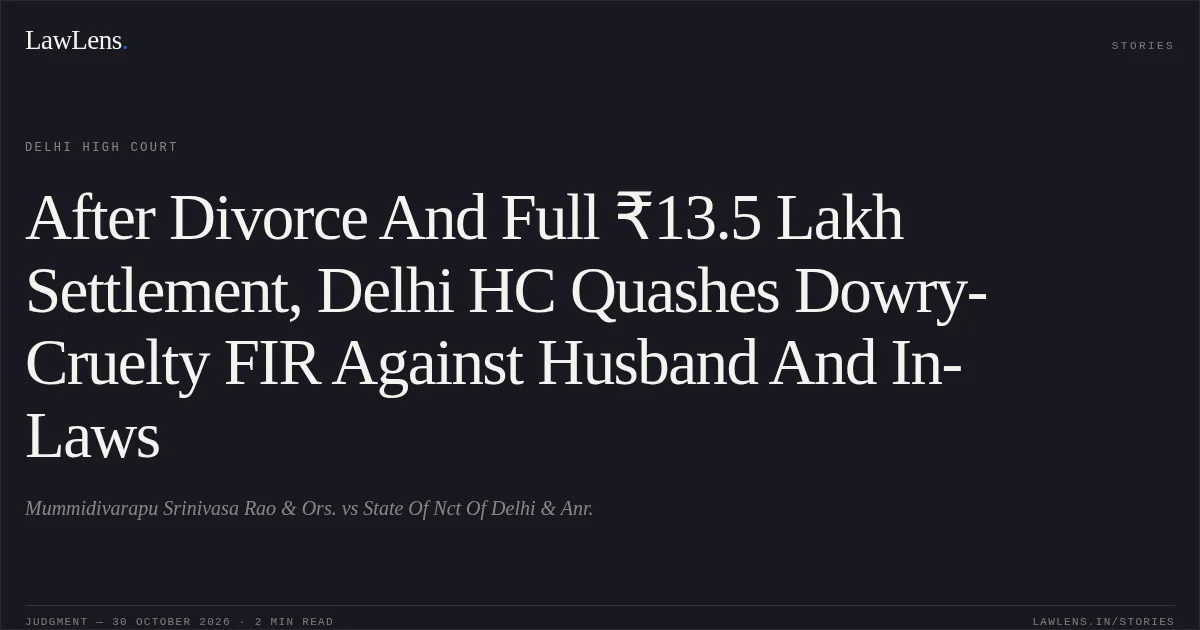
The petitioners sought quashing under Section 528 of the Bharatiya Nagarik Suraksha Sanhita, 2023, of FIR No. 519/2022, registered under Sections 498A/406/34 IPC and Section 4 of the Dowry Prohibition Act, 1961, on the complaint of petitioner No. 1’s former wife, respondent No. 2
p. 1The parties had entered into a settlement covering, among other matters, financial claims, mutual divorce, and quashing of the FIR; the marriage was subsequently dissolved by mutual-consent decree, and respondent No. 2 withdrew her Domestic Violence Act complaint
pp. 2–5Respondent No. 2 filed an affidavit of no objection, confirmed her voluntary settlement, and stated that she had received the full settlement amount of ₹13,50,000
p. 602Issues
i.Whether the High Court should exercise its inherent jurisdiction under Section 528 BNSS to quash the FIR and consequential proceedings for non-compoundable matrimonial offences after the parties settled their disputes
p. 1, 6ii.Whether the settlement was sufficient, in the circumstances, to warrant quashing where respondent No. 2 had no objection and the related matrimonial proceedings had been resolved
pp. 5–603Law Applied
Section 528 of the BNSS preserves the High Court’s inherent power to make orders necessary to secure the ends of justice.
The Court relied on Gian Singh v. State of Punjab, (2012) 10 SCC 303, in considering whether criminal proceedings arising from a matrimonial dispute could be quashed following settlement, notwithstanding that an offence was non-compoundable.
p. 6The judgment does not set out or elaborate the governing test from Gian Singh.
Provisions in the judgment · 5 · Linked ones open on LawLens
Bharatiya Nagarik Suraksha Sanhita, 2023 Section 528
Indian Penal Code, 1860 Section 406Section 34
Dowry Prohibition Act, 1961 Section 4
Protection of Women from Domestic Violence Act, 2005 Section 12
04Reasoning
The Court noted that the parties had settled their matrimonial disputes, their marriage had been dissolved, and the Domestic Violence Act complaint had been withdrawn.
pp. 5–6Respondent No. 2 confirmed that the settlement was voluntary, that she had received the entire agreed amount, and that she had no objection to quashing.
p. 6Applying the principle in Gian Singh, the Court found no impediment to allowing the petition despite the non-compoundable nature of an offence in the FIR.
p. 605Holding
The Court allowed the petition and quashed FIR No. 519/2022, registered under Sections 498A/406/34 IPC and Section 4 of the Dowry Prohibition Act, 1961, at P.S. Mehrauli, together with all consequential proceedings.
p. 6The pending application was also disposed of.
p. 6Original Court PDF
Mummidivarapu Srinivasa Rao & Ors.vsState Of Nct Of Delhi & Anr.
Click to open original judgment
Original judgment, available to read, download and summarize on LawLens.in