01Facts
The petitioners sought quashing under Section 528 of the Bharatiya Nagarik Suraksha Sanhita, 2023, of an FIR registered against them under Sections 498A, 406, 506 and 34 IPC and Section 4 of the Dowry Prohibition Act, 1961.
pp. 1–2Petitioner No. 1 was the complainant’s husband; the other petitioners were his relatives. The parties married in 2015, had one child, and had lived separately since 2018.
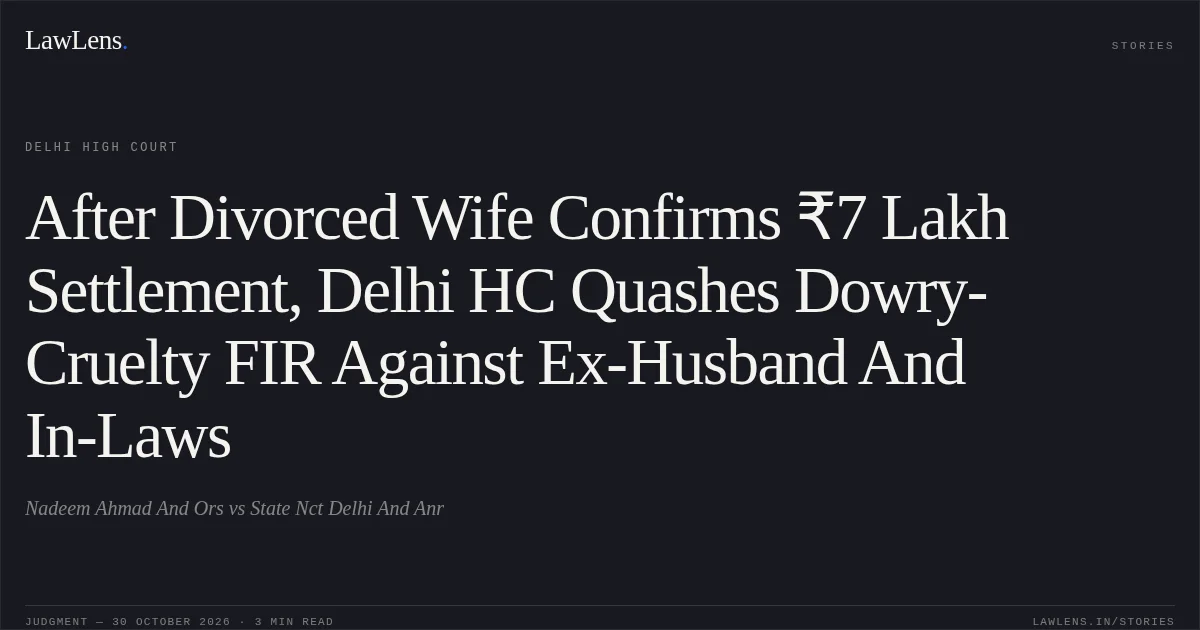
pp. 1–2They entered into a settlement through mediation on 12 February 2025. Under it, the husband agreed to pay Rs. 7,00,000, including amounts for the complainant’s claims and the child’s welfare; the parties also agreed to dissolve the marriage, address custody and visitation, and cooperate in seeking quashing of the FIR.
pp. 10–11The marriage was dissolved by mutual consent on 21 April 2025. The full settlement sum was paid, and the complainant, present in court, confirmed the settlement and stated that it was voluntary and that she had no objection to quashing.
pp. 11–12The trial had not progressed beyond framing of charge, and no prosecution witness had been examined.
p. 1502Issues
i.Whether the High Court could quash the FIR and consequential proceedings for non-compoundable offences on the basis of a voluntary settlement in a matrimonial dispute.
pp. 12–15ii.Whether, in the circumstances, continuation of the prosecution would serve any useful purpose or whether the likelihood of conviction was remote and bleak.
p. 1503Law Applied
Section 528 BNSS, corresponding to Section 482 CrPC, preserves the High Court’s inherent power to quash proceedings to secure the ends of justice or prevent abuse of process; that power is distinct from statutory compounding and is not barred merely because an offence is non-compoundable.
pp. 12–13Under Gian Singh v. State of Punjab, (2012) 10 SCC 303, and Narinder Singh v. State of Punjab, (2014) 6 SCC 466, the High Court may quash proceedings arising from matrimonial or other predominantly private disputes where the parties have genuinely settled, subject to caution and the nature and seriousness of the offence; the power is not ordinarily exercised for heinous offences or offences with serious societal impact.
pp. 12–14Jitendra Raghuvanshi v. Babita Raghuvanshi, (2013) 4 SCC 58, supports quashing criminal proceedings in private matrimonial disputes where the parties have amicably resolved their differences.
pp. 14–15Provisions in the judgment · 11 · Linked ones open on LawLens
Bharatiya Nagarik Suraksha Sanhita, 2023 Section 528
Code of Criminal Procedure, 1973 Section 482Section 320
Indian Penal Code, 1860 Section 406Section 506Section 34
Bharatiya Nyaya Sanhita, 2023 Section 85Section 316Section 351Section 3
Dowry Prohibition Act, 1961 Section 4
04Reasoning
The Court treated the allegations as arising from a matrimonial relationship and as essentially private in nature, rather than as involving heinous or serious offences of mental depravity.
p. 15It found the settlement genuine and fully performed: the marriage had been dissolved, the entire Rs. 7,00,000 paid, related proceedings withdrawn or disposed of, and the complainant had affirmed the agreement and given no objection to quashing.
pp. 11–12, 15Given that the complainant was no longer willing to support the prosecution and that no prosecution witness had been examined, the Court considered the prospect of conviction remote and continuation of the case futile.
p. 15It therefore concluded that quashing would serve the ends of justice notwithstanding the non-compoundable character of some charges.
pp. 12–1505Holding
The Court allowed the petition and quashed FIR No. 0347/2020, registered at Police Station Jafrabad under Sections 498A, 406, 506 and 34 IPC and Section 4 of the Dowry Prohibition Act, together with all proceedings arising from it, qua all petitioners.
p. 16The pending application was disposed of accordingly.
p. 16Original Court PDF
Nadeem Ahmad And OrsvsState Nct Delhi And Anr
Click to open original judgment
Original judgment, available to read, download and summarize on LawLens.in