Facts
Kanchan Lata filed a complaint under Sections 406 and 506 IPC alleging that her husband, Tota Ram, had retained her istridhan and threatened her.
Source reference: para. 2–7The parties married in 2007 and, according to the complainant, had been living separately since approximately 2008; she claimed to have sought return of the istridhan from 2011.
Source reference: para. 2–7Their marriage was dissolved by a decree of divorce dated 9 October 2012. The complaint was filed on 19 July 2017.
Source reference: para. 2–7After the Magistrate summoned Tota Ram and later issued notice of accusation, he petitioned under Section 482 CrPC to quash the proceedings, principally on the ground that they were time-barred.
Source reference: para. 10, 14–16, 22Issues
Whether the alleged retention of istridhan constituted a continuing offence after the parties’ marriage had been dissolved, such that the complaint was not barred by limitation.
Source reference: para. 17, 23–27Whether the complaint, filed more than three years after the asserted demands for return of the istridhan and the decree of divorce, was barred by Section 468 CrPC.
Source reference: para. 20–22, 27Law Applied
Section 468 CrPC bars a court from taking cognizance after the prescribed limitation period; the Court treated the limitation period applicable to the offences alleged under Sections 406 and 506 IPC as three years.
Source reference: para. 20Applying Krishna Bhattacharjee v. Sarathi Choudhury, (2016) 2 SCC 705, the Court distinguished judicial separation, which does not end the marital relationship and may leave retention of istridhan as a continuing offence, from dissolution of marriage, which severs the parties’ status as husband and wife; in the latter situation, the alleged offence is not continuing on that basis.
Source reference: para. 23–25Reasoning
The complainant’s own case was that demands for return of the istridhan had been made since 2011, while the complaint was filed on 19 July 2017.
Source reference: para. 21–27The Court also found that the marriage had been dissolved on 9 October 2012, severing the marital relationship. It therefore held that the continuing-offence principle applicable where the marital relationship remains intact did not apply.
Source reference: para. 21–27Even using the divorce decree as the relevant point, the complaint was filed more than three years later; the Court accordingly found it barred by limitation.
Source reference: para. 21–27Holding
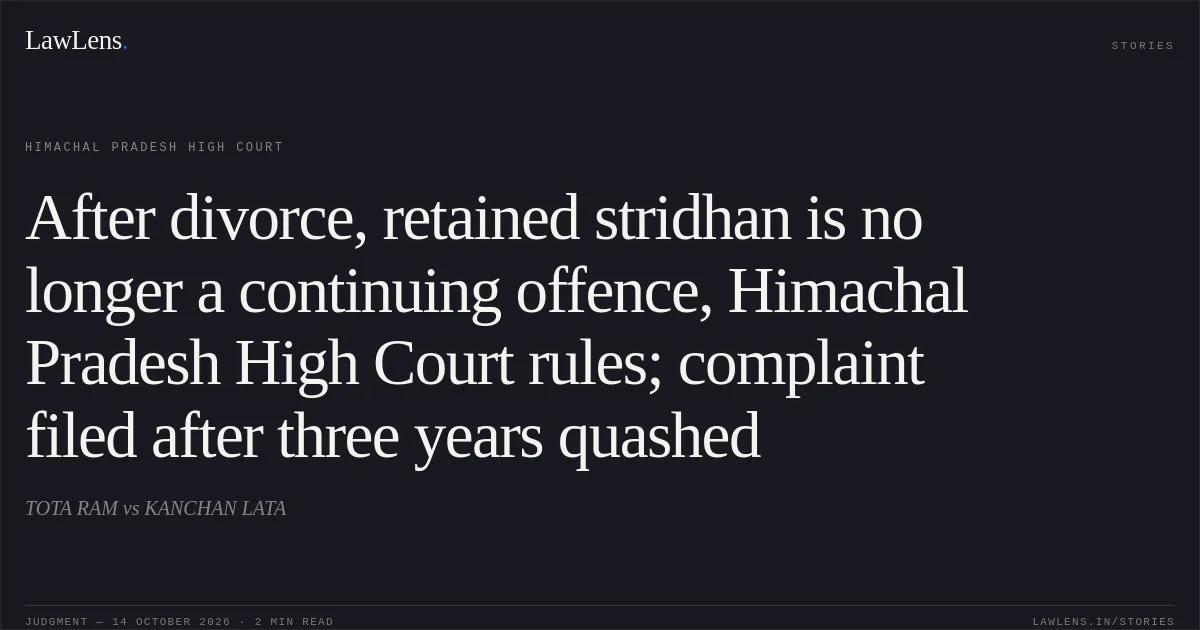
The High Court held that, in the circumstances of this case, the alleged offence was not a continuing offence and the complaint was barred by the three-year limitation period under Section 468 CrPC.
It allowed the petition and quashed the proceedings before the JMFC, including the summoning order dated 1 June 2018, the notice of accusation dated 3 September 2022, and all consequential proceedings.
Source reference: para. 27–29Acts & Sections Cited
11 provisions across 4 statutes referred to in this judgment. Each provision opens on LawLens.
Code of Criminal Procedure, 19734
Indian Penal Code, 18603
Hindu Marriage Act, 19552
Hindu Adoptions and Maintenance Act, 19562
Original Court PDF
TOTA RAMvsKANCHAN LATA
Click to open original judgment
Original judgment, available to read, download and summarize on LawLens.in