01Facts
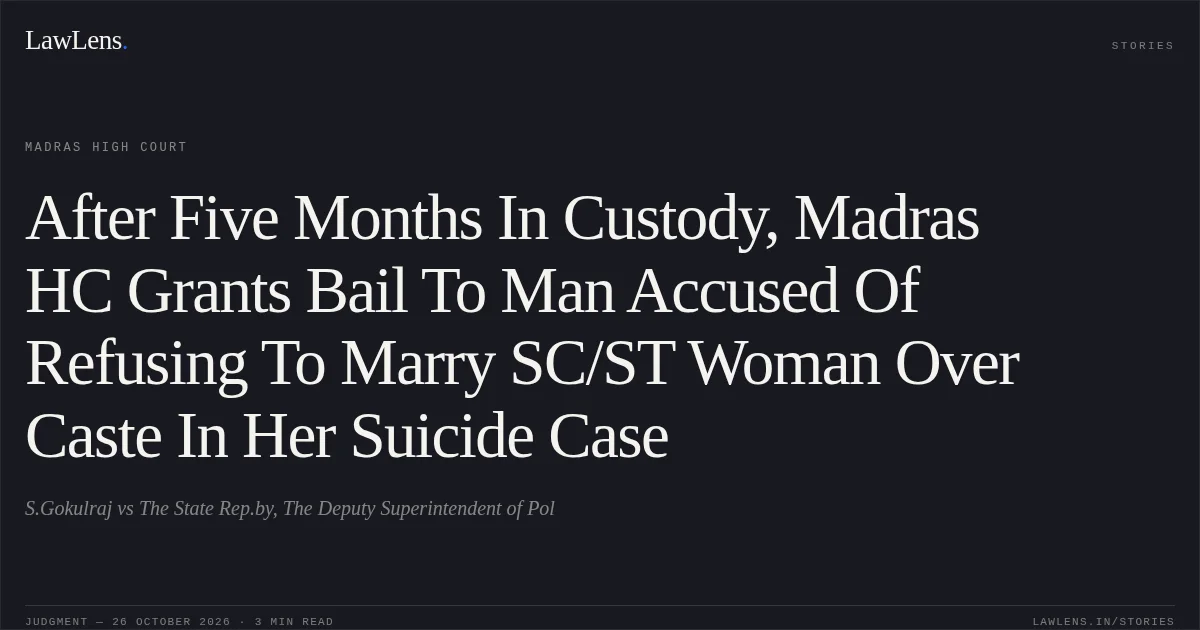
The prosecution alleged that the appellant and the deceased had a consensual relationship, and that he later refused to marry her because she belonged to the SC/ST community, leading to her suicide
p. 3The case was initially registered under Section 194 of the BNSS and later altered to Sections 69 and 108 of the BNS and Sections 3(1)(w)(i) and 3(2)(v) of the SC/ST Act
p. 2The de facto complainant opposed bail, citing the deceased’s pregnancy and a DNA test identifying the appellant as the foetus’s biological father
p. 3The appellant had been in custody since 5 May 2026, and the final report had been filed
pp. 4–5The Sessions Court dismissed his bail application on 28 September 2026; the appellant challenged that order under Section 14(A) of the SC/ST Act read with Section 415 of the BNSS
pp. 1–2The State also informed the High Court that an earlier appeal had been dismissed on 24 July 2026
p. 402Issues
i.1. Whether the Sessions Court’s order refusing bail should be set aside and the appellant released on bail, having regard to the allegations, custody period, and procedural stage of the case
pp. 4–5ii.2. Whether bail should be granted subject to conditions addressing the appellant’s attendance, risk of absconding, interference with evidence or witnesses, and the de facto complainant’s safety
pp. 5–603Law Applied
The appeal was brought under Section 14(A) of the SC/ST Act read with Section 415 of the BNSS
p. 1The prosecution invoked Sections 69 and 108 of the BNS and Sections 3(1)(w)(i) and 3(2)(v) of the SC/ST Act
p. 2The Court did not determine whether the alleged conduct established an offence under Section 108 of the BNS; it left that question to the trial court
p. 5In granting bail, the Court considered the appellant’s period of custody, the filing of the final report, and the stage of the trial
pp. 4–5It also referred to P.K. Shaji v. State of Kerala, [2005] AIR SCW 5560, in relation to the trial court’s power to take appropriate action if bail conditions are breached, and directed that a fresh FIR could be registered under Section 229A of the IPC if the accused absconded
p. 6Provisions in the judgment · 5 · Linked ones open on LawLens
Scheduled Castes and the Scheduled Tribes (Prevention of Atrocities) Act, 1989 Section 3
Bharatiya Nagarik Suraksha Sanhita, 2023 Section 415
Bharatiya Nyaya Sanhita, 2023 Section 69Section 108
Indian Penal Code, 1860 Section 306
04Reasoning
The Court noted that the final report had been filed, charges were likely to be framed soon, and the appellant had been in custody since 5 May 2026
pp. 4–5It considered that he should be able to defend himself effectively at trial and that whether his conduct constituted abetment of suicide under Section 108 of the BNS was for the trial court to decide
p. 5In light of those circumstances, the Court set aside the refusal of bail, while imposing conditions to secure the appellant’s attendance, prevent absconding and interference with the case, and protect the de facto complainant
pp. 5–605Holding
The High Court allowed the appeal and set aside the Sessions Court’s order dated 28 September 2026
p. 7It granted bail on conditions, including execution of a bond with two sureties, regular appearances before the trial court, and prohibitions on committing a similar offence, absconding, or tampering with evidence or witnesses; the police were also directed to ensure the de facto complainant’s safety
pp. 5–6The order further permits appropriate action for breach of conditions and states that a fresh FIR may be registered under Section 229A IPC if the appellant absconds
p. 6Original Court PDF
S.GokulrajvsThe State Rep.by, The Deputy Superintendent of Pol
Click to open original judgment
Original judgment, available to read, download and summarize on LawLens.in