01Facts
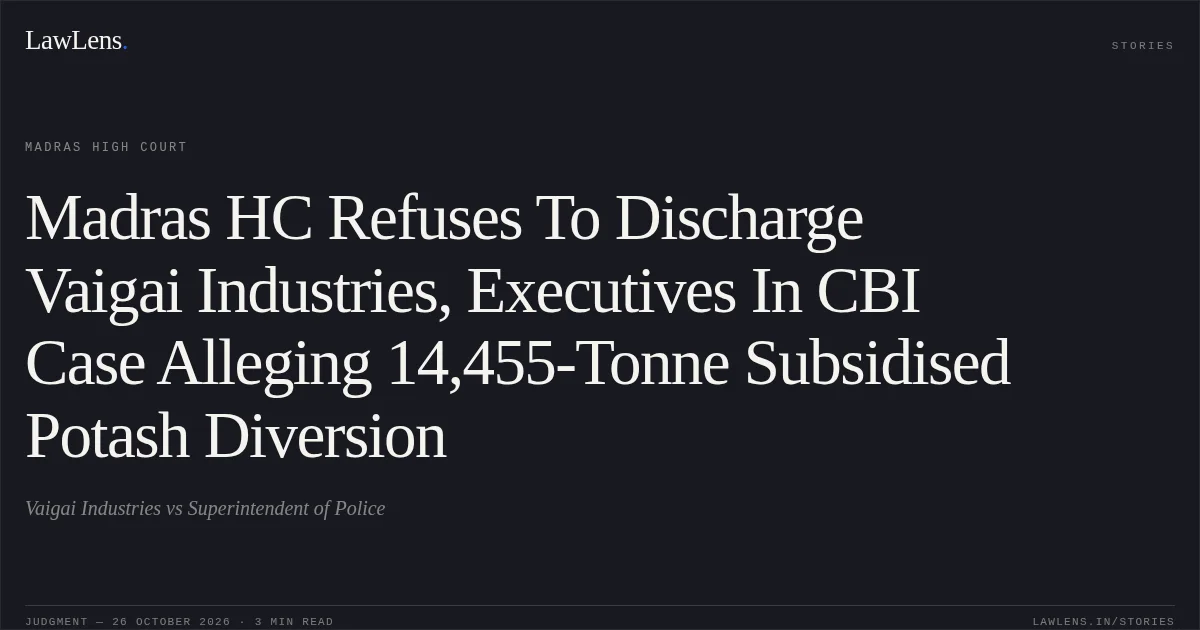
The CBI prosecuted the petitioners, including Vaigai Industries and its Chairman and Vice-Chairman, alleging that they conspired with fertilizer dealers to procure subsidised, agricultural-grade potassium chloride (MOP) and divert it for industrial manufacture of potassium chlorate.
pp. 3–5The prosecution alleged diversion of 14,455 MT and loss to the Union of India, as well as manufacture exceeding the company’s licensed capacity under the Arms Act.
pp. 3–5The petitioners sought discharge, relying in part on proceedings under Sections 6A and 6C of the Essential Commodities Act, in which the seized material was released, and arguing that the Arms Act prosecution lacked sanction and was time-barred.
pp. 7–9The Magistrate dismissed the discharge applications; the petitioners challenged those orders in revision.
p. 602Issues
i.Whether findings or orders in proceedings under Sections 6A and 6C of the Essential Commodities Act prevent or determine a prosecution under Section 7 of that Act.
pp. 12–13ii.Whether the accused may rely on defence material in support of discharge, and whether the High Court could convert the revisions into petitions to quash the proceedings.
pp. 13–16iii.Whether the allegations under the Arms Act and IPC justified discharge, including the petitioners’ objections concerning sanction and the alleged offences.
pp. 16–1803Law Applied
Sections 6A and 6C of the Essential Commodities Act govern quasi-judicial proceedings concerning confiscation or release of seized property, whereas Section 7 concerns criminal liability; Section 6D expressly provides that confiscation does not prevent prosecution under Section 7.
pp. 12–13Under State of Orissa v. Debendra Nath Padhi, (2005) 1 SCC 568, a court considering discharge or framing of charges ordinarily considers the prosecution material, not defence material; Satish Mehra v. Delhi Administration, (1996) 9 SCC 766, was overruled on that point.
pp. 13–15The High Court may treat a petition according to its substance and exercise inherent or constitutional powers to quash proceedings, regardless of its nomenclature, as recognised in Pepsi Foods Ltd. v. Special Judicial Magistrate, AIR 1998 SC 128, and Akanksha Arora v. Tanay Maben, 2024 INSC 962.
p. 15Under the Arms Act, Section 39 requires sanction for an offence under Section 3, but not for an offence under Section 5; Section 5 addresses manufacture.
p. 17Provisions in the judgment · 15 · Linked ones open on LawLens
Essential Commodities Act, 1955 Section 7Section 10Section 3
Arms Act, 1959 Section 3Section 5Section 25Section 33Section 39
Indian Penal Code, 1860 Section 420
Code of Criminal Procedure, 1973 Section 468Section 482Section 227Section 228Section 91Section 397
04Reasoning
The Collector’s decision to release or not confiscate seized material did not determine whether the accused committed an offence under Section 7, because the confiscation proceedings and criminal prosecution address different matters and apply different standards.
pp. 12–13The petitioners therefore could not secure discharge by relying on the Sections 6A and 6C orders, which were defence materials outside the material ordinarily considered at that stage.
p. 15Although the High Court could consider quashing the case despite the revisions’ form, the charge sheet alleged additional conduct—including diversion of agricultural-grade MOP and manufacture beyond licensed capacity—that was not disposed of by the confiscation proceedings.
pp. 15–18The Court considered the Arms Act allegation to concern manufacture under Section 5, for which Section 39 sanction was not required.
p. 17The prosecution allegations under the Essential Commodities Act, IPC and Arms Act thus did not warrant discharge at this stage.
pp. 17–1805Holding
The High Court dismissed both criminal revisions and closed the connected miscellaneous petitions.
p. 18The orders refusing discharge therefore remained in force, and the prosecution was permitted to proceed.
p. 18Original Court PDF
Vaigai IndustriesvsSuperintendent of Police
Click to open original judgment
Original judgment, available to read, download and summarize on LawLens.in