Facts
The appellant, a TNEB Commercial Inspector, was convicted by the Special Court for Prevention of Corruption Act Cases, Villupuram, under Sections 7 and 13(2) read with 13(1)(d) of the Prevention of Corruption Act, 1988, and sentenced to concurrent terms of imprisonment.
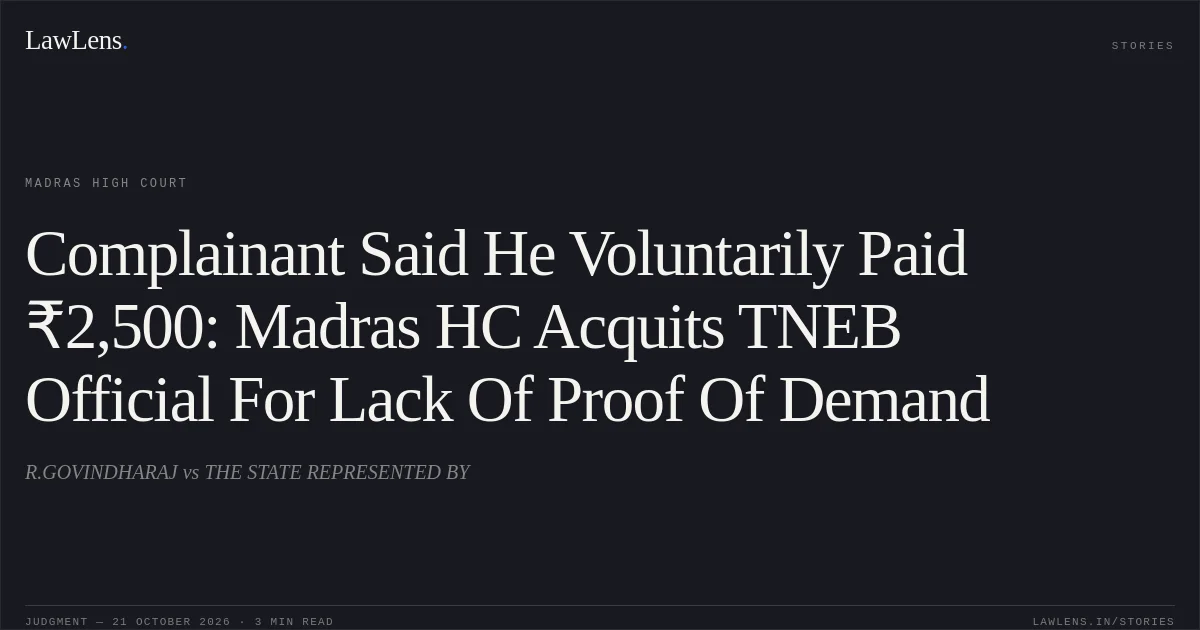
Source reference: para. 1, 4–5The prosecution alleged that he demanded Rs.2,500 from P.W.2 in connection with a domestic electricity connection and accepted the marked currency during a trap; the money was recovered and the chemical test was positive.
Source reference: para. 2In cross-examination, however, P.W.2 stated that the appellant had not demanded money, that he had offered it on his own, and that he had complained out of anger over delay.
Source reference: para. 14, 17The shadow witness also stated that he could not hear the conversation.
Source reference: para. 14, 17The Special Court relied on the chief examination, corroborative evidence and the Section 20 presumption to convict the appellant.
Source reference: para. 5He appealed against the conviction and sentence.
Source reference: para. 1Issues
1. Whether the prosecution proved beyond reasonable doubt that the appellant demanded illegal gratification from P.W.2.
Source reference: para. 9(a)2. Whether the alleged acceptance and recovery of the tainted money could sustain the conviction and give rise to the presumption under Section 20 of the Act.
Source reference: para. 9(b)3. Whether the Special Court’s judgment of conviction and sentence warranted appellate interference.
Source reference: para. 9(c)Law Applied
Under Sections 7 and 13(1)(d) read with Section 13(2) of the Prevention of Corruption Act, as applicable at the time, the prosecution must prove demand and acceptance; recovery or possession of tainted currency alone does not establish the offence.
Source reference: para. 11Under Section 20, the presumption may be invoked only after the prosecution proves the foundational facts, including demand and acceptance; the accused may rebut it on a preponderance of probabilities, including by relying on prosecution evidence.
Source reference: para. 11, 13, 23Neeraj Dutta v. State (Government of NCT of Delhi), (2023) 4 SCC 731, permits proof of demand and acceptance through direct or circumstantial evidence where the complainant is hostile or unavailable, but requires a legally sustainable inference rather than conjecture.
Source reference: para. 12Under Bhagwan Singh v. State of Haryana, (1976) 1 SCC 389, a witness’s testimony is not to be rejected wholesale merely because the witness resiles from an earlier statement; the court must assess the whole evidence, including the parts favouring the accused.
Source reference: para. 13Reasoning
P.W.2’s cross-examination denied any demand and described the payment as voluntary, while the Special Court’s inference that he had been won over rested on speculation unsupported by evidence.
Source reference: para. 14–16P.W.12 could not hear the conversation, and P.W.6’s evidence established neither a demand nor the appellant’s knowledge that the money was offered as a bribe.
Source reference: para. 17–18, 22The chronology did not cure these deficiencies: P.W.2 knew of the sanctioned estimate before the alleged meeting, and the appellant’s possible communication about the work was also consistent with ordinary official conduct.
Source reference: para. 19Although recovery and the chemical test showed that the appellant handled the currency, those facts were consistent with P.W.2’s account of a voluntary payment and did not prove demand or knowing acceptance.
Source reference: para. 22The Section 20 presumption therefore did not arise; in any event, the prosecution evidence supplied a probable explanation capable of rebutting it.
Source reference: para. 23Holding
The High Court held that the prosecution had failed to prove demand beyond reasonable doubt and that the recovery and chemical test could not independently sustain the convictions.
It allowed the appeal, set aside the conviction and sentence under Sections 7 and 13(2) read with 13(1)(d), and acquitted the appellant.
Source reference: para. 24–25The fine was ordered to be refunded, and any bail bond was cancelled.
Source reference: para. 25The Court left the challenge to the validity of the sanction open.
Source reference: para. 25Acts & Sections Cited
6 provisions across 2 statutes referred to in this judgment. Each provision opens on LawLens.
Code of Criminal Procedure, 19732
Prevention of Corruption Act, 19884
Original Court PDF
R.GOVINDHARAJvsTHE STATE REPRESENTED BY
Click to open original judgment
Original judgment, available to read, download and summarize on LawLens.in