Facts
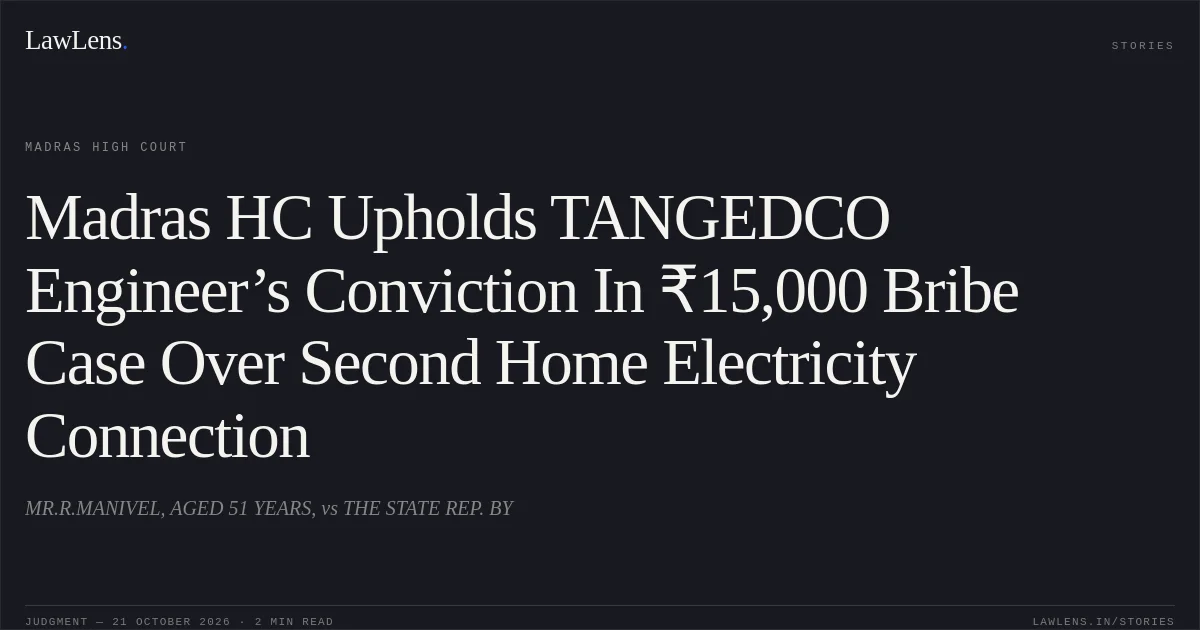
The appellant, an Assistant Executive Engineer with TANGEDCO, was accused of demanding ₹15,000 from P.W.2 in connection with a second electricity service connection for a house owned by P.W.2’s wife. After an initial alleged payment of ₹5,000 on 2 June 2015, a trap was laid the next day. The prosecution alleged that the appellant demanded and accepted the remaining ₹10,000, which was recovered from his desk drawer
Source reference: paras. 3.1–3.15; pp. 2–6The Special Court convicted him under Sections 7 and 13(2) read with Section 13(1)(d) of the Prevention of Corruption Act, 1988, and imposed four years’ rigorous imprisonment and a fine under each count
Source reference: para. 2; p. 2On appeal under Section 374(2) CrPC, the appellant challenged, among other matters, proof of demand and acceptance, the recovery and trap evidence, the handling of the electricity application, the sanction, and the admissibility of electronic records
Source reference: paras. 4.1–4.30; pp. 7–16Issues
Whether the prosecution proved beyond reasonable doubt that the appellant demanded and accepted illegal gratification from P.W.2, such as to sustain the convictions
Source reference: paras. 6.2, 6.28, 6.31; pp. 22, 30–31Whether the Trial Court’s appreciation of the evidence disclosed a material error warranting appellate interference with the convictions and sentences
Source reference: paras. 6.31–6.32; p. 31Law Applied
The appeal was brought under Section 374(2) of the Code of Criminal Procedure, 1973, against convictions under Sections 7 and 13(2) read with Section 13(1)(d) of the Prevention of Corruption Act, 1988
Source reference: paras. 2, 3.17; pp. 2, 7The Court stated that recovery of tainted currency alone is insufficient where the foundational facts of demand and acceptance remain unproved; the prosecution must establish the ingredients of the charged offences beyond reasonable doubt
Source reference: para. 6.28; p. 30It also identified the possible relevance of the statutory presumption, while making its application dependent on proof of the foundational facts
Source reference: para. 6.31; p. 31Reasoning
The Court recounted the prosecution evidence concerning the alleged demand, the trap, acceptance of the marked notes, and recovery from the drawer, as well as the departmental records relating to the application
Source reference: paras. 6.5–6.15; pp. 23–26It also noted the defence challenges—including inconsistencies in witness accounts, the absence of the voice recording and the alleged earlier payment, the hand-wash evidence, and the dispute over the application’s eligibility and processing
Source reference: paras. 6.19–6.26; pp. 27–29However, after stating the governing requirement of proof of demand and acceptance, the Court did not make detailed findings resolving those challenges or explain specifically how the evidence established the foundational facts; it concluded that the Trial Court’s findings disclosed no sufficient ground for interference
Source reference: paras. 6.28–6.32, 7.2; pp. 30–32Holding
The High Court dismissed the appeal and confirmed the convictions and sentences imposed by the Special Court
It cancelled the appellant’s bail bonds and directed the Special Judge to issue a warrant to secure him and commit him to prison to serve the remaining sentence. The order also directed set-off of the period already detained, referring to Section 468 BNSS / Section 428 CrPC
Source reference: para. 7.3; p. 32Acts & Sections Cited
6 provisions across 3 statutes referred to in this judgment. Each provision opens on LawLens.
Code of Criminal Procedure, 19732
Prevention of Corruption Act, 19883
Bharatiya Nagarik Suraksha Sanhita, 20231
Original Court PDF
MR.R.MANIVEL, AGED 51 YEARS,vsTHE STATE REP. BY
Click to open original judgment
Original judgment, available to read, download and summarize on LawLens.in