Facts
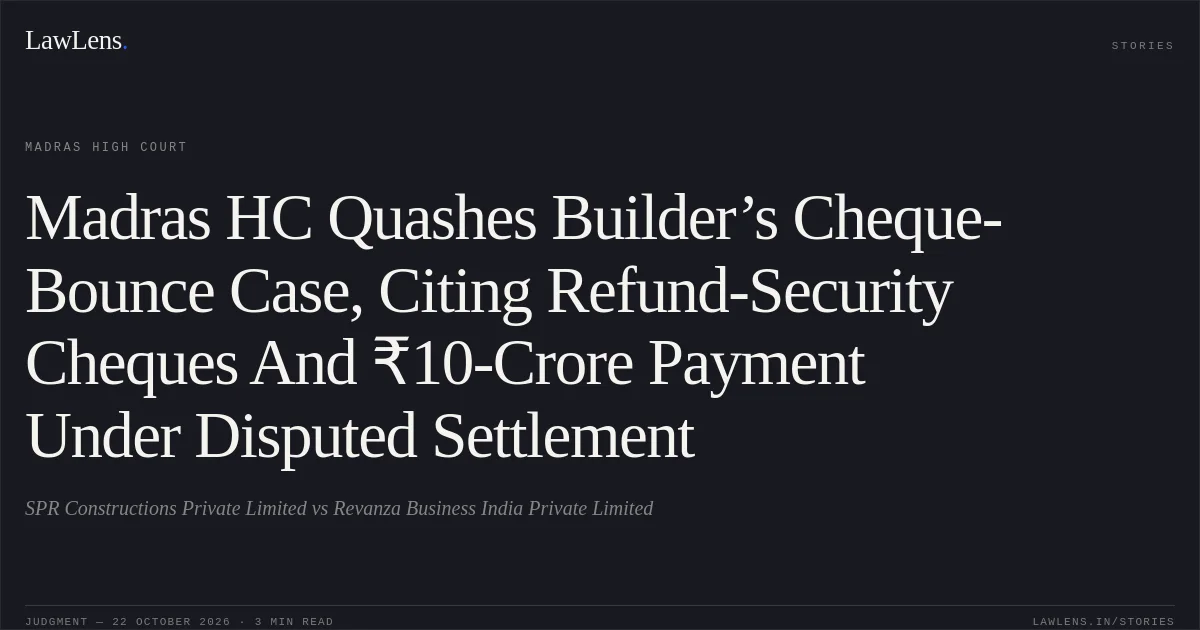
The respondent filed a complaint under Sections 138 and 141 of the Negotiable Instruments Act, 1881 (NI Act), alleging that the petitioners owed approximately ₹44.47 crore following financial and commercial dealings.
Source reference: pp. 12–13The complaint concerned 14 cheques, which were dishonoured with the remarks “Payment Stopped by Drawer” and “Exceeds Arrangement”
Source reference: pp. 12–13The petitioners maintained that the cheques were security instruments connected with a phased refund arrangement following cancellation of property bookings, and that the amount actually refundable was substantially lower than the respondent’s claim
Source reference: pp. 14–16After the respondent lodged an FIR, the parties executed a settlement dated 16 June 2026: the petitioners paid ₹10 crore and agreed to pay a further ₹20 crore; the petitioners later challenged the settlement in a pending civil suit
Source reference: pp. 17–18The petitioners sought to quash the complaint in S.T.C. No. 17013 of 2026 under Section 528 of the Bharatiya Nagarik Suraksha Sanhita, 2023
Source reference: p. 2Issues
1. Whether the cheques represented a legally enforceable debt or liability, particularly when the complaint did not specify the dates and amounts of the alleged advances or explain the computation of the claimed outstanding sum
Source reference: p. 12, para. 13(i); pp. 13–14, para. 152. Whether the Section 138 proceedings were maintainable in light of the settlement dated 16 June 2026 and the petitioners’ payment of ₹10 crore under it
Source reference: p. 12, para. 13(ii)Law Applied
Section 138 of the NI Act applies where a cheque is dishonoured and was issued towards a legally enforceable debt or other liability; Section 139 provides a presumption in favour of the holder that the cheque was issued in discharge of such debt or liability
Source reference: pp. 7–8, paras. 9–10Under Dashrathbhai Trikambhai Patel v. Hitesh Mahendrabhai Patel, a cheque must represent a legally enforceable debt on the date of its presentation, and an intervening part-payment may reduce the liability below the cheque amount
Source reference: pp. 20–21, para. 22Indus Airways Private Limited v. Magnum Aviation Private Limited confirms that a cheque must relate to a subsisting legally enforceable obligation, rather than an obligation that does not exist when payment is sought
Source reference: pp. 22–23, paras. 24–25The Court also referred to the limited power to quash proceedings where the complaint discloses no offence or suffers from a fundamental legal defect, as stated in Municipal Corporation of Delhi v. Ram Kishan Rohtagi and Rajendra Bihari Lal v. State of Uttar Pradesh
Source reference: pp. 9–11, para. 11Section 3 of the Tamil Nadu Prohibition of Charging Exorbitant Interest Act, 2003, prohibits charging exorbitant interest on a loan
Source reference: p. 19, para. 21Reasoning
The Court found that the complaint did not identify the dates or amounts of the alleged advances, provide a transaction-wise account, explain how the ₹44.47 crore figure was calculated, or specify the interest claimed
Source reference: pp. 13–14, 18–19, paras. 15, 20–21It considered those omissions alongside the petitioners’ account that the cheques secured a phased refund arrangement, the alleged repayments, and the ₹10 crore payment under the later settlement.
Source reference: no citationIn the Court’s view, those circumstances made the nature and extent of the liability on the dates of presentation material, particularly under Dashrathbhai’s rule that the cheque must represent the subsisting debt when presented
Source reference: pp. 19–21, paras. 21–23It therefore concluded that the respondent had not made out a prima facie case that the cheque amounts corresponded to legally enforceable liabilities on those dates
Source reference: pp. 21–23, paras. 23–26Holding
The Court held that the complaint did not make out a prima facie case under Section 138 of the NI Act in respect of the cheques in question.
It allowed the petition and quashed the entire proceedings in S.T.C. No. 17013 of 2026; the connected miscellaneous petitions were closed
Source reference: p. 24, para. 27Acts & Sections Cited
13 provisions across 5 statutes referred to in this judgment. Each provision opens on LawLens.
Bharatiya Nagarik Suraksha Sanhita, 20231
Negotiable Instruments Act, 18813
Indian Penal Code, 18607
Code of Criminal Procedure, 19731
Tamil Nadu Prohibition of Charging Exorbitant Interest Act, 20031
Original Court PDF
SPR Constructions Private LimitedvsRevanza Business India Private Limited
Click to open original judgment
Original judgment, available to read, download and summarize on LawLens.in