Facts
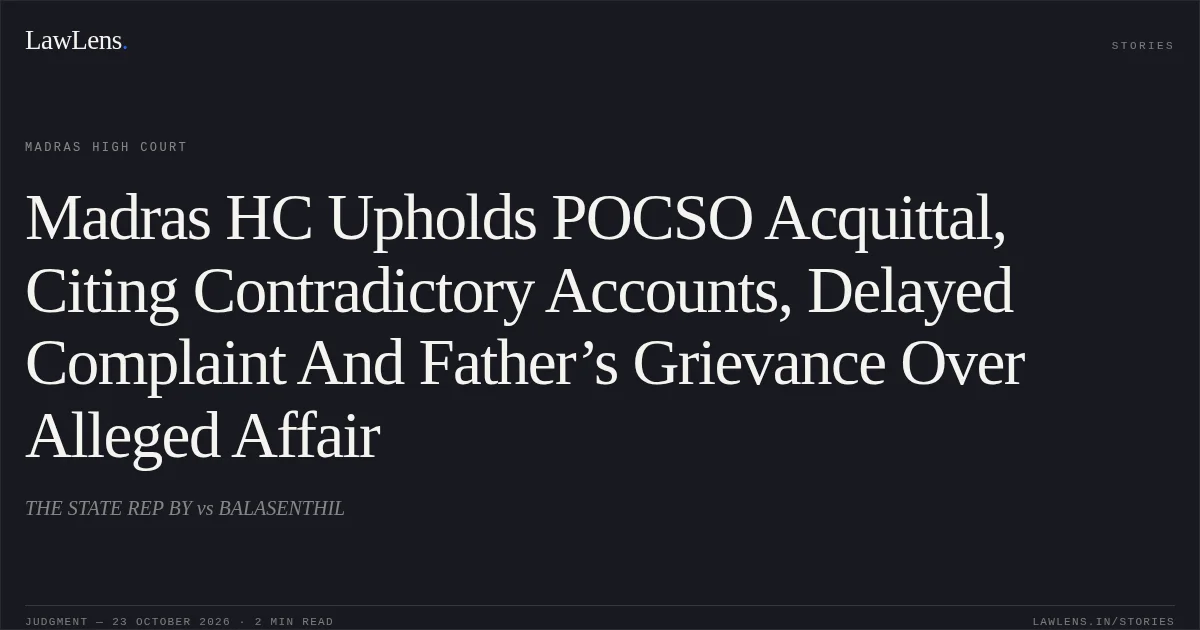
The prosecution alleged that the first respondent hugged and groped the minor victim, the daughter of the second respondent, on 19 June 2018.
Source reference: p. 2The victim’s father complained on 1 July 2018, alleging the incident and that the respondents had administered sleeping medicine to the victim.
Source reference: p. 2The case was investigated under Sections 9(m) read with 10 and Sections 16 read with 17 of the Protection of Children from Sexual Offences Act, 2012, and Section 25 of the Juvenile Justice (Care and Protection of Children) Act, 2015.
Source reference: pp. 2–3The trial court acquitted the respondents, finding the complaint motivated and belated, and identifying contradictions in the victim’s accounts and a lack of evidence supporting the allegation of sleeping medicine.
Source reference: p. 3The State appealed under Section 378(i) of the Code of Criminal Procedure, 1973.
Source reference: p. 1Issues
1. Whether the trial court’s acquittal was based on findings so perverse as to warrant appellate interference.
Source reference: pp. 5–62. Whether the victim’s testimony, considered alongside the inconsistencies, medical evidence, delay, and circumstances of the complaint, established grounds to overturn the acquittal.
Source reference: pp. 4–6Law Applied
The appeal was brought under Section 378(i) of the Code of Criminal Procedure, 1973, against an acquittal.
Source reference: p. 1The prosecution had proceeded under Sections 9(m) read with 10 and Sections 16 read with 17 of the POCSO Act, and Section 25 of the Juvenile Justice Act.
Source reference: p. 3The Court applied the principle that an appellate court should not interfere with an acquittal where the trial court’s view is plausible and its findings are not perverse.
Source reference: p. 6The judgment cites no precedent or further statutory interpretation.
Source reference: no citationReasoning
The victim’s trial evidence that the first respondent hugged her repeatedly and pressed her hands differed from her statement to the Magistrate, which described an attempt to hug and kiss her; the investigating officer confirmed the account in the Section 164 CrPC statement.
Source reference: pp. 4–5The medical examination recorded no external injuries and “No clinical evidence of recent sexual contact”.
Source reference: p. 5The father’s trial claim that the victim had been injured was not reflected in his complaint or police statement, while the allegations about sleeping medicine were unproved.
Source reference: p. 5The Court considered these matters, the delay in reporting, and the evidence that the father was aggrieved by the respondents’ relationship, and held that the trial court’s assessment was plausible and not perverse.
Source reference: pp. 5–6Holding
The Court held that the trial court’s findings did not warrant interference in an appeal against acquittal and dismissed the State’s appeal, leaving the acquittal undisturbed.
It also directed the High Court Legal Services Committee to pay the scheduled fee to the respondents’ Legal Aid Counsel.
Source reference: p. 6Acts & Sections Cited
7 provisions across 3 statutes referred to in this judgment. Each provision opens on LawLens.
Code of Criminal Procedure, 19732
Protection of Children from Sexual Offences Act, 20124
Juvenile Justice (Care and Protection of Children) Act, 2015.1
Original Court PDF
THE STATE REP BYvsBALASENTHIL
Click to open original judgment
Original judgment, available to read, download and summarize on LawLens.in