Facts
The twelve applicants were appointed as Probationer Sub-Inspectors in the Jammu and Kashmir Police in 1995 and underwent the Basic Training Course at the Police Training Academy (PTA), Udhampur.
Source reference: p. 5-6Upon completion, the official respondents framed a seniority list. The applicants discovered they were placed below respondents 4 to 81, despite the applicants having higher aggregate marks in the final training examination.
Source reference: p. 6, 7The official respondents contended that the applicants had failed one or more indoor subjects by not securing the minimum 40% marks and were only declared "pass" after the Director, PTA, exercised discretion to grant statute/grace marks.
Source reference: p. 11-12Conversely, the private respondents had cleared all subjects on their own merit without such concessions.
Source reference: p. 13The applicants initially filed SWP No. 2023/2004 in the High Court of J&K, which was later transferred to the Central Administrative Tribunal (CAT) Jammu Bench as TA 6274/2020.
Source reference: p. 5, 10Issues
1. Whether candidates who required statute/grace marks to pass specific subjects in a training examination can claim seniority over candidates who passed all subjects on their own merit, solely on the basis of higher aggregate marks.
Source reference: p. 16, para. 92. Whether the placement of such candidates lower in the seniority list constitutes an arbitrary punishment or an illegal classification.
Source reference: p. 19, para. 14Law Applied
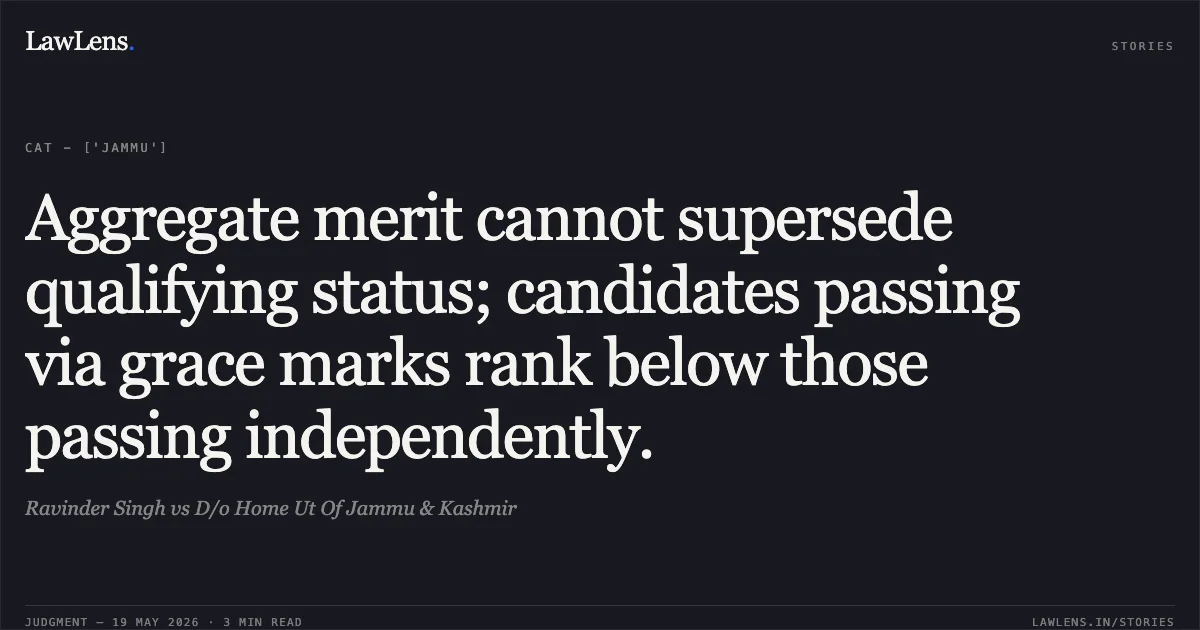
The Tribunal applied the principle of reasonable classification under Article 14 of the Constitution, asserting that merit in a disciplined force implies meeting minimum prescribed standards in every compulsory subject.
Source reference: p. 17-18It held that the grant of grace marks is a concession to prevent failure but does not "obliterate the fact" that the subject was not cleared on merit initially.
Source reference: p. 18The court relied on the doctrine that seniority must be fixed on a rational basis consistent with merit assessment, and that judicial review is limited to instances of perversity, mala fides, or violation of statutory rules.
Source reference: p. 20-21It also emphasized the principle of "settled seniority," where courts are reluctant to disturb long-standing seniority lists unless demonstrably illegal.
Source reference: p. 22-23Reasoning
The Tribunal reasoned that passing every subject in a police training course is an essential standard of competence, not a mere formality.
Source reference: p. 17It found a "clear and rational distinction" between candidates who passed all subjects independently and those who passed via grace marks; this classification has a direct nexus with the objective of determining professional merit.
Source reference: p. 18The Tribunal rejected the applicants' argument that aggregate marks should be the sole determinant, noting that aggregate scores only matter between candidates within the same category (i.e., those who passed without aid).
Source reference: p. 21It further observed that placing the applicants lower was not a "punishment" as they retained their appointments and suffered no disciplinary action; it was simply a reflection of their relative merit.
Source reference: p. 19Finally, the Tribunal noted that the dispute dates back to 1995 and the petition to 2004; unsettling the seniority list after such a long duration would cause undue cascading administrative consequences.
Source reference: p. 22Holding
The Tribunal answered that candidates passing through grace marks are not identically situated to "ordinary pass" candidates and cannot claim higher seniority based on aggregate marks.
The seniority list was held to be legal, fair, and based on a reasonable classification. The Tribunal dismissed the Transfer Application, holding that no enforceable right of the applicants was violated and no interference with the settled seniority list was warranted. No order as to costs was made.
Source reference: p. 23-24Acts & Sections Cited
3 provisions across 3 statutes referred to in this judgment. Linked provisions open on LawLens.
Dissuading Persons from Military and Police Service, Made Penal Svt, 19741
Indian Penal Code, 18601
Code of Criminal Procedure1
Original Court PDF
Ravinder SinghvsD/o Home Ut Of Jammu & Kashmir
Click to open original judgment
Original judgment, available to read, download and summarize on LawLens.in