01Facts
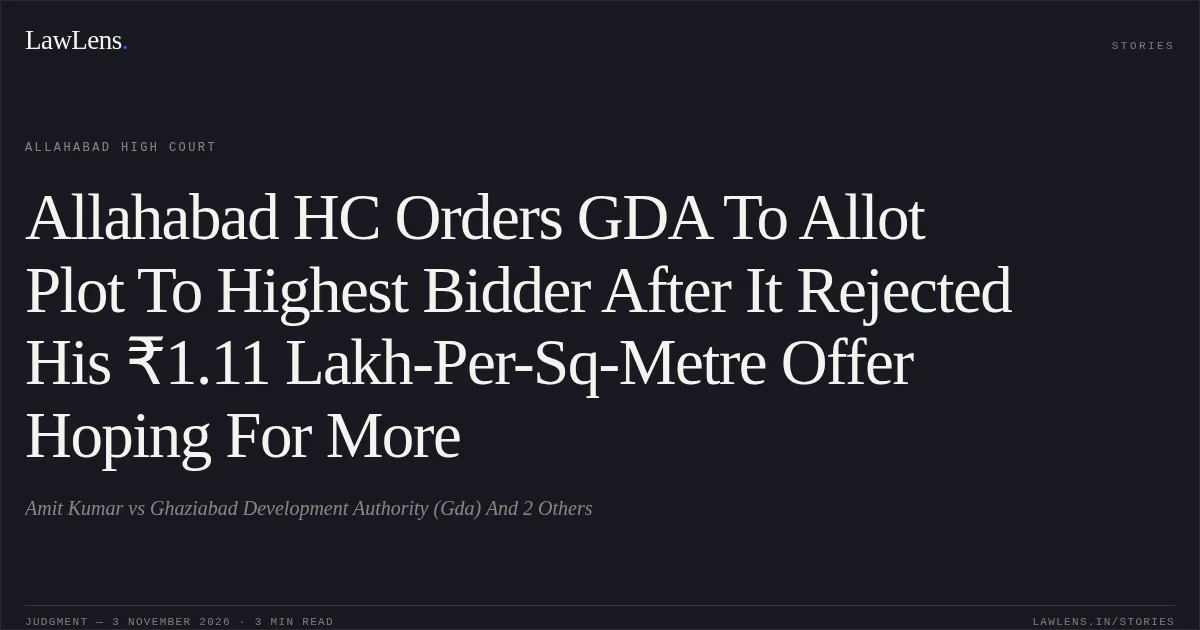
The GDA auctioned Plot No. A-252 on 15 October 2025, with a reserve price of ₹93,000 per sq. m.
¶ 2–8Amit Kumar’s bid of ₹1,11,000 per sq. m. was the highest.
¶ 2–8The Authority rejected it, stating that the bid was unacceptable, and later explained that it expected a higher price.
¶ 2–8The plot had previously been auctioned twice: the highest bids of ₹1,95,000 and ₹1,56,000 per sq. m. were also rejected, on different grounds.
¶ 2–8The Authority subsequently re-auctioned the plot, and a bid of ₹2,06,000 per sq. m. was accepted while this writ petition was pending.
¶ 2–8The High Court examined the Authority’s original records and found no evidence of fraud, collusion, or other irregularity in the petitioner’s auction.
¶ 14–23, 32–3402Issues
i.1. Whether the cancellation of the petitioner’s highest bid, without reasons in the communicated intimation, amounted to a colourable exercise of power
¶ 12(i)ii.2. Whether the Authority could reject the bid because it expected a higher price in a future auction
¶ 12(ii)iii.3. Whether the petitioner’s writ petition was liable to be dismissed because the subsequent allottee was not impleaded
¶ 12(iii)iv.4. What relief should follow if the cancellation was unlawful
¶ 12(iv)03Law Applied
A highest bidder has no indefeasible right to have a bid accepted; an authority may reject the highest bid or cancel an auction, subject to judicial review of whether the decision rested on relevant considerations, was supported by material, and was non-arbitrary
¶ 25Under Golden Foods Products India v. State of U.P., 2026 INSC 225, a valid bid above the reserve price cannot be rejected merely because the authority expected a higher bid; rejection must have a rational basis, such as an infirmity affecting the auction
¶ 26–27M/s Dhanlaxmi Merchandise Pvt. Ltd. v. State of Madhya Pradesh, 2026 INSC 1125, was relied on for reviewing the reasonableness and non-arbitrariness of a public authority’s decision
¶ 25, 29The Court also applied the principle that judgments ordinarily operate retrospectively unless expressly made prospective
¶ 27The Court also applied the doctrine of lis pendens under Section 52 of the Transfer of Property Act, 1882, by which a transfer during pending litigation is subject to the outcome of that litigation
¶ 35–36A subsequent allottee acting in good faith may be entitled to restitution where the allotment is displaced
¶ 38Provisions in the judgment · 1 · Linked ones open on LawLens
Transfer of Property Act, 1882 Section 52
04Reasoning
Although Clause (xi) reserved final approval of the auction to the Vice-Chairman, that discretion remained subject to judicial review.
¶ 18–23The Authority’s records showed that it repeatedly rejected bids above the unchanged reserve price in anticipation of a better return, without identifying any defect in the petitioner’s auction or a reasoned basis for rejecting his bid.
¶ 18–23The earlier rejected bid of ₹1,95,000 per sq. m. could not rationally serve as the benchmark for rejecting later bids after the Authority itself had declined to accept it.
¶ 18–23Applying Golden Foods, the Court held that anticipated future prices alone did not justify cancellation; the process was therefore arbitrary and a colourable exercise of power.
¶ 26–30The later allotment had been made during the writ proceedings, with the Authority having notice of the petition, and was subject to lis pendens.
¶ 32–39The allottee’s interests could be addressed by refund and interest, so non-impleadment did not require dismissal of the petition.
¶ 32–3905Holding
The Court held that the petitioner’s bid was unlawfully cancelled and that expectation of a higher future bid was not a valid ground for rejection.
¶ 40–44It set aside the cancellation intimation dated 27 October 2025 and restored the auction held on 15 October 2025 to the petitioner’s highest bid.
¶ 40–44The Authority was directed to issue an allotment letter, subject to the petitioner making payments under the bid conditions.
¶ 40–44The subsequent auction and allotment were held to have no legal effect; the subsequent allottee was entitled to a refund with 6% interest within one month, rising to 9% in case of default.
¶ 40–44The writ petition was allowed, with no order as to costs.
¶ 40–44Original Court PDF
Amit KumarvsGhaziabad Development Authority (Gda) And 2 Others
Click to open original judgment
Original judgment, available to read, download and summarize on LawLens.in