Facts
The petitioner, owner of Parit Associates (OPC) Private Limited, challenged Case Crime No. 0194 of 2026 registered at Police Station Wave City, Ghaziabad, under Sections 64, 74, 75(2), 76 and 351(3) of the Bharatiya Nyaya Sanhita, 2023 (“BNS”), and sought quashing of the FIR and protection from arrest.
Source reference: paras. 1–2The prosecutrix, an employee of the petitioner, alleged repeated molestation, sexual harassment, digital penetration, inducement through promises of promotion and money, and threats to harm her and her family members.
Source reference: paras. 4–12The prosecutrix claimed that she resigned on 8 April 2026 and that the petitioner thereafter caused a false extortion case, Case Crime No. 294 of 2026, to be registered against her.
Source reference: paras. 12–17After allegedly approaching the police station and the Commissioner of Police without securing registration of an FIR, she filed an application under Section 173(4) of the Bharatiya Nagarik Suraksha Sanhita, 2023 (“BNSS”) before the Magistrate.
Source reference: paras. 20–21Although the police report described her allegations as false, baseless and a possible counter-blast, the Magistrate, by order dated 20 July 2026, directed registration of an FIR and investigation.
Source reference: paras. 22–24Issues
Whether the FIR disclosed cognizable offences warranting registration and investigation, or whether it was liable to be quashed under Article 226 of the Constitution.
Source reference: paras. 55–64Whether the Magistrate mechanically directed registration of the FIR by disregarding the police report dated 16 July 2026.
Source reference: paras. 45–50, 69Whether the FIR was liable to be quashed on the ground that it was a malicious counter-blast to Case Crime No. 294 of 2026.
Source reference: paras. 58–62Whether the conduct of the police authorities in not registering the prosecutrix’s initial complaints required judicial scrutiny and corrective directions.
Source reference: paras. 74–80Law Applied
The Court exercised its limited jurisdiction under Article 226 of the Constitution concerning quashing of criminal proceedings.
Source reference: no citationIt applied the principle in Lalita Kumari v. Government of Uttar Pradesh, that registration of an FIR is mandatory when information discloses a cognizable offence and that a preliminary inquiry is permissible only to ascertain whether such an offence is disclosed.
Source reference: para. 55Relying on Neeharika Infrastructure Pvt. Ltd. v. State of Maharashtra, the Court held that the police possess a statutory right and duty to investigate cognizable offences and that the High Court should not ordinarily interfere merely because the accused disputes the allegations.
Source reference: para. 57The Court also applied the principles in State of Haryana v. Bhajan Lal, under which quashing is permissible only in exceptional cases, such as where the allegations disclose no offence, are inherently absurd or impossible, or the proceedings are manifestly mala fide; disputed defences and allegations of motive ordinarily require investigation and trial.
Source reference: paras. 58–60Sections 64, 74, 75(2), 76 and 351(3) of the BNS were considered in determining whether the allegations prima facie disclosed sexual offences, harassment, sexual assault and criminal intimidation, while Section 173(4) BNSS provided the procedural basis for approaching the Magistrate after police inaction.
Source reference: paras. 21, 49, 56Reasoning
The Court held that the prosecutrix’s allegations, including physical molestation, digital penetration, inducement through promises of promotion or money, and threats to kill or harm her family, disclosed cognizable offences when taken at face value.
Source reference: paras. 56, 64–65The petitioner’s objections concerning delay, continued employment, absence of electronic evidence, alleged improbability and the existence of the earlier extortion case raised disputed questions of fact that could not be conclusively determined in a writ petition.
Source reference: paras. 43, 59–63The police report was not a final adjudication; its reliance on the prosecutrix’s failure to produce chats or recordings could not negate allegations of physical acts and threats, nor could it shift the investigative burden onto the complainant.
Source reference: paras. 50–54The Magistrate had considered both the complaint and the police report before directing registration and was not bound to accept the police officer’s preliminary opinion.
Source reference: paras. 47–50, 69Since the FIR did not fall within any exceptional category under the quashing principles, interference was unwarranted.
Source reference: no citationHowever, the failure of the police to register the FIR when the allegations prima facie disclosed cognizable offences justified an inquiry into police conduct.
Source reference: paras. 74–77Holding
The Court dismissed the petition and refused to quash Case Crime No. 0194 of 2026, holding that the allegations prima facie disclosed cognizable offences and required a fair investigation.
It clarified that no final opinion had been expressed on the merits of the prosecution case.
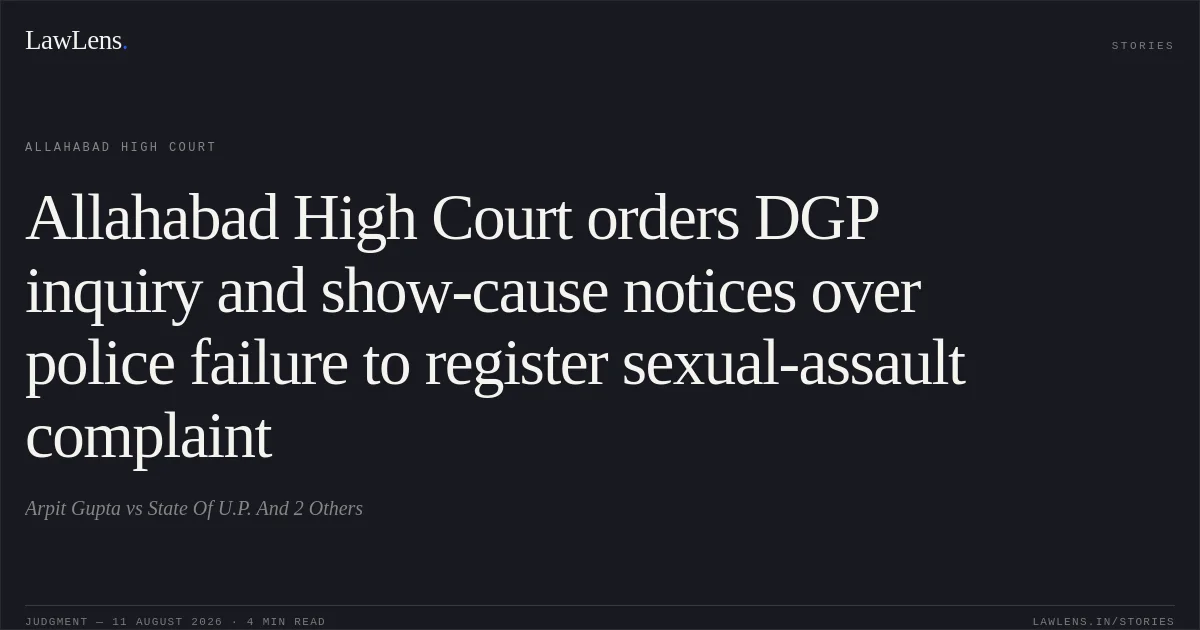
Source reference: para. 73The Director General of Police, Uttar Pradesh, was directed to inquire into the failure to register the prosecutrix’s complaints, issue show-cause notices to the concerned police officials, examine the legality of the pre-FIR police report, and submit a personal-affidavit compliance report within four weeks.
Source reference: para. 77The Commissioner of Police, Ghaziabad, was directed to ensure a fair, impartial and lawful investigation in Case Crime No. 0194 of 2026, and the matter was directed to be listed after four weeks for consideration of the compliance report.
Source reference: paras. 78–80Acts & Sections Cited
7 provisions across 2 statutes referred to in this judgment. Each provision opens on LawLens.
Bharatiya Nyaya Sanhita, 20236
Bharatiya Nagarik Suraksha Sanhita, 20231
Original Court PDF
Arpit GuptavsState Of U.P. And 2 Others
Click to open original judgment
Original judgment, available to read, download and summarize on LawLens.in