01Facts
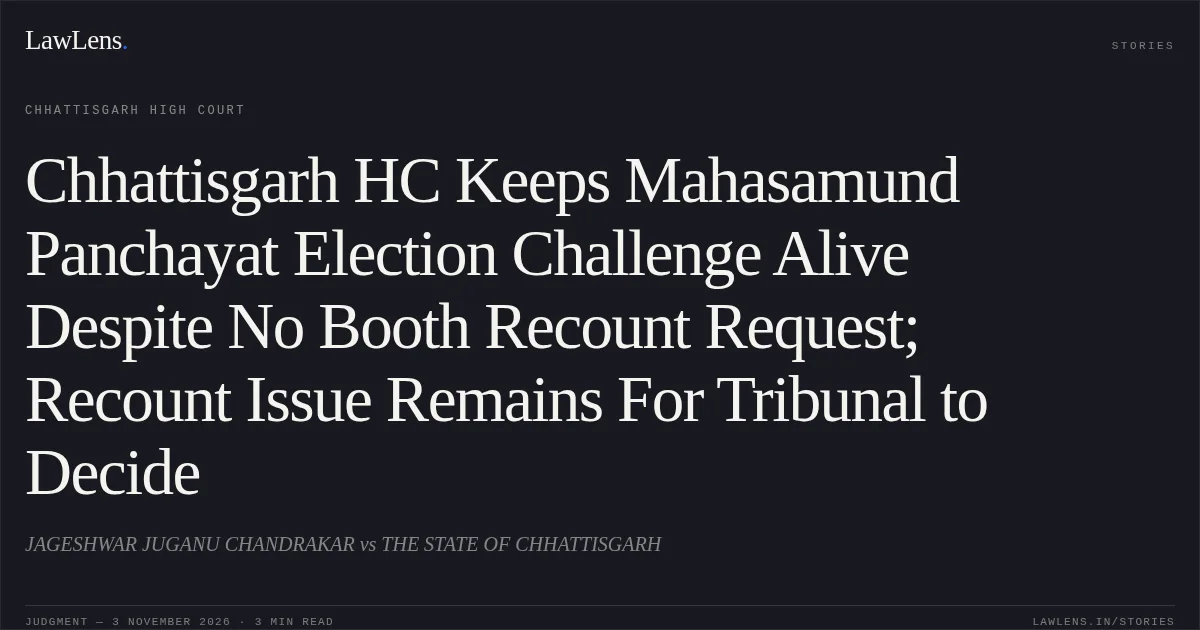
The petitioner, the returned candidate for Member of Zila Panchayat, Mahasamund, challenged the Election Tribunal’s order dated 22 April 2026 rejecting his application under Order VII Rule 11 CPC to dismiss Respondent No. 7’s election petition
¶ 1, 3Respondent No. 7’s petition under Section 122 of the Chhattisgarh Panchayat Raj Adhiniyam, 1993, alleged discrepancies in the vote-counting and tabulation records for Booth No. 187, including overwriting in Proforma-19, and sought recounting and consequential relief
¶ 20–22The petitioner argued that the election petition was not maintainable because neither Respondent No. 7 nor his authorised agent had requested a recount during counting, as contemplated by Rule 80 of the Chhattisgarh Panchayat Nirvachan Niyam, 1995
¶ 4, 24Respondent No. 7 relied on discrepancies allegedly discovered after obtaining the tabulation chart and on the District Election Officer’s subsequent order noting discrepancies but stating that he lacked authority to recount the ballots
¶ 6, 21–22, 26The election petition had proceeded to the final-hearing stage
¶ 3402Issues
i.Whether the Election Tribunal erred in rejecting the petitioner’s application under Order VII Rule 11 CPC, where the election petition alleged discrepancies in the election records and sought recounting
¶ 10ii.Whether the absence of a request for recounting during counting, or the District Election Officer’s refusal to recount, by itself rendered the election petition liable to rejection at the threshold
¶ 24–3103Law Applied
Order VII Rule 11 CPC requires the court to assess, on the basis of the election petition’s averments read as a whole, whether it discloses a cause of action or is barred by law; the defendant’s case and disputed evidence are ordinarily not considered at this stage
¶ 11–15Saleem Bhai v. State of Maharashtra, (2003) 1 SCC 557, and Karam Singh v. Amarjit Singh, 2025 SCC OnLine SC 2240, support confining the inquiry to the petition’s pleadings
¶ 13–14Popat and Kotecha Property v. State Bank of India Staff Association, (2005) 7 SCC 510, Madiraju Venkata Ramana Raju v. Peddireddigari Ramachandra Reddy, (2018) 14 SCC 1, and Ashraf Kokkur v. K.V. Abdul Khader, (2015) 1 SCC 129, establish that pleadings must be read holistically and that the threshold inquiry is whether a cause of action requiring adjudication is disclosed, not whether the petitioner will ultimately succeed
¶ 15, 17–18Kimneo Haokip Hangshing v. Kenn Raikhan, 2024 SCC OnLine SC 2548, states that an election petition should not be rejected where its pleadings substantially disclose a cause of action
¶ 16Section 122 of the Chhattisgarh Panchayat Raj Adhiniyam, 1993, provided the basis for the election petition; the petitioner relied on Rule 80(1) read with Rule 80(5) of the 1995 Rules, but the Court did not finally determine the effect of those rules on the merits
¶ 3–4, 24–25Provisions in the judgment · 3 · Linked ones open on LawLens
Representation of the People Act, 1951 Section 83Section 100Section 101
04Reasoning
The Court treated the inquiry as a limited threshold assessment, not a determination of whether the alleged manipulation occurred or whether a recount should ultimately be ordered
¶ 19, 32Read as a whole, the election petition pleaded specific differences between the calculation and tabulation charts, alleged overwriting in Proforma-19, and relied on the District Election Officer’s recorded observations about discrepancies
¶ 20–23, 29Those pleaded facts could not be dismissed as incapable of raising an election dispute without adjudication.
The alleged failure to seek recounting during counting, and the later proceedings before the District Election Officer, did not by themselves establish that the entire petition was barred by law; their legal effect required consideration in light of the applicable rules and the complete pleadings
¶ 25–31, 33The petition’s progress to final hearing did not prevent an Order VII Rule 11 application, but reinforced the need to apply the correct test rather than isolate one circumstance
¶ 3405Holding
The Court held that the election petition, on a holistic reading, disclosed a cause of action and had not been shown to be ex facie barred by law.
¶ 35–36The absence of a recount request during counting was not, by itself, sufficient to warrant rejection under Order VII Rule 11 CPC
¶ 35–36The writ petition was dismissed, the Tribunal’s order dated 22 April 2026 was affirmed, and the Tribunal was directed to decide the election petition in accordance with law, uninfluenced by the Court’s observations on the merits
¶ 37–39Original Court PDF
NAYAN PATELvsTHE STATE OF CHHATTISGARH
Click to open original judgment
Original judgment, available to read, download and summarize on LawLens.in