01Facts
The parties married on 1 January 2015 and had a son, who lives with the wife.
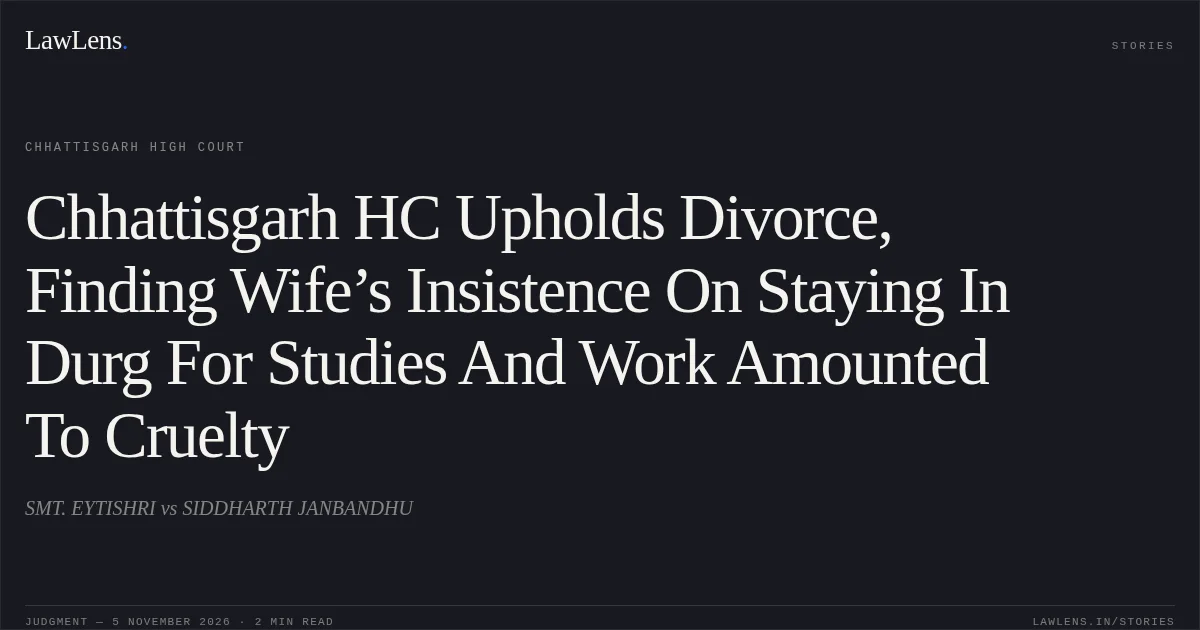
¶ 3–6The husband alleged that the wife chose to pursue studies and employment in Durg and refused to reside with him in Dongargarh, despite his proposals that she commute between the two places.
¶ 3–6The wife denied the allegations, said the husband had driven her out, and stated that she was willing to continue the marriage.
¶ 3–6The Family Court found cruelty proved, but not desertion, and granted the husband a divorce.
¶ 3–6The wife appealed.
¶ 3–602Issues
i.1. Whether the Family Court was justified in granting a divorce on the ground of cruelty under Section 13(1)(ia) of the Hindu Marriage Act, 1955
¶ 10ii.2. Whether the Family Court’s finding of cruelty was sustainable on the evidence and warranted appellate interference
¶ 7, 1003Law Applied
Section 13(1)(ia) of the Hindu Marriage Act, 1955 permits divorce where the other spouse has treated the petitioner with cruelty.
¶ 12In Samar Ghosh v. Jaya Ghosh, (2007) 4 SCC 511, the Supreme Court held that cruelty may be mental or physical, that the cumulative effect of the parties’ conduct must be assessed, and that conduct may constitute cruelty where it makes continued cohabitation intolerable.
¶ 12The Court also relied on Narendra v. K. Meena, (2016) 9 SCC 455, concerning persistent conduct that causes mental distress to a spouse; it quoted the Supreme Court’s conclusion that persistent efforts to compel a husband to separate from his family, without justifiable reason, may amount to cruelty.
¶ 11Provisions in the judgment · 3 · Linked ones open on LawLens
Code of Criminal Procedure, 1973 Section 125
Hindu Marriage Act, 1955 Section 9Section 13
04Reasoning
The Court considered the wife’s preference to study and work in Durg, her refusal to reside with the husband in Dongargarh, and the husband’s asserted attempts to facilitate her studies and employment while maintaining the household.
¶ 11It found his request that she commute between the towns reasonable and concluded that her continued refusal to live with him and discharge what the Court viewed as matrimonial responsibilities, including responsibilities toward his mother, amounted to mental cruelty.
¶ 11Applying the cumulative-conduct approach in Samar Ghosh, the Court upheld the Family Court’s finding under Section 13(1)(ia).
¶ 12It expressly declined to comment on the allegation of an extramarital relationship.
¶ 1205Holding
The Court held that the wife had not shown perversity or illegality in the Family Court’s cruelty finding and dismissed the appeal.
¶ 13–15It affirmed the divorce decree dated 3 August 2024; there was no order as to costs.
¶ 13–15Original Court PDF
SMT. EYTISHRIvsSIDDHARTH JANBANDHU
Click to open original judgment
Original judgment, available to read, download and summarize on LawLens.in