01Facts
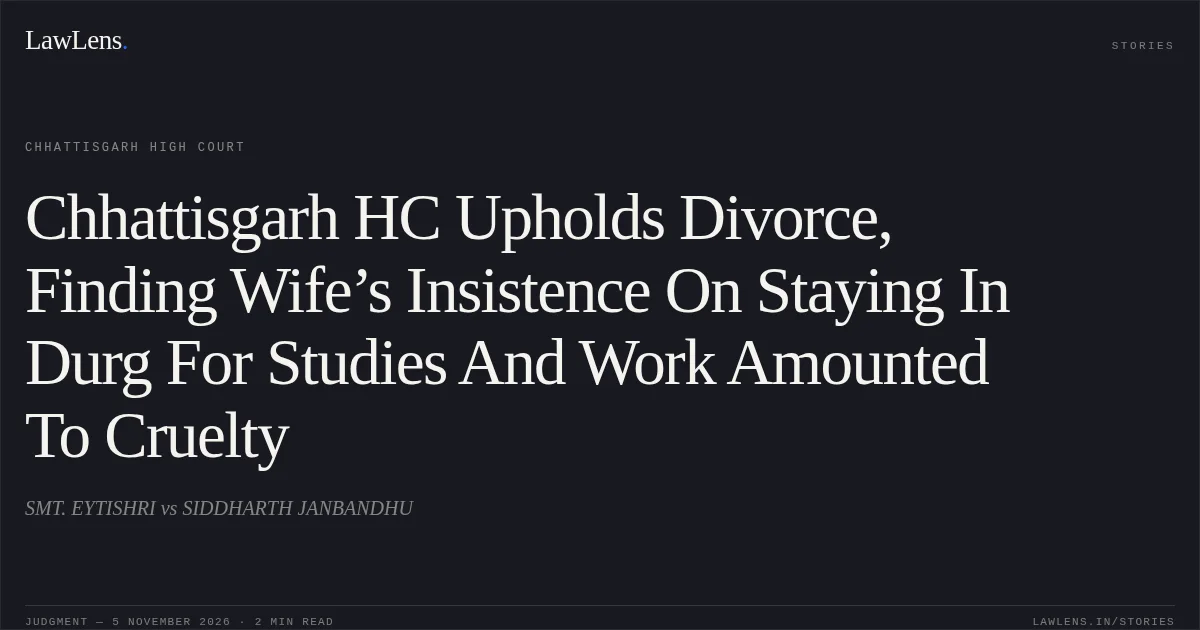
The parties married on 8 December 2015 and had a son
¶ 3The husband sought divorce under Section 13(1)(ia) of the Hindu Marriage Act, 1955, alleging that the wife had mistreated his family, made baseless allegations about his character, and refused to resume cohabitation
¶ 4–8The wife denied the allegations and maintained that the husband had sent her to her parental home and failed to take her back
¶ 9–10The Family Court granted the husband a decree of divorce on the ground of cruelty
¶ 11, 14The wife appealed under Section 19 of the Family Courts Act, 1984
¶ 102Issues
i.Whether the Family Court was justified in granting divorce to the husband on the ground of cruelty
¶ 17(i)ii.Whether the husband was entitled to a decree of divorce as claimed
¶ 17(ii)03Law Applied
Section 13(1)(ia) of the Hindu Marriage Act, 1955 permits divorce where one spouse has treated the other with cruelty.
As cruelty is not defined by the Act, its assessment depends on the facts and circumstances of each case.
The Court relied on V. Bhagat v. D. Bhagat, (1994) 1 SCC 337; Praveen Mehta v. Inderjit Mehta, (2002) 5 SCC 706; Samar Ghosh v. Jaya Ghosh, (2007) 4 SCC 511; and Naveen Kohli v. Neelu Kohli, (2006) 4 SCC 558.
¶ 22–23, 27The illustrative principles in Samar Ghosh include that sustained conduct causing serious mental pain may constitute cruelty, while ordinary marital disagreements and isolated incidents generally do not; reckless, baseless allegations impugning a spouse’s character or fidelity may also amount to mental cruelty, depending on the circumstances
¶ 22–23, 27Provisions in the judgment · 3 · Linked ones open on LawLens
Family Courts Act, 1984 Section 19
Dowry Prohibition Act, 1961 Section 4
Hindu Marriage Act, 1955 Section 13
04Reasoning
The Court found that the husband and his witnesses gave consistent evidence, and that cross-examination disclosed no material undermining their reliability
¶ 24It considered the wife’s suggestions in cross-examination that the husband had an illicit relationship with his sister-in-law, finding no evidential foundation for those serious allegations.
¶ 25–28The Court also relied on the wife’s and her father’s admissions concerning her departures to her parental home, the husband’s efforts to bring her back, and his provision of care and medical expenses during pregnancy and delivery
¶ 29–30Further admissions indicated that the wife had refused to accompany the husband, including during counselling
¶ 31Viewed cumulatively, the baseless character allegations and her unwillingness to resume cohabitation supported the finding of mental cruelty
¶ 3205Holding
The Court held that cruelty under Section 13(1)(ia) of the Hindu Marriage Act was established and found no illegality or perversity in the Family Court’s decision
¶ 33It dismissed the appeal, affirmed the decree of divorce, and directed the parties to bear their own costs.
¶ 34–35Original Court PDF
SMT. ANJALI YADAVvsRAHUL YADAV
Click to open original judgment
Original judgment, available to read, download and summarize on LawLens.in