01Facts
The parties married on 6 May 2017 and had a son.
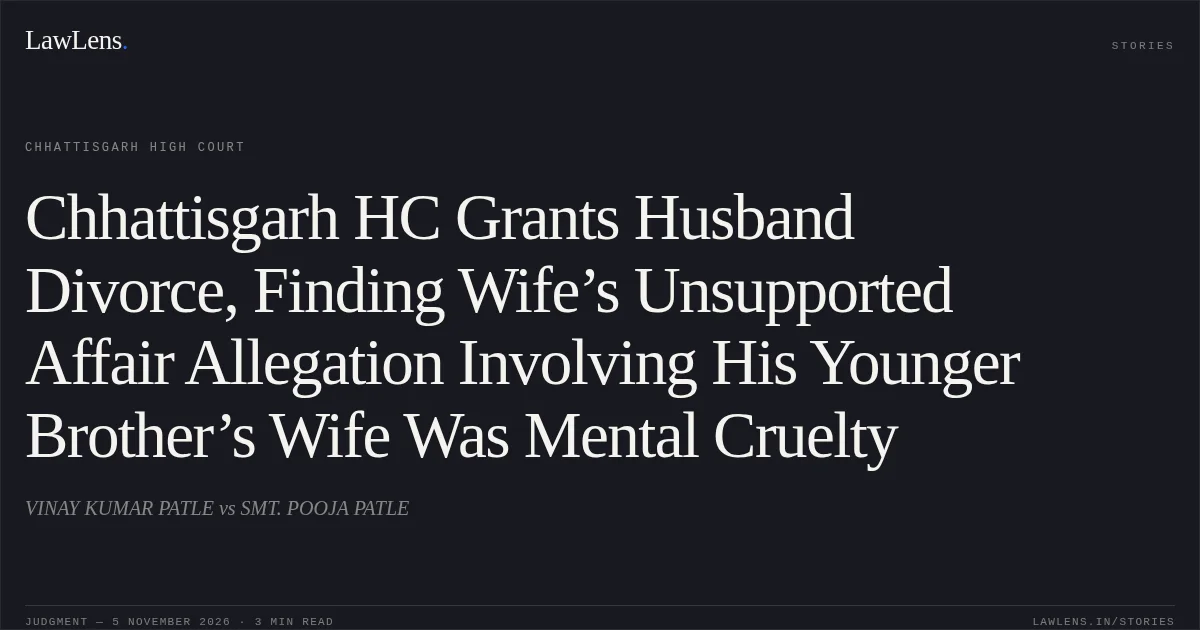
¶ 1–5, 21The husband alleged that the wife left the matrimonial home on 4 December 2018, made an unsupported allegation that he was having an illicit relationship with his younger brother’s wife, and initiated criminal and domestic-violence proceedings against him and his family.
¶ 1–5, 21The wife denied the allegations and claimed that she had been subjected to cruelty.
¶ 1–5, 21The husband’s petition for divorce on the grounds of cruelty and desertion was dismissed by the Family Court, which found neither ground proved.
¶ 1–5, 21The husband appealed.
¶ 1–5, 21The wife did not give evidence before the Family Court.
¶ 1–5, 2102Issues
i.1. Whether the wife’s conduct, including her allegation of the husband’s illicit relationship and the proceedings brought against him and his family, amounted to mental cruelty under Section 13(1)(i-a) of the Hindu Marriage Act, 1955.
¶ 4, 13–25ii.2. Whether the wife had deserted the husband for the continuous period of at least two years immediately preceding the filing of the divorce petition.
¶ 4, 11, 21–2203Law Applied
Section 13(1)(i-a) of the Hindu Marriage Act, 1955 permits divorce where one spouse has treated the other with cruelty; mental cruelty is assessed in light of the facts and circumstances of the case.
Section 13(1)(i-b) requires desertion for a continuous period of at least two years immediately before presentation of the petition.
Relying on Vijaykumar Ramchandra Bhate v. Neela Vijaykumar Bhate, the Court stated that baseless allegations of an extramarital relationship may constitute mental cruelty, depending on their gravity and impact.
¶ 15It also relied on Narendra v. K. Meena for the principle that false and reckless allegations of an affair may cause mental cruelty.
¶ 16Under Rakesh Raman v. Kavita, the filing of criminal complaints, or their resulting in acquittal, does not by itself establish cruelty; the circumstances and overall facts must be considered.
¶ 18The Court further referred to K. Srinivas v. K. Sunita concerning a knowingly false criminal complaint as conduct capable of constituting cruelty.
¶ 19Provisions in the judgment · 6 · Linked ones open on LawLens
Family Courts Act, 1984 Section 19
Hindu Marriage Act, 1955 Section 13
Indian Penal Code, 1860 Section 34Section 323Section 324
Code of Criminal Procedure, 1973 Section 161
04Reasoning
The Court found that the wife had specifically alleged that the husband was having an illicit relationship with his younger brother’s wife, but the allegation lacked a foundation in the evidence.
¶ 14It considered the allegation particularly serious because it implicated a close family member and could cause the husband mental pain and suffering.
¶ 14The Court also considered the criminal proceedings and the husband’s submission that he and his family had been acquitted; the wife’s counsel did not categorically dispute that submission.
¶ 17, 19–20However, the acquittal judgment was not on the record, and the criminal case had still been pending when the Family Court decided the divorce petition.
¶ 17, 19–20The Court held that the Family Court had erred by failing to address the allegation of an illicit relationship and the evidence relevant to cruelty.
¶ 23It upheld the Family Court’s finding on desertion: the pleaded departure was on 4 December 2018, while the divorce petition was filed on 10 January 2020, short of the statutory two-year period.
¶ 21–2405Holding
The appeal was allowed.
¶ 24–25The Court set aside the Family Court’s finding on cruelty and held that the husband had proved mental cruelty; it left undisturbed the finding that desertion had not been established.
¶ 24–25The divorce petition was allowed, and the marriage was dissolved on the ground of cruelty.
¶ 26–28Original Court PDF
VINAY KUMAR PATLEvsSMT. POOJA PATLE
Click to open original judgment
Original judgment, available to read, download and summarize on LawLens.in