01Facts
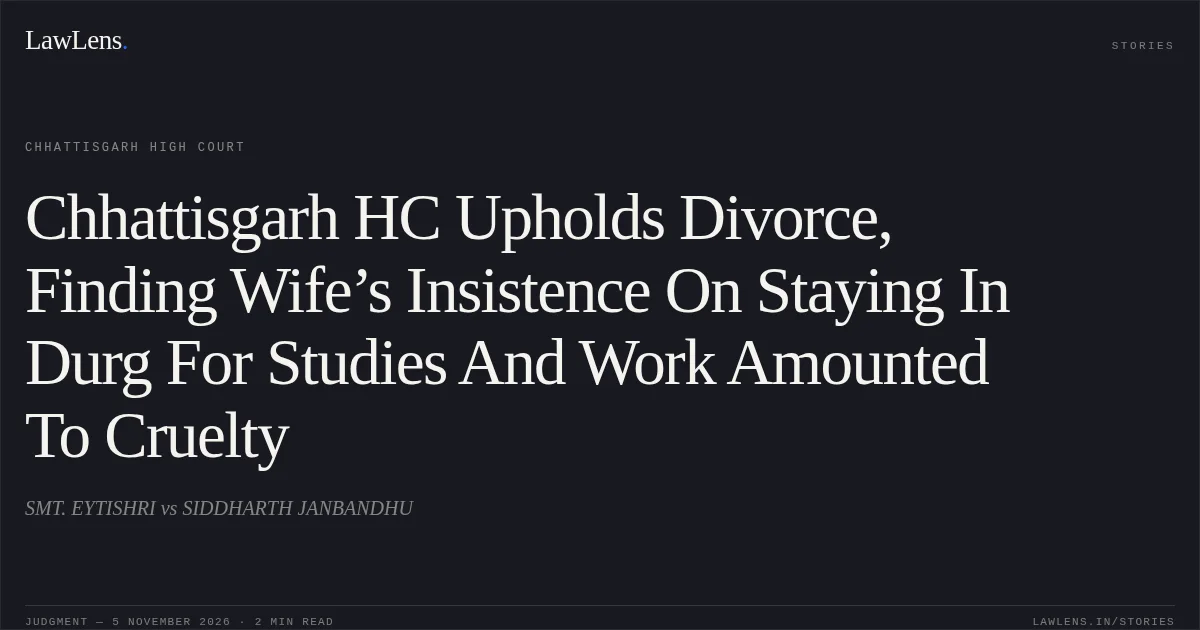
The parties married on 21 April 2014.
¶ 1The husband sought divorce under Section 13(1)(i-a) of the Hindu Marriage Act, 1955, alleging cruelty, including that the wife left the matrimonial home in July 2014 and refused to resume cohabitation, and made false allegations against him.
¶ 1–2The wife denied desertion and cruelty, asserting that she went to her parental home with the husband’s consent and had been harassed at the matrimonial home.
¶ 3The Family Court granted a decree of divorce on the ground of cruelty on 30 November 2022; the wife appealed under Section 19(1) of the Family Courts Act, 1984.
¶ 1, 502Issues
i.1. Whether the wife’s conduct established mental cruelty warranting divorce under Section 13(1)(i-a) of the Hindu Marriage Act, 1955.
¶ 4, 9–12ii.2. Whether the Family Court’s decree of divorce should be set aside for failing to properly assess the parties’ pleadings and evidence.
¶ 6–8, 34–3503Law Applied
Section 13(1)(i-a) of the Hindu Marriage Act, 1955 permits divorce where one spouse has treated the other with cruelty; mental cruelty is assessed in light of the parties’ circumstances and the overall course of their matrimonial life.
¶ 10–12The court relied on Samar Ghosh v. Jaya Ghosh, (2007) 4 SCC 511, for the illustrative, non-exhaustive indicators of mental cruelty, and on Raj Talreja v. Kavita Talreja, (2017) 14 SCC 194, and K. Srinivas v. K. Sunita, (2014) 16 SCC 34, concerning knowingly false accusations or complaints.
¶ 22–32It also cited K. Srinivas Rao v. D.A. Deepa, (2013) 5 SCC 226, Narasimha Sastry v. Suneela Rani, (2020) 18 SCC 247, and Rakesh Raman v. Kavita, (2023) 17 SCC 433, on when false or repeated proceedings may constitute cruelty; Vidhya Viswanathan v. Kartik Balakrishnan, (2014) 15 SCC 21, on prolonged refusal of marital intimacy; and Sonal Talpada v. Veerbhan Singh, Civil Appeal No. 8391 of 2026, on the reciprocal responsibilities of marriage.
¶ 22–32Provisions in the judgment · 8 · Linked ones open on LawLens
Family Courts Act, 1984 Section 19
Hindu Marriage Act, 1955 Section 13
Code of Criminal Procedure, 1973 Section 125Section 161
Protection of Women from Domestic Violence Act, 2005 Section 12
Indian Penal Code, 1860 Section 182Section 323Section 324
04Reasoning
The court found that the wife admitted she had gone to her parental home in July 2014 and remained there, while her police applications and the Women’s Cell record indicated that she wished to reside separately and did not seek further counselling or proceedings.
¶ 16–20, 24–25It considered this evidence, together with the parties’ prolonged separation, as supporting the husband’s case of withdrawal from matrimonial life without sufficient cause.
¶ 21, 26, 33The court also relied on the dismissal of the wife’s maintenance and domestic-violence proceedings and concluded that her allegations against the husband were false; however, it noted that those proceedings were initiated after the divorce petition and held that its conclusion was independently supported by the other evidence.
¶ 15, 18, 29, 33Assessing the evidence cumulatively, the court held that the wife’s conduct amounted to mental cruelty.
¶ 3305Holding
The High Court dismissed the wife’s appeal and affirmed the Family Court’s decree dissolving the marriage under Section 13(1)(i-a) of the Hindu Marriage Act, 1955.
¶ 34–37It found no perversity or legal error warranting appellate interference.
¶ 34–37Original Court PDF
DR. VIJETA JHAvsASHOK KUMAR JHA
Click to open original judgment
Original judgment, available to read, download and summarize on LawLens.in