Facts
The respondent (plaintiff) filed a suit for possession, recovery of rent, and damages against the petitioner (defendant) regarding a property in Sunder Nagri, Delhi, alleging a landlord-tenant relationship
Source reference: para. 4In his original written statement, the petitioner denied the tenancy, claiming he constructed the shop with his own funds and that the land was DDA-acquired
Source reference: para. 4, 8In 2018, the Trial Court dismissed the petitioner’s application under Order VIII Rule 1A CPC to introduce ownership documents dated May 7, 1985
Source reference: para. 7In 2022, after the respondent’s evidence concluded and the case was set for the defendant's evidence, the petitioner filed an application under Order VI Rule 17 CPC to amend his written statement to claim ownership via purchase from one Noor Biwi in 1985
Source reference: para. 5, 7The Trial Court dismissed this application on March 22, 2023, leading to this petition under Article 227
Source reference: para. 1Issues
1. Whether the petitioner satisfied the "due diligence" requirement under the proviso to Order VI Rule 17 CPC for amendments sought after the commencement of trial.
Source reference: para. 6, 102. Whether the proposed amendment, which introduces a plea of ownership inconsistent with earlier pleadings, is permissible at the stage of defendant’s evidence.
Source reference: para. 8, 10Law Applied
Order VI Rule 17 of the Code of Civil Procedure (CPC), which permits amendments necessary to determine the real controversy but contains a mandatory proviso barring amendments after trial commencement unless the party demonstrates "due diligence"
Source reference: para. 6Supreme Court precedent in Basavaraj v. Indira & Ors (2024), which establishes that "oversight" is an insufficient ground to allow amendments at the fag end of a trial when facts were already within the party's knowledge
Source reference: para. 6M/s Estralla Rubber vs. Dass Estate (Pvt.) Ltd. (2001) regarding the general principles of amendment
Source reference: para. 3Reasoning
The court found that the trial had highy progressed, reaching the stage of the petitioner’s own evidence
Source reference: para. 7The court observed that the facts regarding the 1985 purchase were well within the petitioner's knowledge at the time of filing the initial written statement in 2017, as evidenced by his failed 2018 attempt to produce those very documents under Order VIII Rule 1A
Source reference: para. 7, 9The petitioner's four-year delay in seeking the amendment after that dismissal negated any claim of "due diligence"
Source reference: para. 9Furthermore, the court noted that the petitioner’s original defense—that the property was DDA land—was "totally inconsistent" with the new plea of private ownership from Noor Biwi; allowing such a shift would cause significant prejudice to the respondent
Source reference: para. 8, 10Holding
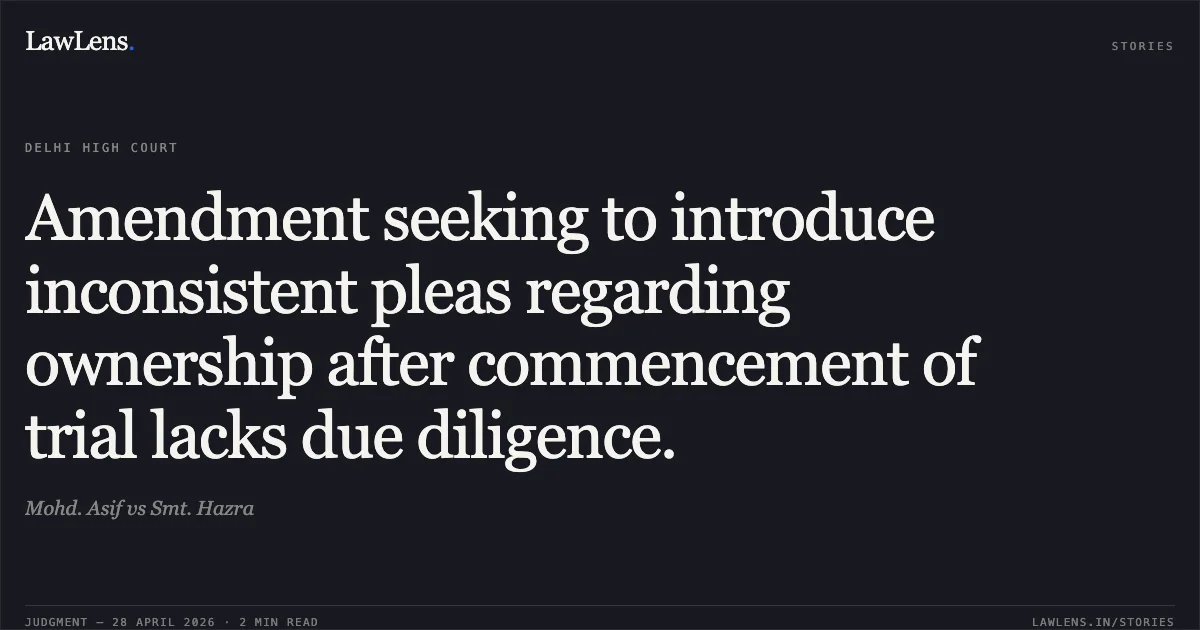
The High Court upheld the Trial Court’s order, holding that the petitioner failed to meet the due diligence threshold required by the proviso to Order VI Rule 17 CPC
The court concluded there was no infirmity or illegality in the impugned order as the amendment sought was belated, inconsistent, and prejudicial. The petition was dismissed
Source reference: para. 10Acts & Sections Cited
1 provisions across 1 statute referred to in this judgment. Each provision opens on LawLens.
Code of Civil Procedure, 19081
Original Court PDF
Mohd. AsifvsSmt. Hazra
Click to open original judgment
Original judgment, available to read, download and summarize on LawLens.in