01Facts
The Respondent No. 1 (R1) advanced a loan of ₹15 lakhs to the Appellants, of which ₹2 lakhs was repaid, leaving a balance of ₹13 lakhs plus interest
¶ 18-19R1 filed a winding-up petition (CP No. 306 of 2012), which was admitted on January 22, 2013
¶ 4, 18During an appeal against the admission, the Appellants deposited ₹13 lakhs as security
¶ 4, 20On September 13, 2013, the Hon’ble Supreme Court (SC) disposed of a Special Leave Petition based on a compromise where R1 was permitted to withdraw ₹10 lakhs from the deposit, and the remaining ₹3 lakhs was to be returned to the Appellants
¶ 7, 21The SC ordered the winding-up proceedings to be dropped but directed the expedited hearing of a pending civil suit (CS No. 332 of 2012) filed by the Appellants
¶ 21Following this order, R1 amended its written statement in the civil suit to include a counterclaim for the remaining interest and principal
¶ 8, 23The Trial Judge allowed a portion of this counterclaim, which the Appellants challenged in this appeal
¶ 2, 1002Issues
i.1. Whether the compromise recorded by the Supreme Court on September 13, 2013, constituted a final settlement of all financial disputes between the parties, thereby barring R1’s subsequent counterclaim
¶ 9, 26, 29ii.2. Whether the phrase "settlement for the time being" in the Supreme Court order allowed the parties to reopen financial claims in the pending civil suit
¶ 11, 27-28iii.3. Whether Defendant No. 3 was entitled to an increase in litigation costs
¶ 16, 3203Law Applied
The Court applied the principles of Order 23 Rule 1(4) of the Code of Civil Procedure, 1908, regarding the abandonment of claims
¶ 9It relied on the interpretation of the phrase "for the time being" as established in Jivendra Nath Kaul v. Collector/District Magistrate (1992) 3 SCC 576, which defines it as the state of affairs existing at a particular moment
¶ 15, 27Regarding the appropriation of payments, the Court noted Order 21 Rule 1(4) CPC and the precedents in Industrial Credit & Development Syndicate v. Smithaben H. Patel (1999) 3 SCC 80 and V. Kala Bharathi v. Oriental Insurance Company Limited (2014) 5 SCC 577, which generally direct the adjustment of payments first toward interest and then toward the principal
¶ 14, 30Provisions in the judgment · 5 · Linked ones open on LawLens
Code of Civil Procedure, 1908 Section 21Section 23
Indian Contract Act, 1872 Section 59Section 60Section 61
04Reasoning
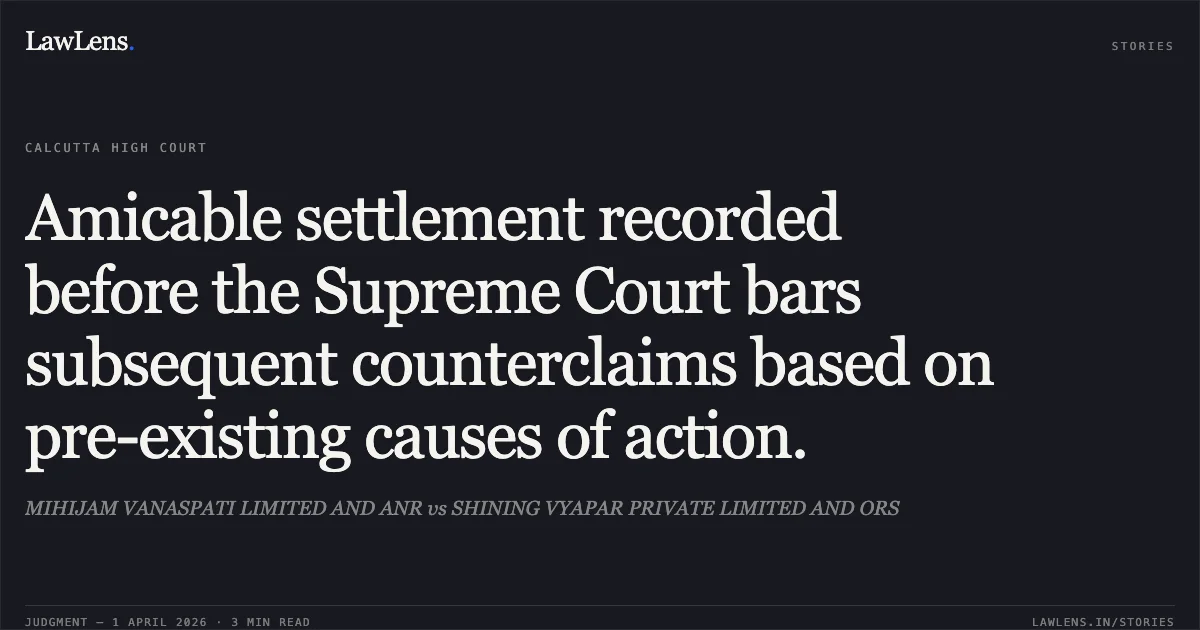
The Court held that the parties were fully aware of their respective liabilities when they entered into the compromise before the Supreme Court in 2013
¶ 25By agreeing to accept ₹10 lakhs out of the ₹13 lakhs deposit and permitting the return of ₹3 lakhs to the Appellants, the parties effectively settled their disputes as they stood on that date
¶ 25-26, 29The Court rejected R1's contention that the phrase "for the time being" kept the counterclaim open; drawing from Jivendra Nath Kaul, the Court interpreted the phrase to mean the settlement was absolute for the circumstances existing at the time the order was passed
¶ 28Since no new cause of action or event occurred after September 13, 2013, R1 could not introduce a counterclaim for claims that existed prior to the settlement
¶ 28-29Consequently, the Trial Judge erred in reopening the financial disputes and allowing the counterclaim
¶ 29The Court further noted that since the underlying dispute was settled by the SC order, the general principles of interest adjustment under Smithaben H. Patel were inapplicable
¶ 3105Holding
The High Court allowed the appeal in part and set aside the portion of the Trial Judge’s decree that quantified the principal and interest payable to Respondent No. 1
¶ 32The Court dismissed the cross-objection filed by Respondent No. 1
¶ 33The Court upheld the Trial Judge’s direction regarding litigation costs for Defendant No. 3, as it was not specifically challenged
¶ 32The Registrar, Original Side, was directed to refund the remaining sums deposited in the winding-up and appeal proceedings to the Appellants, subject to a deduction of ₹50,000 to be paid to Respondent No. 3 in satisfaction of the decretal litigation costs
¶ 35-37Original Court PDF
MIHIJAM VANASPATI LIMITED AND ANRvsSHINING VYAPAR PRIVATE LIMITED AND ORS
Click to open original judgment
Original judgment, available to read, download and summarize on LawLens.in