Facts
The prosecution alleged that, owing to the deceased Vallabhbhai Bijalbhai’s prior abduction of Anuben, the minor daughter of Hakka Pola Bharwad, the accused abducted and assaulted him on 2 September 1996.
Source reference: p.2, para.2According to the prosecution, accused No. 5 stopped the deceased’s Matador, accused No. 1 tied and assaulted him with a stick, and accused Nos. 2 and 3 subsequently inflicted further stick blows while accused No. 4 allegedly drove a motorcycle.
Source reference: p.2, para.2The deceased sustained injuries and later died during treatment.
Source reference: p.9, para.11The accused were charged under Sections 302, 364, 120B, 342 and 114 of the Indian Penal Code and Section 135 of the Bombay Police Act.
Source reference: pp.3–6, paras.3–7After recording oral and documentary evidence and the accused’s statements under Section 313 of the Code of Criminal Procedure, the Sessions Court, Rajkot, acquitted all accused by judgment dated 21 September 1998.
Source reference: pp.3–6, paras.3–7The State preferred the present appeal under Section 378(1) and (3) CrPC against the acquittal.
Source reference: p.1, para.1Issues
Whether the trial Court was justified in acquitting the accused of the offences charged?
Source reference: p.8, para.10(1)Whether the trial Court properly appreciated the oral and documentary evidence led by the prosecution?
Source reference: p.8, para.10(2)Whether the impugned judgment of acquittal suffered from any illegality, irregularity or perversity warranting appellate interference?
Source reference: p.8, para.10(3)Law Applied
The Court considered the prosecution charges under Sections 302, 364, 120B, 342 and 114 IPC and Section 135 of the Bombay Police Act, and the State’s appellate remedy under Section 378 CrPC.
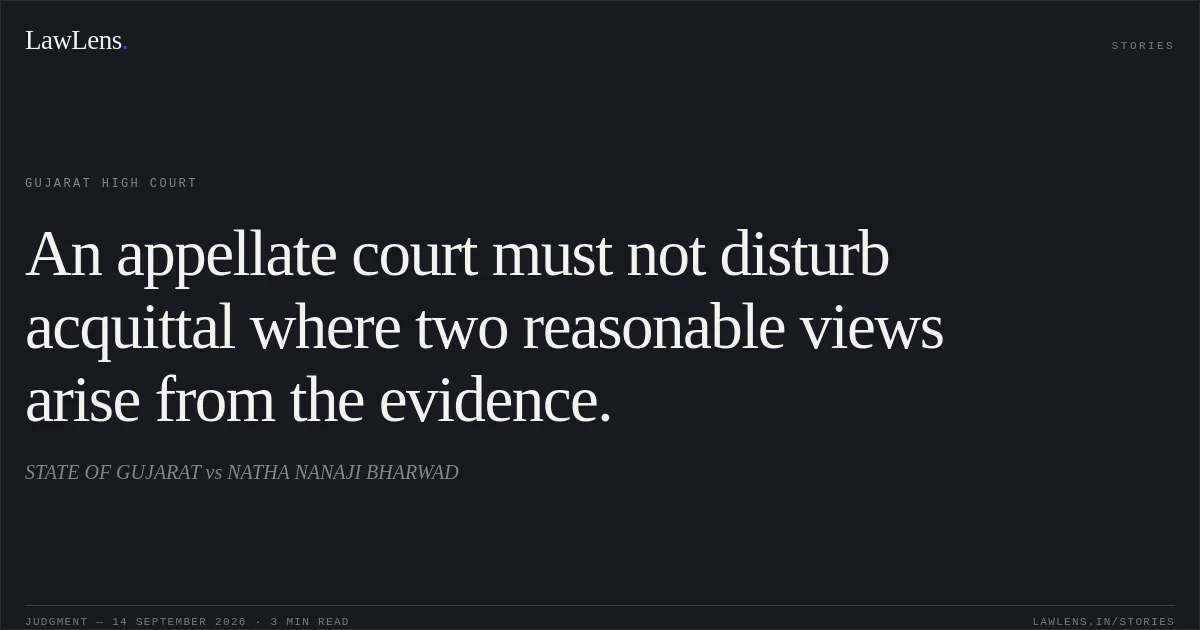
Source reference: p.1, para.1It applied the principle that an appellate court may review, reappreciate and reconsider evidence in an appeal against acquittal, but must recognise the strengthened or “double” presumption of innocence in favour of the accused.
Source reference: pp.15–16, paras.22–24Where two reasonable conclusions are possible, the acquittal should not ordinarily be disturbed unless the trial Court’s view is manifestly illegal, perverse or impossible.
Source reference: pp.15–16, paras.22–24These principles were drawn principally from Chandrappa v. State of Karnataka, (2007) 4 SCC 415; Rajesh Prasad v. State of Bihar, (2022) 3 SCC 471; Babu Sahebagouda Rudragoudar v. State of Karnataka, (2024) 8 SCC 149; and Ramesh v. State of Karnataka, (2024) 9 SCC 169.
Source reference: pp.16–18, paras.24–25The Court also applied the rule that the quality and reliability of evidence, rather than the number of witnesses, determines whether a conviction can be sustained, as recognised in Masalti v. State of Uttar Pradesh and related authorities.
Source reference: p.14, para.21Reasoning
The Court held that the prosecution evidence did not establish the accused’s identity or their participation beyond reasonable doubt.
Source reference: p.10, para.13The principal eyewitness, the Matador cleaner, did not identify accused Nos. 1 and 5 in Court, and no Test Identification Parade was conducted.
Source reference: p.10, para.13The evidence of the deceased’s brother and the alleged chance witness was considered partisan, unnatural and materially inconsistent; the latter admitted that he had not seen the assailants’ faces.
Source reference: pp.10–12, paras.14–15, 21The medical evidence further weakened the prosecution case: the post-mortem doctor stated that the injuries were not on vital parts and were not likely to cause death, while the treating doctor found no external bleeding and recorded a history involving an iron pipe, contrary to the witnesses’ account of stick blows.
Source reference: pp.9, 12–14, paras.12, 18–21The possibility that complications from blood transfusion contributed to the death was also not excluded.
Source reference: p.12, para.19The alleged dying declaration was not produced because the police officer claimed to have destroyed it, constituting a serious investigative lapse.
Source reference: p.11, paras.16–17The recovery of the string allegedly used to tie the deceased was likewise unsupported by evidence explaining its origin or how the deceased was untied.
Source reference: p.13, para.20In these circumstances, the trial Court’s view that the prosecution story was unreliable was a reasonable view supported by the record, not a perverse or legally impermissible conclusion.
Source reference: pp.14–16, paras.21–24Holding
The High Court answered the issues against the State, holding that the prosecution had failed to prove the charges beyond reasonable doubt and that the trial Court had committed no error of fact or law in acquitting the accused.
Applying the heightened restraint applicable to an appeal against acquittal, the Court dismissed the State’s appeal and confirmed the judgment and order of acquittal dated 21 September 1998.
Source reference: p.19, para.28The bail bonds were cancelled, and the record and proceedings were directed to be sent back to the trial Court.
Source reference: p.19, para.28Acts & Sections Cited
6 provisions across 2 statutes referred to in this judgment. Each provision opens on LawLens.
Code of Criminal Procedure, 19732
Indian Penal Code, 18604
Original Court PDF
STATE OF GUJARATvsNATHA NANAJI BHARWAD
Click to open original judgment
Original judgment, available to read, download and summarize on LawLens.in