Facts
On 4 December 2005, a Maruti car allegedly driven rashly collided with a stationary tractor while the deceased, Punjabhai, and another person were repairing it roadside. Punjabhai, a 28-year-old bachelor, died from his injuries. His mother sought compensation under Section 166 of the Motor Vehicles Act, 1988, claiming that he earned Rs. 3,000 per month and supported her
Source reference: pp. 1–2, paras 2–2.1The Tribunal awarded Rs. 6,01,000 with interest at 9% per annum, directing opponents Nos. 1–3 to pay 90% and opponents Nos. 4–5 to pay 10%.
Source reference: p. 1, paras 1–1.1The insurer appealed, challenging the deductions and future-prospects assessment; the claimant’s counsel argued that the conventional-head awards were inadequate.
Source reference: pp. 3–4, paras 4–5Issues
Whether the Tribunal erred in deducting only one-third of the deceased’s income towards personal and living expenses
Source reference: p. 3, para 4Whether the Tribunal erred in adding 50% of the deceased’s income towards future prospects
Source reference: p. 3, para 4Whether any excess under those heads warranted appellate interference when compensation under conventional heads was allegedly inadequate
Source reference: pp. 5–6, paras 7–8Law Applied
Sections 166 and 168 of the Motor Vehicles Act, 1988 require the determination of just compensation in fatal-accident claims.
Source reference: pp. 2, 5, paras 2.1, 7National Insurance Co. Ltd. v. Pranay Sethi, (2017) 16 SCC 680, laid down standardised principles for assessing compensation, including future prospects and conventional heads.
Source reference: p. 5, para 7The Court also relied on N.K.V. Bros. (P) Ltd. v. M. Karumai Ammal, 1980 (3) SCC 457, and the cited Supreme Court decisions in Rashmirekha Tripathy v. Shriram General Insurance Co. Ltd., 2026 LiveLaw (SC) 654, V. Pathmavathi v. Bharthi Axa General Insurance Co. Ltd., and Anant v. Pratap, for the principle that compensation is an estimate intended to be fair and reasonable, acknowledging that money cannot truly replace the loss caused by a fatal accident.
Source reference: pp. 4–5, para 6The assessment is not an exact science, but must be guided by fairness and the facts of the case.
Source reference: p. 5, para 6Reasoning
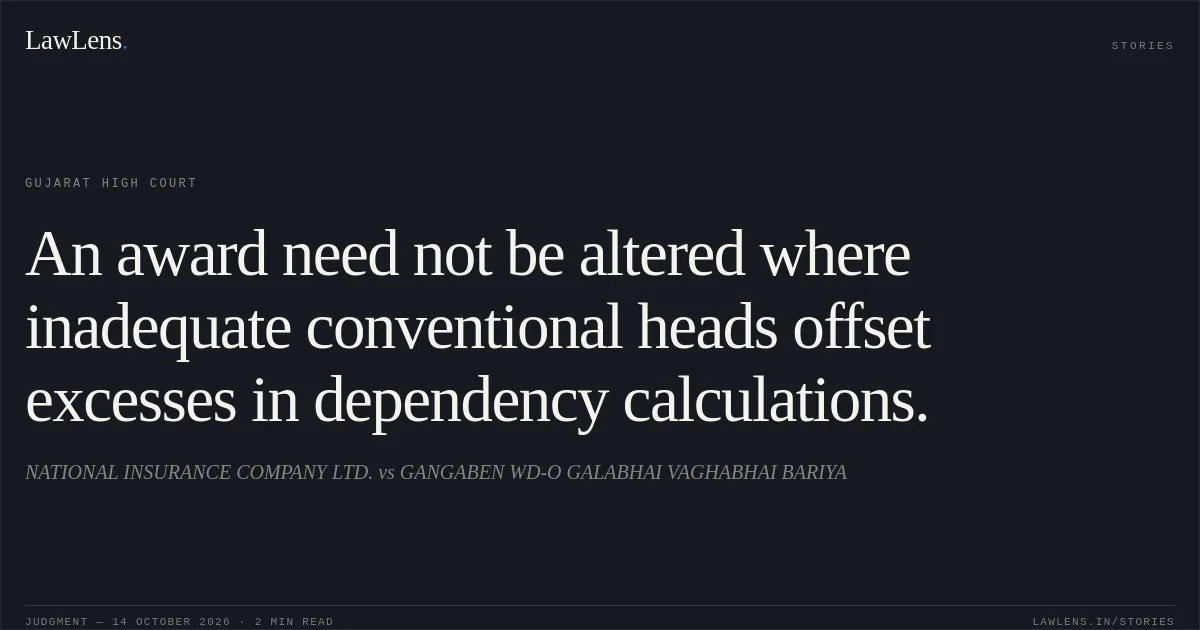
The Court accepted that the Tribunal may have erred both in limiting the personal-expense deduction to one-third and in adding 50% for future prospects.
Source reference: p. 5, para 7However, it found that the Tribunal had awarded only nominal sums for loss of estate and funeral expenses and nothing for the mother’s loss of consortium. Considering the award as a whole, the Court held that these deficiencies substantially offset any excess under the challenged heads; the total award was therefore not so excessive as to justify interference.
Source reference: pp. 5–6, paras 7–8Holding
The Court answered the challenges against the insurer’s appeal but held that the overall award did not warrant appellate modification.
It dismissed the appeal and upheld the Tribunal’s award of Rs. 6,01,000 with interest and the apportioned liability; any interim relief was vacated.
Source reference: p. 7, para 9Acts & Sections Cited
2 provisions across 1 statute referred to in this judgment. Each provision opens on LawLens.
Motor Vehicles Act, 19882
Original Court PDF
NATIONAL INSURANCE COMPANY LTD.vsGANGABEN WD-O GALABHAI VAGHABHAI BARIYA
Click to open original judgment
Original judgment, available to read, download and summarize on LawLens.in