01Facts
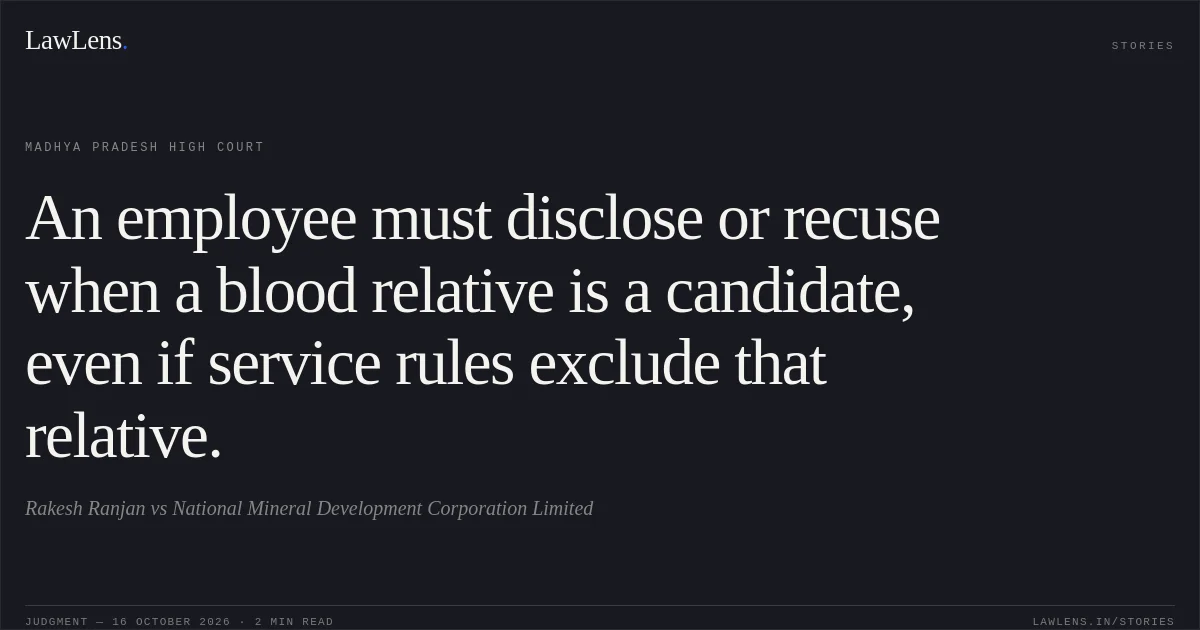
NMDC conducted a special recruitment drive for posts at its Panna project. The appellant, who was posted there as HOD, was not a member of the committees that scrutinised applications, conducted the written test, or evaluated answer sheets. He was, however, nominated to the Skill Test Committee. One candidate, Kismat Singh, was the appellant’s sister’s son.
¶ 2–5Following a departmental inquiry, the Inquiry Officer found that the appellant was not guilty of the charges under Rule 6 of the NMDC CDA Rules, including failure to disclose the relationship. The Disciplinary Authority nevertheless imposed a major penalty of reduction to a lower stage in the time scale of pay for five years, with future increments postponed; the statutory appeal was rejected.
¶ 2–5The writ court dismissed the appellant’s challenge to the punishment. The appellant appealed, arguing, among other things, that the Inquiry Officer’s findings had been accepted without a disagreement note and that the penalty was disproportionate.
¶ 6–902Issues
i.1. Whether the appellant’s participation in the Skill Test Committee, despite Kismat Singh being his sister’s son, justified interference with the writ court’s decision upholding the punishment.
¶ 11–12ii.2. Whether the punishment could stand where the Inquiry Officer had found the appellant not guilty of the charges under Rule 6 and the appellant argued that no disagreement note had been issued.
¶ 7, 11–1203Law Applied
Under Union of India v. P. Gunasekaran, State of Andhra Pradesh v. S. Sree Rama Rao and B.C. Chaturvedi v. Union of India, judicial review of disciplinary proceedings concerns the decision-making process; a court does not reappreciate evidence or substitute its own view unless recognised grounds for interference, such as perversity or mala fides, are established.
¶ 13–14Syed Yakoob v. K.S. Radhakrishnan and Garment Craft v. Prakash Chand Goel state that supervisory or certiorari jurisdiction is limited and is not a means to correct every factual or legal error.
¶ 15–16In a writ appeal, interference with the writ court’s decision is also limited: the appellate court should not substitute its view absent a decision that is perverse or demonstrably wrong, or an arbitrary, capricious or perverse exercise of discretion.
¶ 17Provisions in the judgment · 1
Companies Act, 1956 Section 6
04Reasoning
The Court accepted that the appellant disputed neither that Kismat Singh was his sister’s son nor that he participated in the Skill Test Committee and awarded him marks. It held that, regardless of whether the nephew fell within the formal definition of “relative” under Rule 6, the appellant should have disclosed the relationship to the Project Manager/Appointing Authority or withdrawn from the committee. By failing to do so and participating in the assessment of his nephew, the appellant’s conduct warranted no judicial interference.
¶ 12Applying the restricted standards of judicial and appellate review, the Court found no basis to disturb the writ court’s decision.
¶ 13–1705Holding
The High Court found no error in the writ court’s order and dismissed the writ appeal.
¶ 18The punishment order and the dismissal of the appellant’s writ petition therefore remained undisturbed.
¶ 18Original Court PDF
Rakesh RanjanvsNational Mineral Development Corporation Limited
Click to open original judgment
Original judgment, available to read, download and summarize on LawLens.in