01Facts
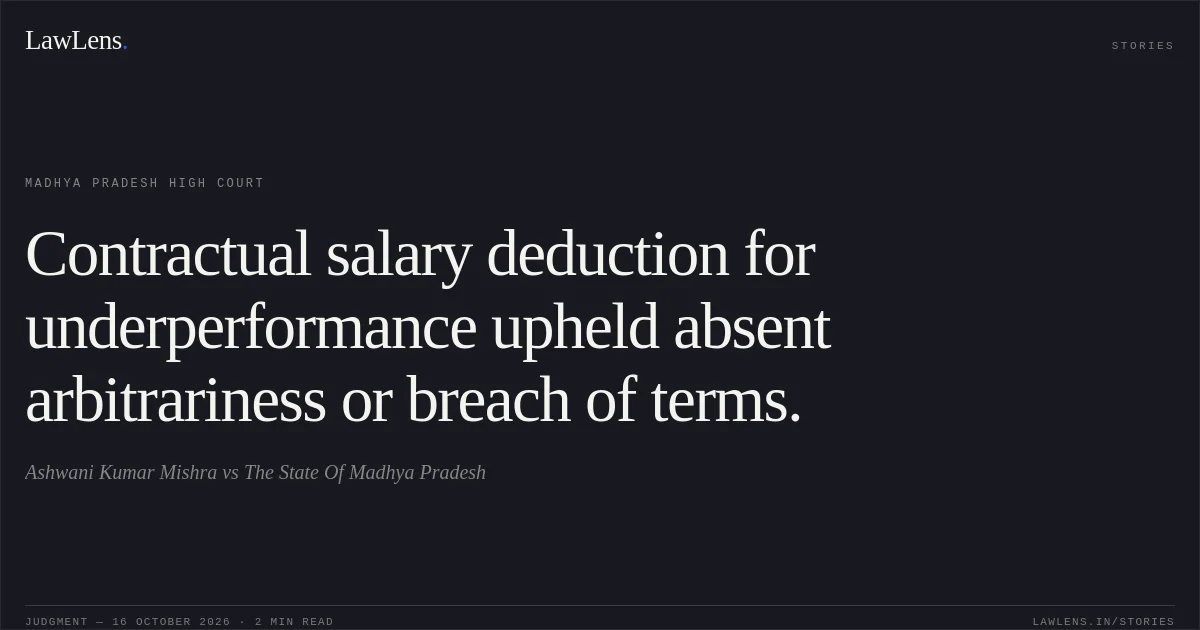
The appellant, a contractual Office Assistant, challenged a 5% salary deduction imposed after his performance for 1 April 2019 to 31 March 2020 was assessed as unsatisfactory.
¶ 1–7He contended that the deduction was imposed without a hearing or a further performance review after his three-month provisional extension, and without a specific order authorising it.
¶ 1–7The respondents maintained that the deduction was a one-time administrative measure for underperformance and that the appellant later received salary appraisals.
¶ 1–7After his representation was rejected, the Single Judge dismissed his writ petition; the appellant appealed.
¶ 1–702Issues
i.Whether the 5% salary deduction was authorised by the appellant’s employment terms and the Board resolution, and was imposed consistently with those terms.
¶ 2–4, 8–9ii.Whether the deduction was arbitrary or otherwise unlawful because it was imposed without a hearing, a further performance review, or a specific order by the ED/CEO.
¶ 2–3, 8–1003Law Applied
The Board resolution authorised a 5% salary reduction for underperforming employees or employees granted provisional extensions, or other appropriate action by the ED/CEO.
¶ 9Clause 3 of the agreement provided for salary as compensation for services rendered and an annual salary review by the employer.
¶ 9Read together, these provisions permitted management to assess performance and take appropriate action under the applicable contractual terms.
¶ 904Reasoning
The Court found that the appellant’s appraisal for the relevant period was unsatisfactory and that he had received a three-month provisional extension to improve, with a further decision to follow a review.
¶ 8–10It considered the Board resolution and the agreement sufficient to permit management action based on performance.
¶ 8–10The appellant’s later salary appraisals did not, by themselves, establish that the earlier deduction was illegal.
¶ 8–10As the record disclosed no material showing arbitrariness, discrimination, or breach of contract, the Court found no basis to interfere with the Single Judge’s decision.
¶ 8–1005Holding
The Court answered the challenges against the appellant: it found no established arbitrariness, discrimination, or breach of contractual terms warranting interference.
¶ 10The writ appeal was dismissed, leaving the Single Judge’s order undisturbed.
¶ 10Original Court PDF
Ashwani Kumar MishravsThe State Of Madhya Pradesh
Click to open original judgment
Original judgment, available to read, download and summarize on LawLens.in