Facts
The appellant and Sunny Murmu had been living together as husband and wife for approximately two years following a love relationship.
Source reference: pp. 1–3, paras. 2–4The prosecution alleged that the appellant regularly assaulted Sunny and, on the relevant date, assaulted her at about 8:30 p.m. and drove her to her parental home.
Source reference: pp. 1–3, paras. 2–4Her mother, P.W.2, alleged that Sunny stated that the appellant had assaulted her with a jhanjhara or large kitchen skimmer.
Source reference: pp. 1–3, paras. 2–4Sunny was thereafter taken for medical treatment and died shortly thereafter from a head injury.
Source reference: pp. 1–3, paras. 2–4The appellant was charged under Section 302 of the Indian Penal Code.
Source reference: pp. 1–3, paras. 2–4The Sessions Court convicted him under Section 304 Part II IPC and sentenced him to five years’ rigorous imprisonment and a fine of ₹5,000, with six months’ simple imprisonment in default.
Source reference: pp. 1–3, paras. 2–4The prosecution examined six witnesses, including the deceased’s parents and relatives, the investigating officer, and the post-mortem doctor.
Source reference: pp. 3–6, paras. 5–10In appeal, the appellant challenged the reliability of the alleged oral dying declaration, the delay in lodging the FIR, the medical evidence, the non-recovery of the alleged weapon, and the alleged hospital treatment.
Source reference: pp. 7–10, paras. 13–14Issues
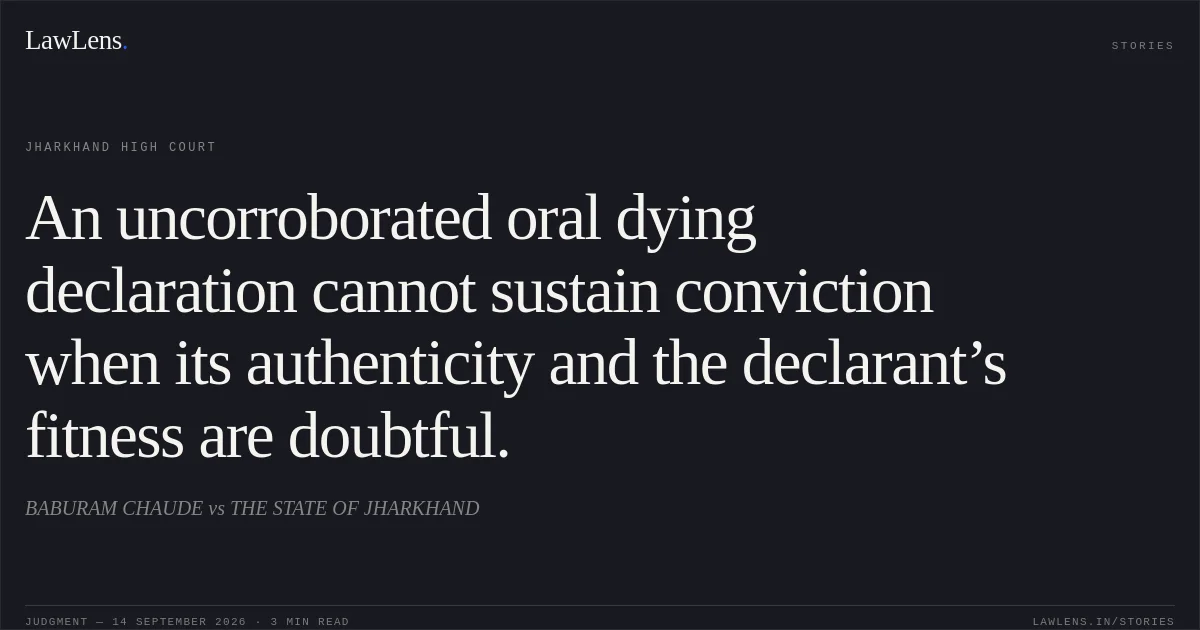
Whether the alleged oral dying declaration made by the deceased to her relatives was sufficiently reliable and made while she was in a fit state of mind to sustain the conviction.
Source reference: pp. 10–11, para. 16Whether the prosecution proved beyond reasonable doubt that the appellant caused the deceased’s fatal head injury, notwithstanding the non-recovery of the alleged weapon and the medical evidence that the injury could have resulted from a fall.
Source reference: pp. 11–12, para. 17Whether the discrepancies concerning the deceased’s condition, hospital admission, delay in lodging the FIR, and the number and nature of injuries entitled the appellant to the benefit of doubt.
Source reference: pp. 12–13, paras. 18–20Law Applied
The Court considered the offence of culpable homicide not amounting to murder under Section 304 Part II of the Indian Penal Code, although the appellant had originally been charged under Section 302 IPC.
Source reference: pp. 2–3, paras. 2–4It applied the settled principle that a dying declaration may, if found wholly reliable and inspiring confidence, form the sole basis of conviction, relying on Atbir v. Government (NCT of Delhi) , (2010) 9 SCC 1.
Source reference: p. 10, para. 15The principle recognised in Rajendra v. State of Maharashtra , 2024 0 Supreme (SC) 473.
Source reference: p. 7, para. 12However, the declaration must be proved to have been made voluntarily, consistently, and while the maker was in a fit mental and physical condition.
Source reference: pp. 10–13, paras. 16–20Where material inconsistencies and circumstances create reasonable doubt, the accused is entitled to acquittal on the benefit-of-doubt principle.
Source reference: pp. 10–13, paras. 16–20Reasoning
The Court held that the alleged oral dying declaration was not reliable enough to support conviction.
Source reference: pp. 10–11, para. 16The prosecution witnesses gave inconsistent accounts regarding Sunny’s condition: several witnesses stated that she was unconscious or did not speak after reaching her parental home, while the alleged declaration was attributed to her by some of the same witnesses.
Source reference: pp. 10–11, para. 16The exact words of the declaration were not proved, P.W.1 did not speak about any dying declaration, and the hospital doctor had refused treatment because of Sunny’s precarious condition, raising doubt about her capacity to make a coherent statement.
Source reference: pp. 10–11, para. 16The alleged jhanjhara was never recovered, and the prosecution did not establish through the post-mortem doctor that the injury could have been caused by that object.
Source reference: p. 11, para. 17The doctor found only one injury and accepted that it could have resulted from a fall on a hard surface, contrary to the witnesses’ claims of injuries all over the body.
Source reference: p. 11, para. 17The unexplained delay in lodging the FIR, the contradiction regarding whether Sunny was admitted to the hospital, and the possible animosity arising from her relationship with the appellant further weakened the prosecution case.
Source reference: pp. 12–13, paras. 18–19These circumstances collectively created reasonable doubt as to the appellant’s guilt.
Source reference: pp. 12–13, paras. 18–19Holding
The Court answered the issues in favour of the appellant, holding that the alleged oral dying declaration did not inspire confidence and that the prosecution had failed to prove the appellant’s guilt beyond reasonable doubt.
The judgment of conviction dated 27 February 2025 and order of sentence dated 28 February 2025 were set aside.
Source reference: pp. 13–14, paras. 20–25The appellant was acquitted by giving him the benefit of doubt and was directed to be released from custody unless required in any other case.
Source reference: pp. 13–14, paras. 20–25The criminal appeal was accordingly allowed.
Source reference: pp. 13–14, paras. 20–25Acts & Sections Cited
4 provisions across 2 statutes referred to in this judgment. Each provision opens on LawLens.
Indian Penal Code, 18603
Code of Criminal Procedure, 19731
Original Court PDF
BABURAM CHAUDEvsTHE STATE OF JHARKHAND
Click to open original judgment
Original judgment, available to read, download and summarize on LawLens.in