01Facts
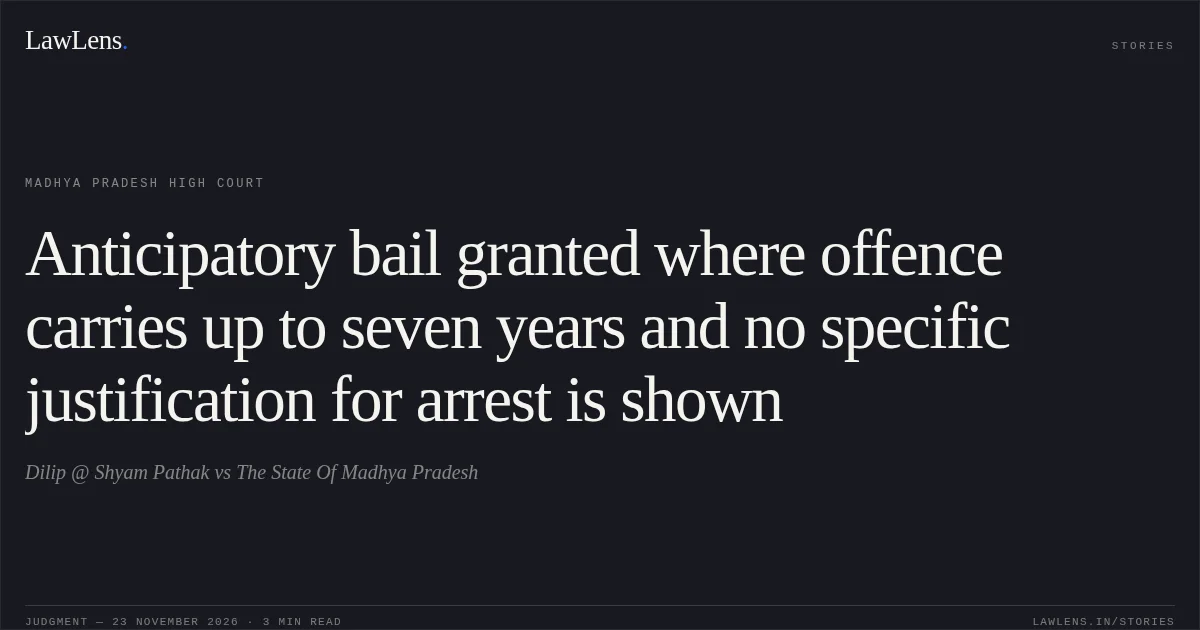
The applicant sought anticipatory bail under Section 482 of the Bharatiya Nagarik Suraksha Sanhita, 2023 (BNSS) in Crime No. 305/2026, P.S. Patera, District Damoh, for offences under Sections 74, 75(2), 78(2), 296, 351(3) and 333 of the Bharatiya Nyaya Sanhita, 2023 (BNS).
p. 1, para 1The complainant alleged that the applicant, who is married, had harassed her for six months and expressed a desire to marry her.
p. 1, para 2On 25.10.2026 the applicant allegedly abused her, caught hold of her, pressed her chest, punched her on the back and pulled her hair; when her sister intervened, he allegedly struck her with a stone and threatened to return with a sword.
p. 1, para 2The applicant contends the FIR is a counterblast to his CM Helpline complaint of 10.07.2026 concerning irregularities in the Mid-Day Meal Scheme run by the complainant and her mother at Government Primary School, Devdongra. An enquiry followed, and action was directed against the complainant's side by communication dated 14.08.2026.
p. 2, para 3The applicant claims no criminal antecedents, is a permanent resident of Damoh, poses no flight risk, and is willing to cooperate.
p. 2, para 3The State opposed the application.
p. 2, para 402Issues
i.1. Whether the applicant has established a reasonable apprehension of arrest warranting the grant of anticipatory bail under Section 482 BNSS.
pp. 2, para 5–p.3, para 6ii.2. Whether the alleged offences, being punishable with imprisonment of up to seven years, and the absence of a disclosed need for custodial interrogation, justify the grant of anticipatory bail.
p. 3, para 9iii.3. Whether the FIR appears to have been lodged with the object of injuring or humiliating the applicant, so as to weigh in favour of bail.
p. 3, para 603Law Applied
The Court relied on Article 21 of the Constitution of India, which guarantees the presumption of innocence until proven guilty.
p. 2, para 5"Bail is the rule and jail is the exception" applies generally to regular bail, but anticipatory bail is an extraordinary discretionary relief to be exercised cautiously so as not to obstruct a fair investigation or enable tampering with evidence.
p. 2, para 5The Court identified the relevant factors as the nature and gravity of the accusation, the applicant's antecedents, the risk of flight, and whether the accusation was made to injure or humiliate the applicant.
pp. 2, para 6–p.3, para 6The principles laid down in Arnesh Kumar v. State of Bihar and Satender Kumar Antil v. Central Bureau of Investigation, which govern the necessity and justification of arrest and which the Investigating Officer must follow, were applied.
pp. 3, para 7–para 8The statutory offence ceiling of seven years' imprisonment was treated as a relevant factor.
p. 3, para 9Provisions in the judgment · 7 · Linked ones open on LawLens
Bharatiya Nagarik Suraksha Sanhita, 2023 Section 482
Bharatiya Nyaya Sanhita, 2023 Section 74Section 75Section 78Section 296Section 351Section 333
04Reasoning
The Court first set out the general framework for anticipatory bail, emphasising that the power is extraordinary and must be exercised with due caution, and then linked that framework to Arnesh Kumar and Antil to guide the Investigating Officer's approach to arrest. Applying these principles, the Court held that the applicant had a "genuine and reasonable apprehension of arrest", because the alleged offences carry a maximum of seven years' imprisonment, custodial interrogation was not required, and the Investigating Officer had not disclosed any specific justification for arrest.
p. 2, para 5 · pp. 3, para 7–para 9The Court did not expressly analyse the applicant's antecedents, the flight risk, or the alleged counterblast motive beyond recording the applicant's submissions. The ruling therefore rests primarily on the offence-threshold and absence-of-justification rationale in para 9.
p. 2, para 3 · p. 3, para 6 · p. 3, para 905Holding
The Court answered the issues in the applicant's favour. It held that the applicant had established a genuine and reasonable apprehension of arrest, that the seven-year offence threshold and lack of disclosed justification for custody warranted protection, and that anticipatory bail should be granted.
pp. 3, para 9–para 10The application was allowed. In the event of arrest, the applicant is to be released on anticipatory bail on a personal bond of Rs. 50,000 with one solvent surety of the same amount, subject to conditions: availability for interrogation, no inducement or threat to witnesses, no leaving India without the Court's permission, and compliance with Section 482(2) BNSS. The order remains operative subject to compliance with these conditions.
pp. 3, para 10–para 11 · p. 4Original Court PDF
Dilip @ Shyam PathakvsThe State Of Madhya Pradesh
Click to open original judgment
Original judgment, available to read, download and summarize on LawLens.in