01Facts
The complainant alleged that the petitioner, who ran an astrology and tantric practice, induced her to hand over gold ornaments worth about Rs.30,000 and cash of Rs.12,000 on 02.12.2015, on the promise of resolving her problems.
pp. 1–2When she returned, the office was locked, and she learned of similar complaints against him.
pp. 1–2FIR No. 64/2016 was registered at Police Station Huzrat Kotwali, Gwalior, under Section 420 IPC and Section 7 of the Drugs and Magic Remedies (Objectionable Advertisements) Act, 1954.
p. 2The Trial Court (JMFC, Gwalior, RCT No. 403/2017, judgment dated 23.09.2026) acquitted the petitioner under Sections 3 and 5 r/w Section 7 of the 1954 Act but convicted him under Section 420 IPC and sentenced him to three years' rigorous imprisonment and a fine of Rs.1,000.
pp. 2–3The petitioner appealed (Criminal Appeal No. 281/2026), challenging the conviction on the merits, including the reliability of interested witnesses and the disputed identification of seized ornaments.
pp. 3–4The Appellate Court (Additional Sessions Judge, Gwalior, order dated 30.10.2026) set aside the entire judgment and remanded the matter to the Trial Court, mainly because the sentence was faulty in identifying the complainant(s) to whom the cheating offence related.
p. 3 · p. 7No appeal or revision was filed by the State, the complainant, or the victim against the acquittal or the conviction.
p. 7The petitioner then filed this revision under Sections 438 and 442 BNSS.
p. 102Issues
i.1. Whether the Appellate Court, in an appeal preferred by the accused against conviction and sentence, could set aside the entire judgment and remit the matter to the Trial Court for fresh consideration on the ground of an alleged error in the imposition of sentence, without independently adjudicating the accused's challenge to his conviction under Section 420 IPC.
p. 8 · p. 11ii.2. Whether, in the absence of any appeal or revision by the State, complainant, or victim, the appellate forum could alter the position of the accused to his prejudice, including by enhancing the sentence or convicting him for an additional offence (such as the alleged cheating of Shobha).
p. 7 · pp. 8–1003Law Applied
Sections 438 and 442 BNSS provide the source of revisional jurisdiction.
p. 1Under Sachin v. State of Maharashtra, 2025 INSC 716, interpreting the corresponding Section 386 CrPC, an appeal by an accused is a valuable statutory and constitutional right, and the accused cannot be placed in a more disadvantageous position than before he appealed.
pp. 8–9Where the appeal is by the accused and there is no challenge by the State or the aggrieved party, the appellate court cannot enhance the sentence.
p. 9Under Nagarajan v. State of Tamil Nadu, 2025 INSC 802, in an appeal by the accused without any challenge by the State or the aggrieved party, the appellate court cannot convict for an additional offence or enhance the sentence suo motu, and the rule against reformatio in peius is an essential component of fair procedure and natural justice.
p. 10Under Nagarajan v. State of Tamil Nadu, 2025 INSC 802, the sentence must be commensurate with the charges framed and the findings recorded.
p. 10Counsel cited Ajay Kumar Ghoshal v. State of Bihar, (2017) 12 SCC 699, for the principle that retrial or remand is an exceptional remedy, but the Court did not expressly rely on it.
p. 6Provisions in the judgment · 7 · Linked ones open on LawLens
Bharatiya Nagarik Suraksha Sanhita, 2023 Section 438Section 442
Indian Penal Code, 1860 Section 420
Drugs and Magic Remedies (Objectionable Advertisement) Act, 1954 Section 3Section 5Section 7
Code of Criminal Procedure, 1973 Section 386
04Reasoning
The petitioner's appeal challenged the conviction under Section 420 IPC on evidentiary grounds, so the Appellate Court was bound to examine those grounds and assess the findings independently.
p. 8The State's objection, that the Trial Court had not specified the complainant for whom the sentence was imposed and had recorded a conviction regarding Shobha without evidence, was a legitimate concern.
pp. 7–8This objection, by itself, could not justify setting aside the whole judgment and remanding it.
p. 8The Appellate Court bypassed the merits of the conviction and disposed of the appeal on the sentencing defect.
p. 11Any correction that would worsen the accused's position, such as enhancement or conviction for the alleged Shobha offence, was impermissible without a State or complainant appeal under Sachin and Nagarajan.
pp. 9–10The remand approach did not conform to the principles of appellate jurisdiction in criminal proceedings.
p. 11The Court expressly declined to comment on the merits of the allegations or the correctness of the Trial Court's findings on the ingredients of cheating, including dishonest intention at inception, reserving those questions for the Appellate Court.
p. 1205Holding
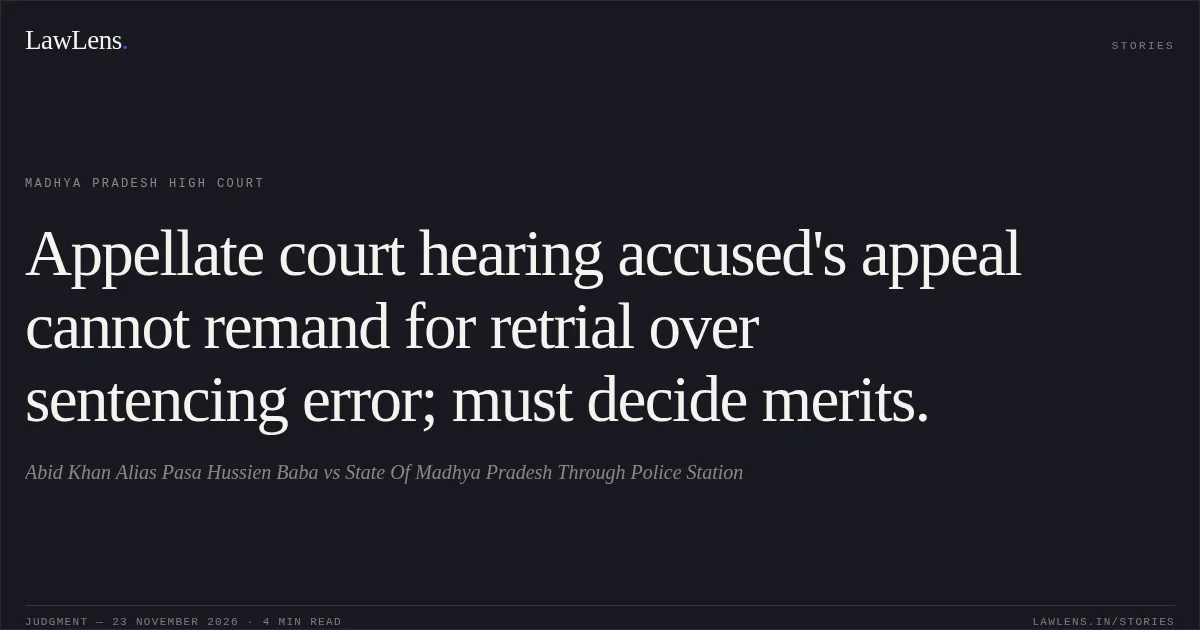
The Appellate Court could not set aside the entire judgment and remit the matter for fresh trial merely on an error in sentencing, and must instead decide the appeal on the merits of the Section 420 IPC conviction.
pp. 11–12The revision is allowed and the order dated 30.10.2026 in Criminal Appeal No. 281/2026 is set aside. The Appellate Court is directed to restore the appeal to its original number and decide it afresh on its own merits, including whether the offence under Section 420 IPC is made out after considering the grounds raised, the evidence on record, and the submissions of both parties. The Appellate Court is requested to decide the appeal preferably within three months of receiving a certified copy of the order.
pp. 12–13Original Court PDF
Abid Khan Alias Pasa Hussien BabavsState Of Madhya Pradesh Through Police Station
Click to open original judgment
Original judgment, available to read, download and summarize on LawLens.in