01Facts
On 16.09.2026, police raided Chichpuri Ka Pura, Joura, acting on information about illegal refilling and black-marketing of domestic LPG cylinders without safety equipment.
p. 1Two persons were apprehended, one fled, and the police seized loading vehicles, LPG cylinders and refilling equipment, including the petitioner's Tata Motors Ace vehicle bearing No. MP-06-ZF-0688, without valid documents.
p. 1This led to Crime No. 411/2026 under Section 287 of the BNS and Sections 3/7 of the Essential Commodities Act.
pp. 1–2The petitioner sought interim supurdginama of the vehicle under Sections 497 and 503 BNSS.
The Judicial Magistrate First Class, Joura, dismissed the application on 24.09.2026 (M.J.C.R. No. 192/2026).
¶ 2The First Additional Sessions Judge, Joura, dismissed the revision on 31.10.2026 (Criminal Revision No. 214/2026).
¶ 2The petitioner then invoked Section 528 BNSS before the High Court.
¶ 2The State opposed the release.
¶ 502Issues
i.1. Whether, during the pendency of trial and of confiscation proceedings, a seized vehicle used in an offence under the Essential Commodities Act should be released on interim supurdginama, or should remain in police or court custody.
¶ 3, 6ii.2. Whether the release of the vehicle would be justified where it is not shown that its release would prejudice the trial or the evidentiary value of the vehicle.
¶ 603Law Applied
The Court relied on Sections 497 and 503 BNSS, which govern interim custody and disposal of seized property, and Section 528 BNSS, which provides the High Court's inherent jurisdiction.
¶ 1–2The Court primarily applied the principle in Basavva Kom Dyamangouda Patil v. State of Mysore [(1977) 4 SCC 358] that seized property should not be retained in custody longer than absolutely necessary, and that it may be returned during inquiry or trial to prevent decay or for other compelling reasons of justice.
p. 2 · ¶ 3The Court further relied on Sunderbhai Ambalal Desai v. State of Gujarat [(2002) 10 SCC 283] and General Insurance Council v. State of Andhra Pradesh [(2010) 6 SCC 768], which followed Basavva.
¶ 4The Court also noted its own earlier decisions releasing vehicles on the same reasoning.
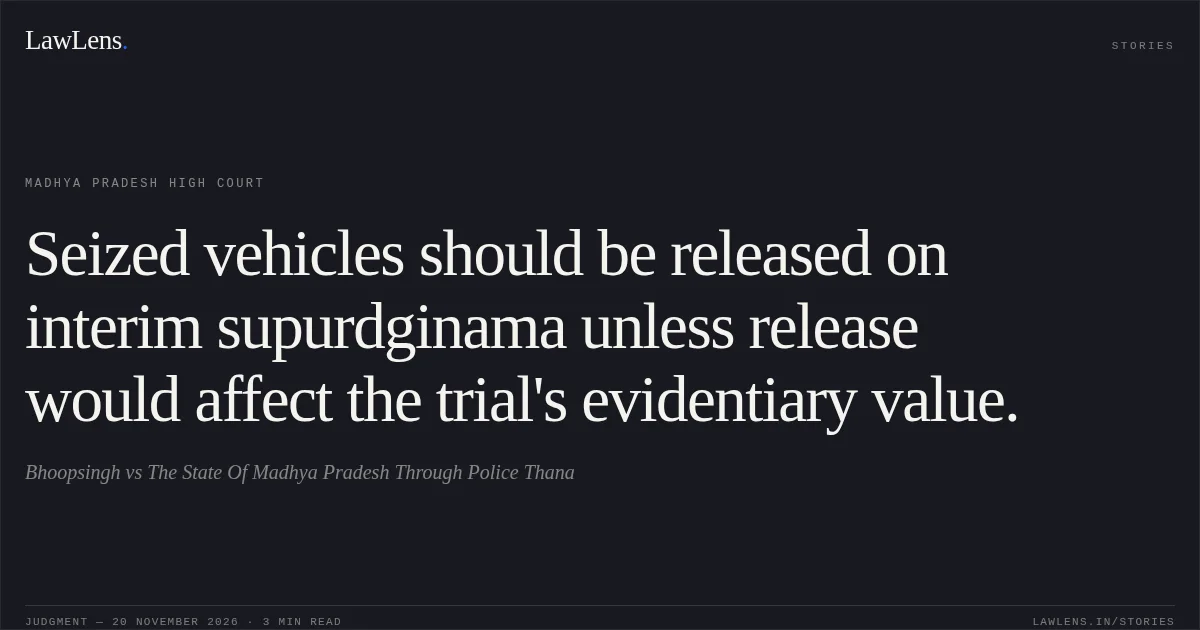
¶ 4Unless the vehicle is confiscated, the competent court must endeavour to release it on supurdgi during the pendency of seizure proceedings to prevent damage and loss of value from weather and other factors, unless release would affect the trial given its evidentiary value.
¶ 6Provisions in the judgment · 6 · Linked ones open on LawLens
Bharatiya Nagarik Suraksha Sanhita, 2023 Section 528Section 497Section 503
Bharatiya Nyaya Sanhita, 2023 Section 287
04Reasoning
The Court held that the trial and revisional courts failed to apply the Basavva principle.
¶ 6–7The petitioner's vehicle was seized as the instrument of the offence, and its retention was not shown to be necessary for the trial. The Court found no material indicating that release would prejudice the trial or diminish the evidentiary value of the vehicle, and the risk of deterioration from prolonged exposure to weather was a relevant factor under the principle.
¶ 6The Court therefore treated release as the default course, subject to safeguards.
¶ 6The judgment does not separately analyse the confiscation provisions of the Essential Commodities Act, but it addresses confiscation through a condition requiring the vehicle to be produced if the competent authority or Collector orders confiscation.
¶ 7(iv)05Holding
The Court held that the orders dated 24.09.2026 and 31.10.2026 were unsustainable and set them aside.
¶ 7The petition was allowed, and the vehicle (Tata Motors Ace, Reg. No. MP-06-ZF-0688, Chassis No. MAT559038RZD08902, Engine No. 700CCD102DVXS40158) was ordered released on interim supurdginama on the following conditions: (i) a personal bond of ₹2,00,000 with one solvent surety of ₹1,00,000, to the satisfaction of the trial court, with an undertaking to produce the vehicle when directed; (ii) photographs showing the registration and chassis numbers, taken in the presence of an officer deputed by the trial court and kept on the case file; (iii) no transfer of ownership, leasing, or alteration that would make the vehicle unidentifiable; (iv) production of the vehicle for confiscation if ordered by the competent authority or Collector.
¶ 7The M.Cr.C. was allowed and disposed of.
¶ 9Original Court PDF
BhoopsinghvsThe State Of Madhya Pradesh Through Police Thana
Click to open original judgment
Original judgment, available to read, download and summarize on LawLens.in