Facts
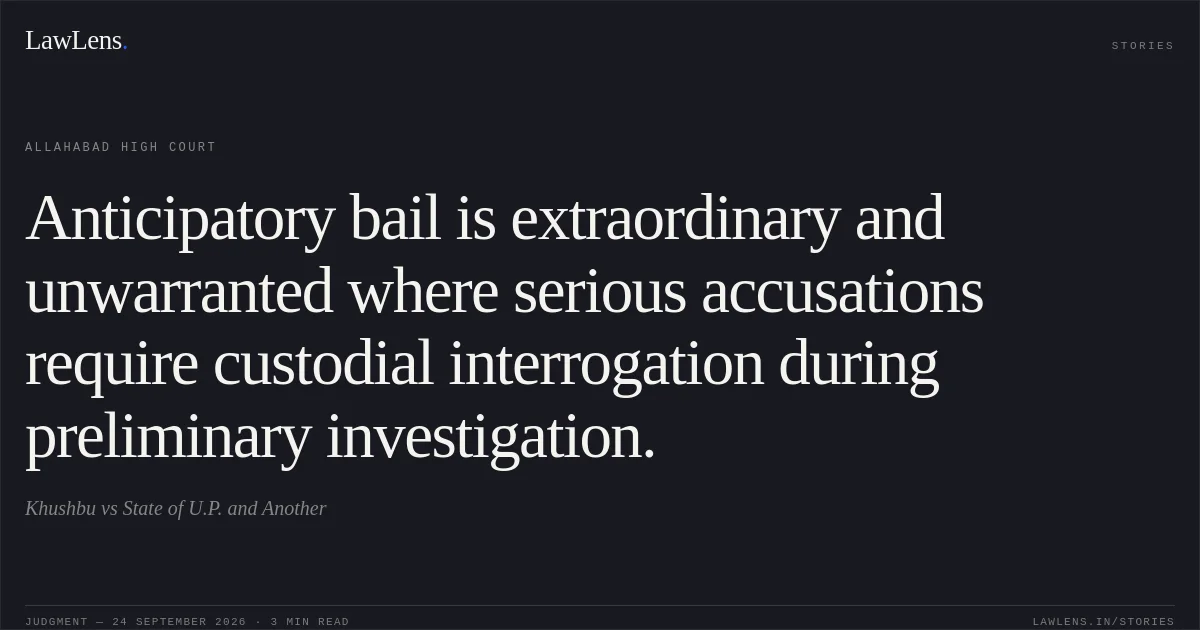
The applicant, Khushbu, sought anticipatory bail in Case Crime No. 263 of 2026, Police Station Atrauli, District Aligarh, registered under Sections 85 and 80(2) of the Bharatiya Nyaya Sanhita, 2023 and Sections 3/4 of the Dowry Prohibition Act.
Source reference: para. 2; p. 1The deceased, who was the applicant’s sister-in-law, was married to Upendra on 15 May 2025 and died in her matrimonial home under unnatural circumstances within one year of marriage.
Source reference: para. 4; p. 1; para. 6; p. 2The applicant argued that the incident occurred on 12 May 2026 but the FIR was lodged on 19 May 2026, that the allegations were general and omnibus, and that the deceased’s hospital letter stated that she had consumed poison herself.
Source reference: para. 3; p. 1The applicant’s writ petition challenging the matter had already been dismissed by a Division Bench on 19 August 2026.
Source reference: para. 6; p. 2Issues
Whether the applicant was entitled to the extraordinary relief of anticipatory bail under Section 482 of the Bharatiya Nagarik Suraksha Sanhita, 2023, in view of the allegations, the dying declaration, and the unnatural death of the deceased within one year of marriage?
Source reference: paras. 6, 10–12; pp. 2, 7–8Whether the nature and preliminary stage of the investigation justified custodial interrogation and warranted refusal of pre-arrest protection?
Source reference: para. 10; p. 7Whether the principles governing anticipatory bail, including those stated in Srikant Upadhyay v. State of Bihar, precluded or restricted grant of relief in the circumstances of the case?
Source reference: paras. 7–9; pp. 2–6Law Applied
The Court applied Section 482 of the Bharatiya Nagarik Suraksha Sanhita, 2023, governing anticipatory bail, and held that pre-arrest bail is an extraordinary remedy to be granted sparingly and only in exceptional cases.
Source reference: paras. 7–8, 11; pp. 2–3, 7Relying on Srikant Upadhyay v. State of Bihar and Another, (2024) 12 SCC 382, the Court emphasised that anticipatory bail is not a matter of right, that courts must exercise caution in serious cases, and that protection may prejudice or hamper investigation; ordinarily, a person against whom a warrant or proclamation has been issued is not entitled to invoke the extraordinary power, save in extreme and exceptional cases.
Source reference: para. 7; pp. 2–3Under P. Chidambaram v. Directorate of Enforcement, (2019) 9 SCC 24, arrest may serve investigative purposes and anticipatory bail should be granted only where exceptional circumstances exist after considering the nature and gravity of the accusation, the possibility of flight, and the effect on investigation.
Source reference: para. 8; pp. 3–4The Court also relied on Kishor Vishwasrao Patil v. Deepak Yashwant Patil, 2022 SCC OnLine SC 2528, Sushila Aggarwal v. State (NCT of Delhi), (2020) 5 SCC 1, and Gurbaksh Singh Sibbia v. State of Punjab, (1980) 2 SCC 565, for the principles that custodial interrogation may be necessary, the applicant’s role and the possibility of influencing investigation must be considered, and anticipatory bail cannot be granted routinely.
Source reference: paras. 9, 11; pp. 4–7Reasoning
The Court found that the deceased had died an unnatural death in her matrimonial home within one year of marriage, and that her dying declaration, as presented by the State, specifically implicated the applicant by stating that the applicant had administered something to her.
Source reference: paras. 4, 6; pp. 1–2These circumstances created a prima facie basis for the prosecution case and outweighed the applicant’s contentions regarding delay in lodging the FIR, the hospital letter, and the alleged absence of a specific allegation in the dying declaration.
Source reference: paras. 3–4, 6, 10; pp. 1–2, 7The investigation was still at a preliminary stage, and the Court held that custodial interrogation was necessary to ascertain the truth and to advance the investigation.
Source reference: para. 10; p. 7Applying the distinction between regular bail and anticipatory bail, the Court held that grounds which may be relevant for regular bail do not automatically justify pre-arrest protection.
Source reference: paras. 10–12; pp. 7–8Holding
The Court answered the issues against the applicant and held that she was not entitled to anticipatory bail.
The seriousness of the allegations, the dying declaration implicating her, the unnatural death within one year of marriage, the preliminary stage of investigation, and the perceived need for custodial interrogation justified refusal of pre-arrest protection.
Source reference: paras. 6, 10–12; pp. 2, 7–8Accordingly, the anticipatory bail application was dismissed; any interim order was vacated, and the Registrar (Compliance) was directed to transmit a copy of the order to the court concerned through the fastest mode.
Source reference: paras. 13–15; p. 8Acts & Sections Cited
6 provisions across 4 statutes referred to in this judgment. Each provision opens on LawLens.
Bharatiya Nagarik Suraksha Sanhita, 20231
Bharatiya Nyaya Sanhita, 20232
Code of Criminal Procedure, 19731
Original Court PDF
KhushbuvsState of U.P. and Another
Click to open original judgment
Original judgment, available to read, download and summarize on LawLens.in