01Facts
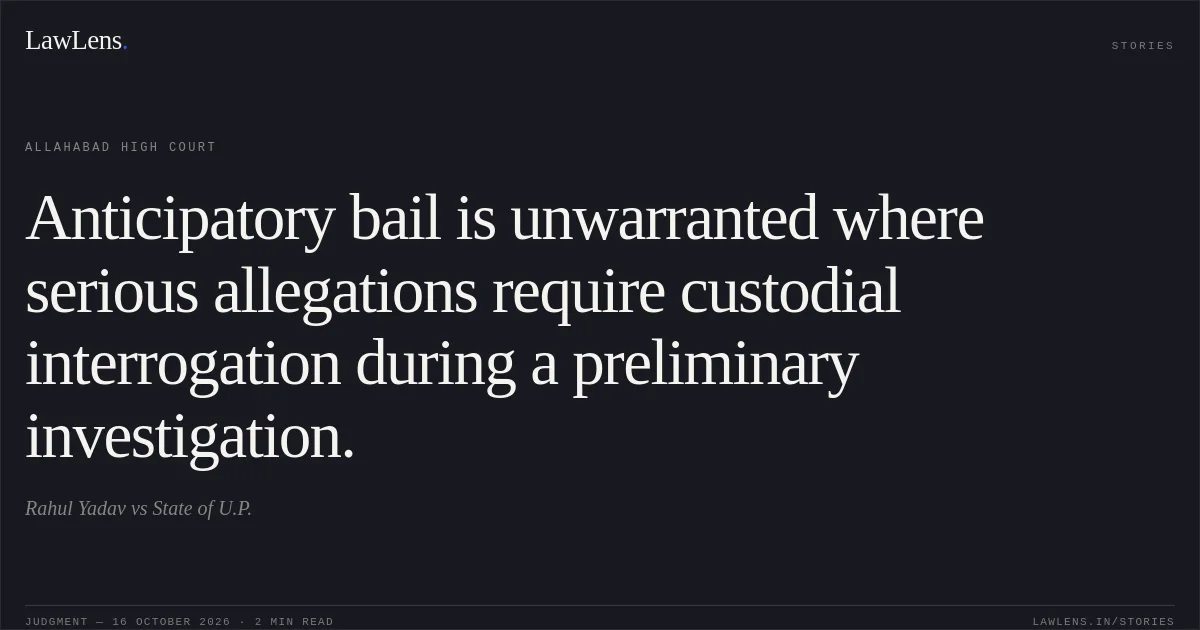
The applicant sought anticipatory bail in Case Crime No. 186 of 2025, registered at Police Station Badahalganj, District Gorakhpur, under Sections 69, 74, 115(2), 352 and 351(3) of the Bharatiya Nyaya Sanhita, 2023.
¶ 3–4He claimed innocence, alleged false implication, and asserted that the complainant was an adult who had been in a consensual relationship with him for two years; he undertook to cooperate with the investigation.
¶ 3–4The informant opposed relief, stating that the applicant had failed to comply with a Division Bench’s 17 April 2025 order requiring a deposit with the Mediation Centre, and that the related writ petition was dismissed on 22 July 2026.
¶ 5The High Court noted that investigation remained ongoing and that a prima facie offence appeared from the FIR.
¶ 702Issues
i.1. Whether the applicant was entitled to anticipatory bail under Section 482 BNSS in light of the allegations, the ongoing investigation and the asserted need for custodial interrogation.
¶ 11–13ii.2. Whether the applicant’s non-compliance with the earlier court order and the principles governing the extraordinary remedy of anticipatory bail weighed against granting relief.
¶ 5, 7–803Law Applied
Section 482 BNSS confers an extraordinary power of pre-arrest protection, to be exercised cautiously and not as a matter of routine; the court must consider, among other matters, the nature and gravity of the accusation, the applicant’s role, the possibility of flight or interference with the investigation, and whether custodial interrogation is necessary.
¶ 8–10The Court relied on Srikant Upadhyay v. State of Bihar, (2024) 12 SCC 382, for the principle that anticipatory bail is not a rule and that protection may be inappropriate where an applicant defies court orders or absconds.
¶ 8It also relied on P. Chidambaram v. Directorate of Enforcement, (2019) 9 SCC 24, and the authorities reproduced in Kishor Vishwasrao Patil v. Deepak Yashwant Patil, 2022 SCC OnLine SC 2528, concerning the investigative purposes of arrest and the need to balance personal liberty against effective investigation.
¶ 9–10The Court referred to Sushila Agrawal v. State (NCT of Delhi), (2020) 5 SCC 1, on the relevant discretionary factors, and to Gurbaksh Singh Sibbia v. State of Punjab, (1980) 2 SCC 565, on the extraordinary nature of the power.
¶ 10, 12Provisions in the judgment · 7 · Linked ones open on LawLens
Bharatiya Nagarik Suraksha Sanhita, 2023 Section 482
Bharatiya Nyaya Sanhita, 2023 Section 69Section 74Section 115Section 352Section 351
Code of Criminal Procedure, 1973 Section 438
04Reasoning
The Court found that the applicant had not complied with the earlier order requiring a deposit, while the investigation was still in progress.
¶ 7It considered the FIR allegations serious, found a prima facie basis for the accusations, and concluded that the applicant had not shown that the case was false.
¶ 11The Court further accepted that custodial interrogation was necessary to investigate the allegations and apply the principles requiring caution in granting pre-arrest protection.
¶ 11–12In those circumstances, the applicant’s claims of innocence and consensual relationship did not persuade the Court to exercise its extraordinary discretion in his favour.
¶ 4, 11–1305Holding
The Court held that the applicant was not entitled to anticipatory bail and dismissed the application.
¶ 13–14Any interim order was vacated, and the Registrar (Compliance) was directed to send a copy of the order to the court concerned by the fastest mode.
¶ 15–16Original Court PDF
Rahul YadavvsState of U.P.
Click to open original judgment
Original judgment, available to read, download and summarize on LawLens.in