Facts
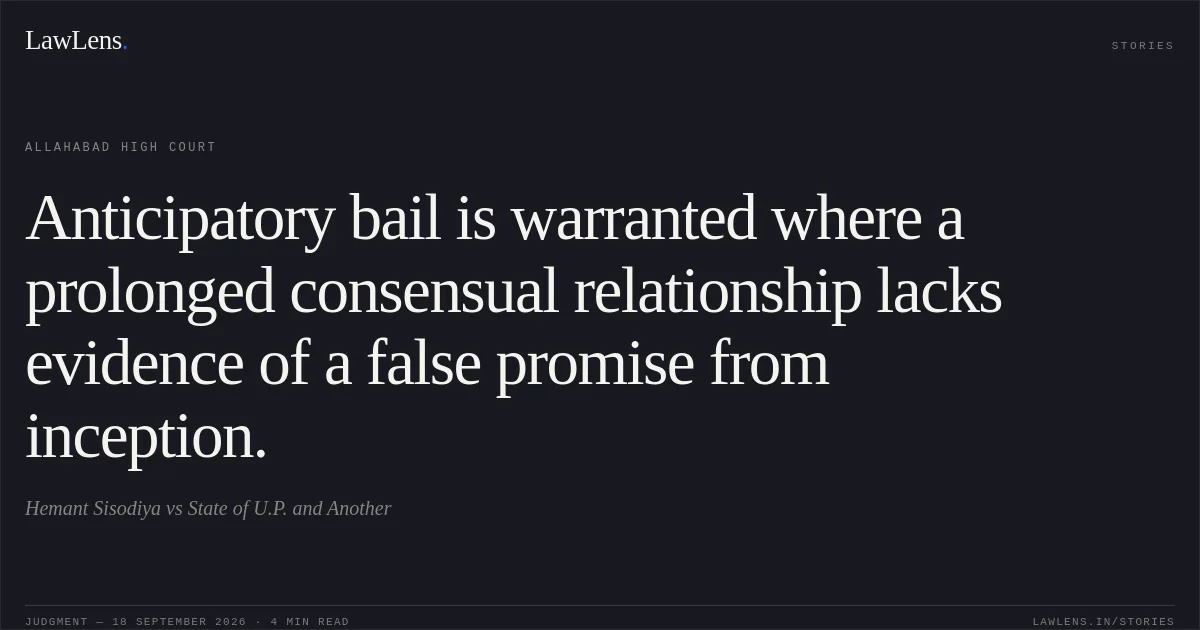
The applicant sought anticipatory bail in Case Crime No. 458 of 2026, Police Station Vrindavan, District Mathura, registered under Sections 69, 89, 115(2), 352 and 351(2) of the Bharatiya Nyaya Sanhita, 2023.
Source reference: para. 2The prosecution allegation was that the applicant had subjected the informant-victim to sexual intercourse on a false promise of marriage.
Source reference: para. 3The applicant contended that the victim, aged approximately 29 years, had voluntarily maintained a relationship with him for nearly eight years and that the FIR arose after the relationship deteriorated.
Source reference: paras. 3–4It was further submitted that the victim had married another person on 28 April 2021, obtained a divorce on 5 January 2026, and that the applicant himself had married on 5 December 2024.
Source reference: para. 4According to the applicant, after the victim allegedly demanded marriage and he refused, the FIR was lodged on 15 July 2026, despite the alleged incident having occurred on 20 June 2026.
Source reference: para. 4The applicant also relied on the absence of medical corroboration, delay in lodging the FIR, the victim’s continued contact with him, and the absence of criminal antecedents.
Source reference: paras. 3–5The informant and the State opposed the application but did not dispute the factual submissions relied upon by the applicant.
Source reference: para. 6Issues
1. Whether, considering the alleged prolonged consensual relationship between two adults, the delay in lodging the FIR, and the surrounding circumstances, the applicant was entitled to anticipatory bail in relation to the offence under Section 69 of the BNS.
Source reference: paras. 3–4, 7–182. Whether the applicant’s arrest was necessary for investigation, having regard to the principles governing personal liberty, custodial interrogation, cooperation with investigation, and the possibility of witness intimidation or absconding.
Source reference: paras. 8–9Law Applied
The Court applied the principles governing anticipatory bail laid down in Sushila Aggarwal v. State (NCT of Delhi), namely that the Court must consider the nature and gravity of the offence, the applicant’s role, the possibility of influencing witnesses or tampering with evidence, and the likelihood of absconding.
Source reference: para. 8Relying on Siddharth v. State of Uttar Pradesh, the Court held that the mere existence of a power to arrest does not justify routine arrest where custodial interrogation is unnecessary and the accused is cooperating with the investigation.
Source reference: para. 9On the substantive issue, the Court relied on Mahesh Damu Khare, Prashant v. State of NCT of Delhi, Samadhan v. State of Maharashtra, Rajnish Singh @ Soni v. State of U.P., Pramod Kumar Navratna v. State of Chhattisgarh, and Ravish Singh Rana v. State of Uttarakhand, which recognise that a prolonged relationship between consenting adults may indicate voluntary consent and that a subsequent refusal or failure to marry does not, by itself, establish rape or a false promise of marriage.
Source reference: paras. 10–15Under Pramod Suryabhan Pawar v. State of Maharashtra, a promise to marry vitiates consent only where it was false from the inception and was made with no intention of being performed; a mere subsequent breach of promise is insufficient.
Source reference: para. 16The Court also relied on Sonu @ Subhash Kumar v. State of Uttar Pradesh, concerning consensual relationships that later become acrimonious.
Source reference: para. 17Reasoning
The Court found that the applicant’s case was prima facie covered by the principles applicable to prolonged consensual relationships between adults.
Source reference: paras. 10–17The alleged relationship had continued for approximately eight years, during which the victim allegedly remained in contact with and continued to meet the applicant.
Source reference: paras. 3–4, 10–17The Court considered these circumstances, together with the delay in lodging the FIR, the victim’s intervening marriage and divorce, the applicant’s subsequent marriage, and the allegation that the FIR followed his refusal to marry her.
Source reference: paras. 3–4, 10–17Applying Pramod Suryabhan Pawar, the Court noted that the available circumstances did not, at the anticipatory-bail stage, demonstrate that the applicant had made a promise to marry without intending to fulfil it from the outset.
Source reference: para. 16The Court also treated the principles of personal liberty and the limited justification for arrest under Siddharth as relevant, particularly because the applicant undertook to cooperate with the investigation and no specific circumstance showing a likelihood of absconding, witness intimidation, or interference with evidence was established.
Source reference: paras. 5, 8–9Without expressing any final opinion on the merits, the Court concluded that the applicant had made out a case for anticipatory bail.
Source reference: para. 18Holding
The anticipatory bail application was allowed.
The Court directed that, in the event of arrest, Hemant Sisodiya be released on anticipatory bail until conclusion of the trial on furnishing a personal bond of ₹50,000 with two sureties of the like amount.
Source reference: para. 19(i)He was required to cooperate with the investigation and appear before the Investigating Officer whenever required.
Source reference: para. 19(ii)He was required to refrain from inducing, threatening or promising any person acquainted with the facts of the case.
Source reference: para. 19(iii)He was required not to leave India without prior permission of the Court.
Source reference: para. 19(iv)In case of breach or misuse of the conditions, the Public Prosecutor, Investigating Officer, or first informant-complainant was granted liberty to seek cancellation of anticipatory bail before the competent court.
Source reference: para. 20Acts & Sections Cited
7 provisions across 3 statutes referred to in this judgment. Each provision opens on LawLens.
Bharatiya Nagarik Suraksha Sanhita, 20231
Bharatiya Nyaya Sanhita, 20235
Indian Penal Code, 18601
Original Court PDF
Hemant SisodiyavsState of U.P. and Another
Click to open original judgment
Original judgment, available to read, download and summarize on LawLens.in