Facts
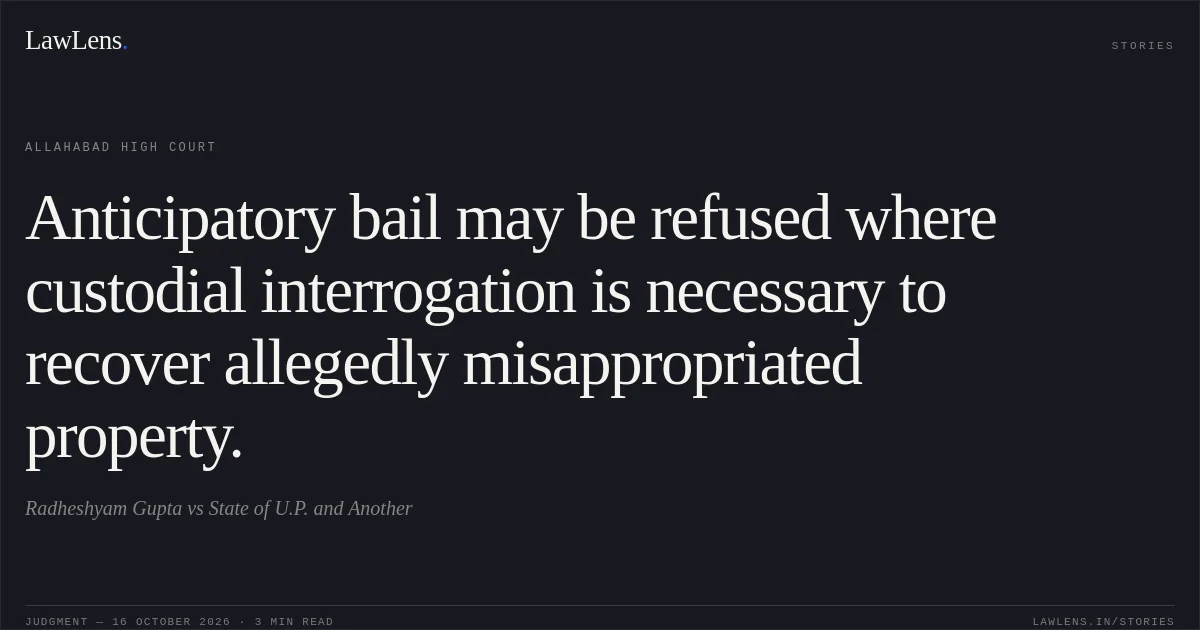
The applicant, a police constable, sought anticipatory bail in a case registered under Section 409 IPC concerning the alleged disappearance and misappropriation of 427 grams of melted gold, cash and 14 Nepali currency notes kept as case property.
Source reference: paras. 2–5The applicant asserted that the articles had not been handed over to him and relied on charge lists dated 18 October and 1 November 2022.
Source reference: paras. 2–5The State contended that the charge list dated 1 November 2022—omitted from the application—recorded the transfer of 65 articles to the applicant, including the missing property at serial no. 58.
Source reference: paras. 2–5The Court noted the seriousness of the allegations, the preliminary stage of the investigation and the asserted need for custodial interrogation to recover the property.
Source reference: paras. 7, 11Issues
1. Whether the applicant was entitled to anticipatory bail in view of the allegations of misappropriation and the material relied on by the State.
Source reference: paras. 7, 11–132. Whether custodial interrogation was necessary in the circumstances of the case.
Source reference: paras. 7, 11Law Applied
The Court considered Section 482 BNSS, under which anticipatory bail may be granted, and the allegation under Section 409 IPC.
Source reference: no citationRelying on Srikant Upadhyay v. State of Bihar (2024) 12 SCC 382, it stated that anticipatory bail is an extraordinary, discretionary remedy requiring caution, particularly where protection may prejudice investigation.
Source reference: para. 8It relied on P. Chidambaram v. Directorate of Enforcement (2019) 9 SCC 24 for the principle that pre-arrest bail should be exercised sparingly, after considering the accusation’s nature and gravity and the effect of protection on investigation.
Source reference: para. 9The Court also referred to Kishor Vishwasrao Patil v. Deepak Yashwant Patil, 2022 SCC OnLine SC 2528, on the need to balance personal liberty against the investigating agency’s need to question the accused and obtain relevant information, and on the particular seriousness of economic offences.
Source reference: para. 10It further cited Sushila Aggarwal v. State (NCT of Delhi) (2020) 5 SCC 1 for the relevant considerations, including the nature and gravity of the offence, the applicant’s role, and the risk of interference with investigation.
Source reference: para. 10It further cited Gurbaksh Singh Sibbia v. State of Punjab (1980) 2 SCC 565 regarding the exceptional character of the power.
Source reference: para. 12Reasoning
The Court found that the State’s account of the charge list dated 1 November 2022 provided prima facie support for the allegation that the missing articles had been entrusted to the applicant, while the applicant had not included that document with his application.
Source reference: paras. 5, 7It considered the alleged misappropriation serious, the investigation preliminary, and recovery of the property a reason for custodial interrogation.
Source reference: paras. 7, 11The applicant had not, in the Court’s view, demonstrated that the case was false or that the record failed to disclose a prima facie basis for the accusation.
Source reference: para. 11Applying the distinction it drew between regular and anticipatory bail, the Court concluded that the circumstances did not justify this extraordinary pre-arrest relief.
Source reference: paras. 12–13Holding
The Court held that the applicant was not entitled to anticipatory bail and dismissed the application.
It vacated the interim order dated 18 September 2026 and directed the Registrar (Compliance) to send the order to the concerned court, which was to communicate it to the investigating officer for further action in accordance with law.
Source reference: paras. 15–16Acts & Sections Cited
9 provisions across 3 statutes referred to in this judgment. Each provision opens on LawLens.
Indian Penal Code, 18607
Code of Criminal Procedure, 19731
Bharatiya Nagarik Suraksha Sanhita, 20231
Original Court PDF
Radheshyam GuptavsState of U.P. and Another
Click to open original judgment
Original judgment, available to read, download and summarize on LawLens.in