Facts
The Appellant (husband) and his parents were acquitted by the Judicial Magistrate First Class, Bhind, for offences under Sections 498-A, 323, 34 of the IPC and Sections 3 and 4 of the Dowry Prohibition Act
Source reference: p. 4-5The Complainant (wife) appealed this acquittal before the Sessions Court under Section 419 of the BNSS (Section 378 CrPC). The Sessions Court reversed the acquittal of the Appellant, convicting him under Section 498-A IPC and Section 4 of the Dowry Prohibition Act, while sustaining the acquittal of the parents
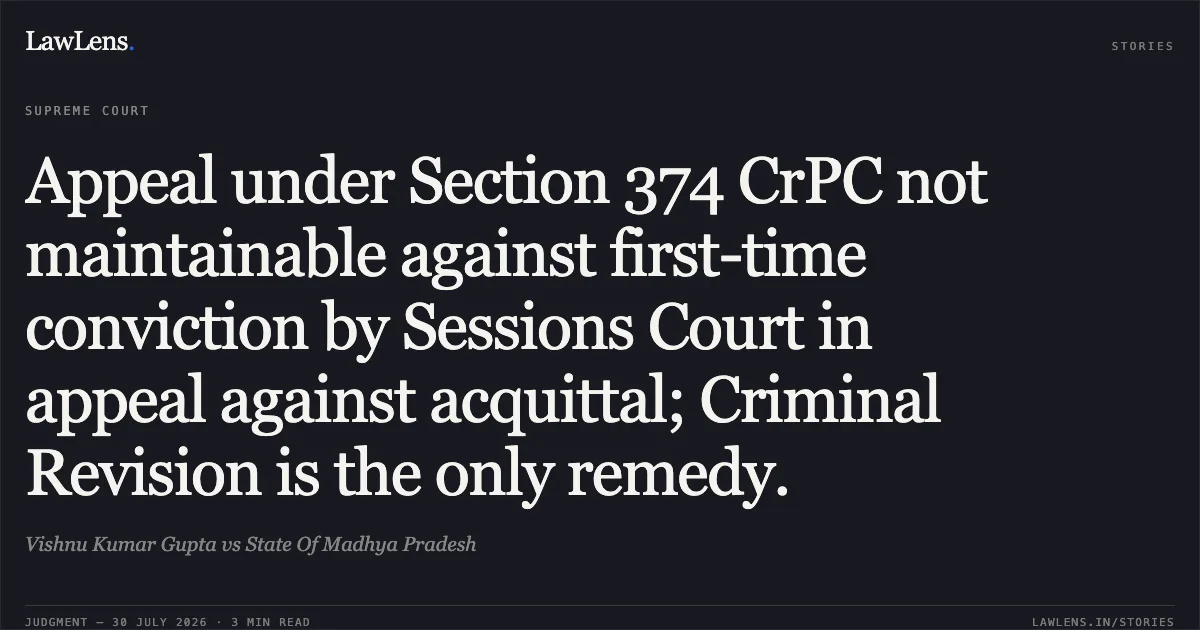
Source reference: p. 5The Appellant challenged this first-time conviction by filing a Criminal Appeal before the High Court of Madhya Pradesh under Section 415 BNSS (Section 374 CrPC). The High Court dismissed the appeal as non-maintainable, holding that the proper remedy was a Revision, not an Appeal
Source reference: p. 6, 12Issues
1. Whether an appeal under Section 374 of the Code of Criminal Procedure, 1973 (corresponding to Section 415 of the Bharatiya Nagarik Suraksha Sanhita, 2023) is maintainable against a judgment of conviction recorded by a Sessions Court while exercising appellate jurisdiction and reversing an order of acquittal passed by a Trial Court?
Source reference: p. 6 / para. 2Law Applied
The court emphasized that the right of appeal is a creature of statute and cannot be assumed or inferred without express legislative provision
Source reference: p. 23-24, National Commission for Women v. State of DelhiIt applied Section 374 of the CrPC (Section 415 BNSS), which grants an appeal from a conviction "on a trial held by" a specific court
Source reference: p. 43, 71The court relied on Hardeep Singh v. State of Punjab to define 'trial' as proceedings commencing with the framing of charges and ending with the judgment/sentence
Source reference: p. 36-39It further distinguished the scope of Appellate Jurisdiction under Section 386 CrPC (re-appreciation of facts and law) from Revisional Jurisdiction under Sections 397/401 CrPC (supervisory power to correct patent illegality or perversity)
Source reference: p. 54, 58, 61Reasoning
The Court interpreted the phrase "on a trial held by" in Section 374 CrPC to mean the court that conducted the original trial proceedings, from the framing of charges to the delivery of the verdict
Source reference: p. 44-46Since the Sessions Court in this instance was exercising its appellate jurisdiction under Section 378 CrPC to reverse an acquittal, it was not "holding a trial" within the literal and statutory meaning of Section 374
Source reference: p. 47-49The Court rejected the "doctrine of continuity of proceedings" as a basis to treat an appeal as a trial for the purpose of creating a new appellate forum, noting that trial and appellate jurisdictions are qualitatively distinct
Source reference: p. 51-53Consequently, a conviction rendered for the first time by an appellate court does not trigger a second statutory appeal under Section 374
Source reference: p. 42, 69The Court overruled the contrary view taken by the Himachal Pradesh High Court in Arun Sharma v. State of H.P.
Source reference: p. 54Holding
The Court answered the issue in the negative, holding that an appeal under Section 374 CrPC (or Section 415 BNSS) is not maintainable against a conviction recorded by a Sessions Court in its appellate capacity
The proper remedy for the accused is to file a Criminal Revision under Section 397 read with Section 401 CrPC (Sections 438/442 BNSS)
Source reference: p. 70The Court clarified that in such cases, High Courts should exercise their revisional powers with greater scrutiny since it is the accused's first opportunity to challenge the conviction
Source reference: p. 68-69The appeal was dismissed with liberty to the Appellant to file a revision
Source reference: p. 70Original Court PDF
Vishnu Kumar GuptavsState Of Madhya Pradesh
Click to open original judgment
Original judgment, available to read, download and summarize on LawLens.in