01Facts
The plaintiff (respondent) filed O.S. No. 411/2018 seeking a declaration of title and possession of a portion of the suit property allegedly encroached upon by the defendants on its southern side, along with a Commissioner-based ascertainment of the encroachment and mesne profits.
¶ 3, 4The defendants disputed title and pleaded adverse possession.
¶ 5After trial, the plaintiff filed I.A. No. 15 under Order VII Rule 17 CPC to amend the plaint to state the extent of encroachment, and I.A. No. 17 under Order XVI Rule 7 CPC to summon the surveyor.
¶ 6The Trial Court rejected both applications and dismissed the suit.
¶ 6The plaintiff's appeal (R.A. No. 65/2018) was allowed on 20.08.2019 and the matter was remanded.
¶ 7This Court in M.S.A. No. 77/2019 set aside the remand and restored the appeal to reconsider I.A. Nos. 15 and 17 and decide the appeal in light of its observations.
¶ 8, 9On remand, the Lower Appellate Court allowed both applications, permitted amendment, and directed the Trial Court to record the surveyor's evidence, keeping the appeal pending.
¶ 1, 11The defendants challenged that order under Article 227 of the Constitution.
¶ 102Issues
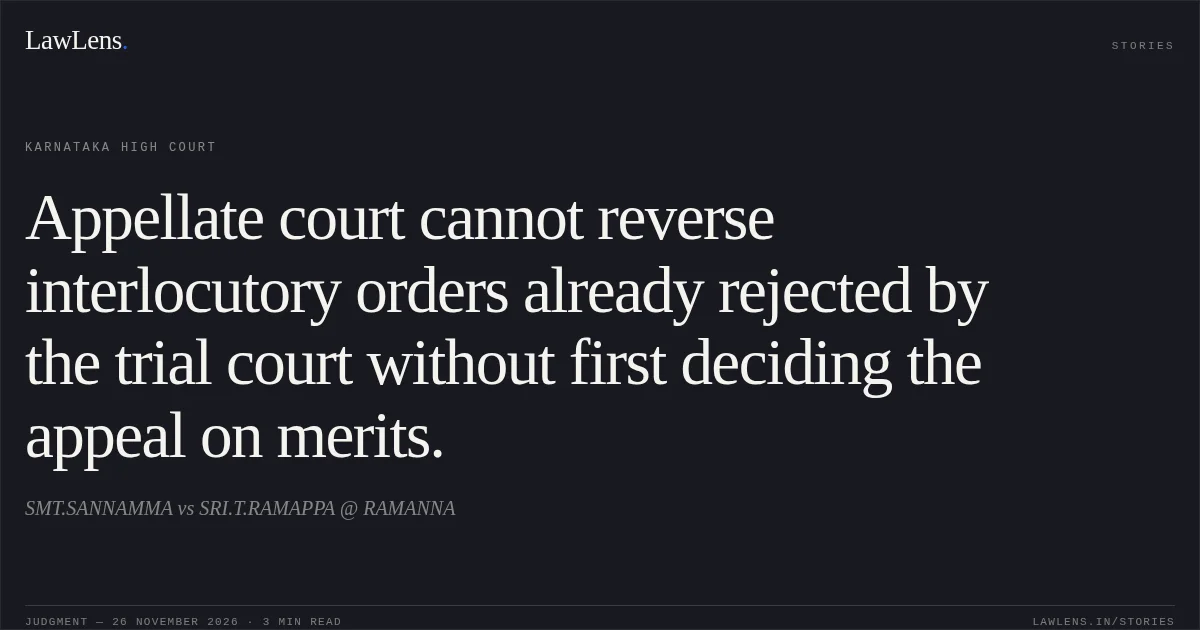
i.1. Whether the Lower Appellate Court could independently allow I.A. Nos. 15 and 17, which had already been rejected by the Trial Court, without first reversing or examining the merits of the judgment and decree in the appeal.
¶ 12, 13, 15, 16, 26ii.2. Whether, in a suit for declaration and possession founded on encroachment, the extent and location of the encroachment must be ascertained through a Commissioner under Order XXVI Rule 9 CPC, rather than through title documents alone.
¶ 19, 20, 21, 2303Law Applied
Order VII Rule 17 and Order XVI Rule 7 CPC, under which the plaint may be amended and a witness summoned, though the Court treated these applications as having been disposed of by the Trial Court and not as pending.
¶ 6, 12Section 96 read with Section 105 CPC, under which interlocutory orders not independently challenged may be questioned in an appeal against the decree, and Article 227 of the Constitution, which permits supervisory interference where warranted.
¶ 14Order XXVI Rule 9 CPC, under which a Commissioner may be appointed for local investigation of physical features and measurements, and whose report remains subject to objections.
¶ 19, 21, 22The Co-ordinate Bench decision in Shadaksharappa v. Kumari Vijayalaxmi, W.P. No. 201274/2022, which laid down guidelines for encroachment suits, though the judgment does not set out those guidelines.
¶ 24, 32(iv)Provisions in the judgment · 2 · Linked ones open on LawLens
Code of Civil Procedure, 1908 Section 96Section 105
04Reasoning
The direction in M.S.A. No. 77/2019 to "reconsider" the applications did not confer independent jurisdiction to reopen applications already decided by the Trial Court, which had passed reasoned orders and then dismissed the suit.
¶ 13, 15Since the applications were not pending, the Lower Appellate Court had to first examine the merits of the decree and the grounds of appeal, and could grant consequential relief on the interlocutory orders only after reversing the decree.
¶ 16, 18, 28, 30The encroachment dispute turns on physical identity and measurements, which cannot be resolved by title documents alone or by the Court's own spot inspection. Hence the Commissioner mechanism under Order XXVI Rule 9 is the appropriate route.
¶ 20, 21, 23A remand to the Trial Court is left open only as a discretionary step after merits review.
¶ 29, 32(iv)The impugned order suffers from a procedural irregularity that warranted interference.
¶ 3105Holding
The Lower Appellate Court cannot reopen rejected interlocutory applications without first deciding the appeal on its merits.
¶ 32(iii), 32(iv)The writ petition is allowed, and the order dated 13.11.2020 on I.A. Nos. 15 and 17 in R.A. No. 65/2018 is set aside. The Lower Appellate Court is directed to hear both parties on the merits of the appeal and decide it in accordance with law and the Shadaksharappa guidelines, examine the correctness of the I.A. orders while deciding the appeal, pass consequential orders if warranted, and has discretion to remand to the Trial Court with specific directions. The appeal must be disposed of within three months of receipt of the order, and all contentions are kept open.
¶ 32(i), 32(ii), 32(iv), 32(vi), 32(vii)Original Court PDF
SMT.SANNAMMAvsSRI.T.RAMAPPA @ RAMANNA
Click to open original judgment
Original judgment, available to read, download and summarize on LawLens.in