01Facts
The petitioner-plaintiff sued for partition and separate possession in O.S. No. 99/2011 before the Principal Civil Judge and JMFC, Hosadurga.
The trial court's judgment and decree dated 07.11.2014 was set aside by the Appellate Court in R.A. No. 287/2016, which allowed I.A. No. III under Order I Rule 10(2) CPC, permitted proposed defendants 3 and 4 to be impleaded, and remanded the suit.
¶ 3The Appellate Court directed the plaintiff to pay costs of Rs. 10,000 to defendants 1 and 2, bring the proposed defendants on record, and appear before the trial court on 10.01.2019 without further notice; non-compliance would confirm the decree.
¶ 3 · ¶ 4On 10.01.2019, the trial court recorded the plaintiff's absence and dismissed the suit because the costs were not deposited and the impleading applications were not filed.
¶ 5On 23.11.2021, the plaintiff filed I.A. Nos. 7 and 8 seeking restoration and leave to take the necessary steps, explaining the circumstances of non-compliance.
¶ 5By common order dated 29.07.2022, the trial court rejected both applications; this order is impugned in the writ petition under Article 227.
¶ 1 · ¶ 5The Court noted the intervening COVID-19 disruption to judicial proceedings.
¶ 602Issues
i.1. Whether the trial court erred in rejecting I.A. Nos. 7 and 8 and refusing restoration of the suit despite the plaintiff's non-compliance with the Appellate Court's directions.
¶ 5 · ¶ 6ii.2. Whether the dismissal of the suit on 10.01.2019, without affording a reasonable opportunity to the plaintiff, was sustainable.
¶ 5 · ¶ 9iii.3. Whether the High Court could restore the suit subject to conditions, namely payment of further costs, in the interest of substantial justice and to avoid multiplicity of proceedings.
¶ 7 · ¶ 8 · ¶ 1003Law Applied
The Appellate Court's remand under Order XLI Rule 1 read with Section 96 CPC and the impleading power under Order I Rule 10(2) CPC were intended to secure adjudication of the suit on merits.
¶ 3 · ¶ 4A party has no indefeasible right to restoration and must satisfactorily explain delay and non-compliance, but courts exercising jurisdiction over substantive civil rights must balance procedural discipline with substantial justice.
¶ 7The right to seek partition is a recurring cause of action, so dismissal does not bar fresh proceedings.
¶ 8The Supreme Court's approach of extending procedural indulgence in view of the COVID-19 pandemic was applied, though no specific authority is named.
¶ 6The power to impose costs as a condition of relief, in lieu of outright dismissal, is drawn from the trial court's judicial discretion.
¶ 9 · ¶ 10The writ jurisdiction under Article 227 of the Constitution of India was invoked to test the impugned orders.
¶ 1Provisions in the judgment · 1 · Linked ones open on LawLens
Code of Civil Procedure, 1908 Section 96
04Reasoning
The Court found a lack of diligence on the plaintiff's part in complying with the Appellate Court's directions, but held that the trial judge failed to consider the COVID-19 disruption and called the matter and dismissed the suit without reasonable opportunity.
¶ 5 · ¶ 6Because the suit concerned partition, a dismissal would not end the dispute, and a fresh suit could follow, which would multiply proceedings without purpose. The Court held that the trial judge should have imposed costs and made restoration conditional on compliance rather than shutting out the plaintiff entirely.
¶ 8 · ¶ 905Holding
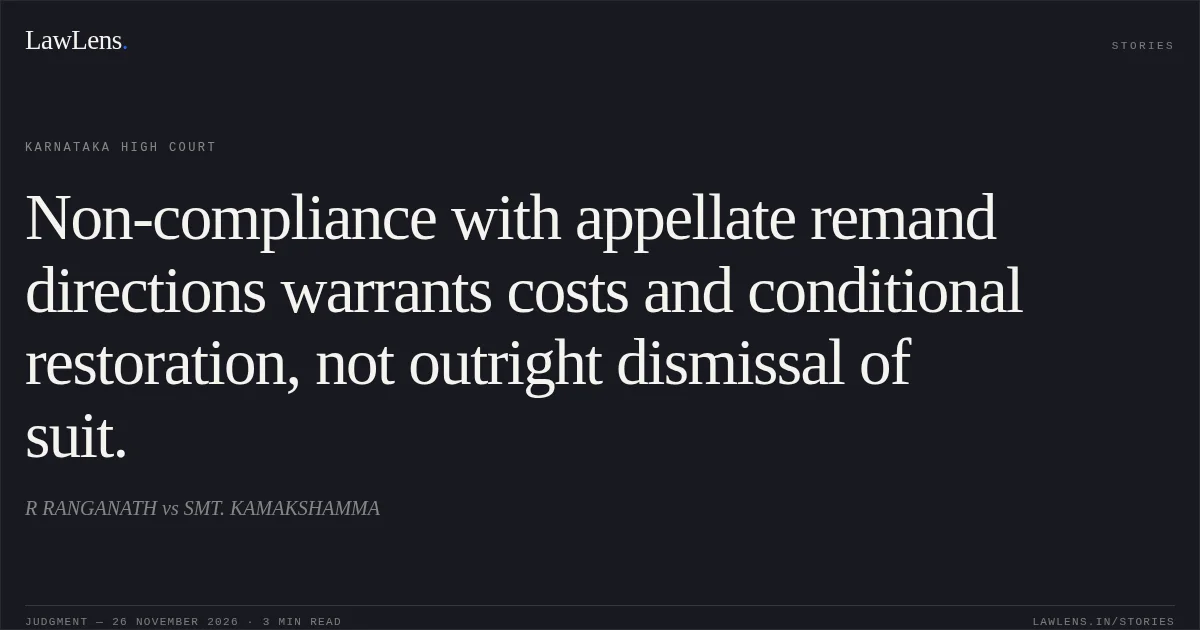
The High Court answered the issues in favour of the plaintiff, holding that the Court granted one further opportunity as a matter of indulgence, not of right, while requiring the plaintiff to compensate defendants 1 and 2 with further costs so that the dispute is adjudicated on merits.
¶ 10The writ petition was allowed. The common order dated 29.07.2022 on I.A. Nos. 7 and 8 and the dismissal order dated 10.01.2019 were quashed and set aside, and the suit was restored to its original file. The plaintiff must appear before the trial court on 14.12.2026 and deposit Rs. 10,000 (the costs directed by the Appellate Court to defendants 1 and 2) together with a further Rs. 10,000 imposed by the High Court. On deposit, the trial court shall permit the plaintiff to prosecute the suit and proceed in terms of the Appellate Court's remand directions. The indulgence is conditional on strict compliance with these terms.
¶ 11(i)–(iv)Original Court PDF
R RANGANATHvsSMT. KAMAKSHAMMA
Click to open original judgment
Original judgment, available to read, download and summarize on LawLens.in