01Facts
The petitioners, plaintiffs in O.S. No. 41/2015, instituted a partition suit under liberty granted by the High Court. The suit was later clubbed with O.S. No. 62/2012.
¶ 3In the partition suit, the petitioners sought partition and separate possession of their shares by metes and bounds and challenged the release deed dated 27.04.1992, relied upon by the defendants, as not binding on their shares.
¶ 3The plaintiffs in O.S. No. 62/2012 subsequently withdrew that suit.
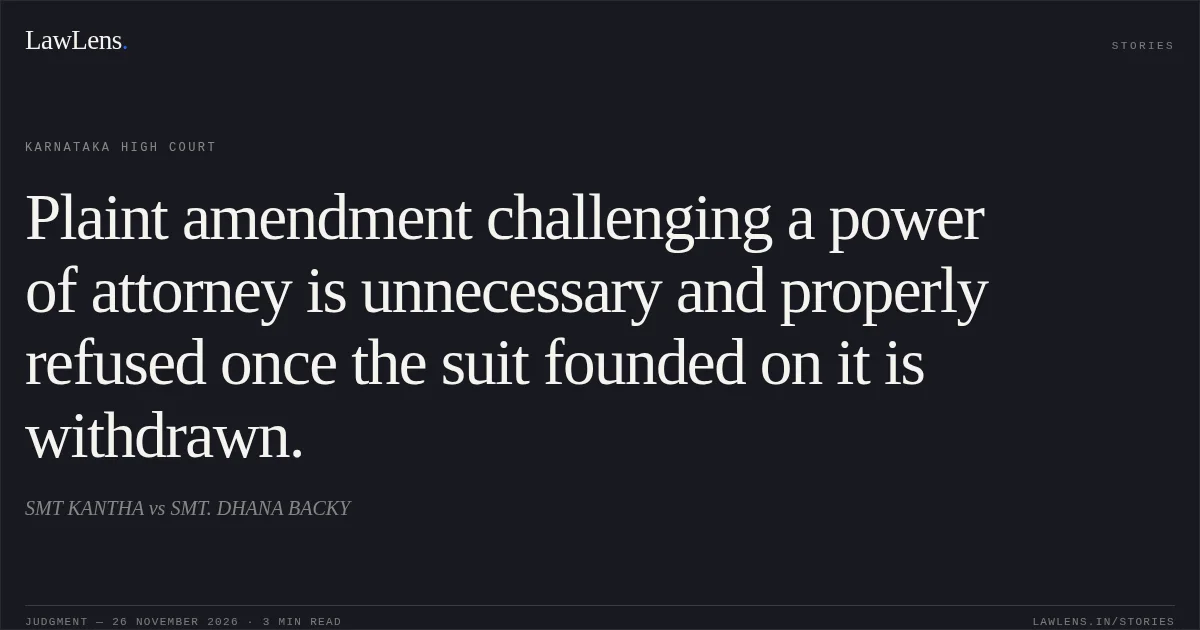
¶ 4The petitioners alleged that O.S. No. 62/2012 was founded on a fraudulent General Power of Attorney dated 10.12.2013. They sought to amend the plaint by inserting paragraphs 11A and 11B and an additional prayer challenging that Power of Attorney.
¶ 4The trial court rejected the amendment application (IA No. 13 under Order VI Rule 17 r/w Section 151 CPC, order dated 22.03.2021).
title/prayerThe petitioners challenged that order under Articles 226 and 227 of the Constitution.
title/prayer02Issues
i.1. Whether the proposed amendment challenging the Power of Attorney dated 10.12.2013 retained any relevance to the partition suit after the withdrawal of O.S. No. 62/2012.
¶ 5, 7ii.2. Whether the trial court's rejection of the amendment application suffers from perversity, infirmity, or jurisdictional error warranting interference under supervisory jurisdiction.
¶ 803Law Applied
The trial court's discretion to allow or refuse amendment of pleadings under Order VI Rule 17 CPC read with Section 151 CPC.
title/prayer · ¶ 8The settled limit on writ jurisdiction under Articles 226 and 227 of the Constitution, under which interference is warranted only where an order is perverse, infirm, or jurisdictionally erroneous.
¶ 8The core questions in a partition suit are whether the suit properties are joint family ancestral properties, whether the petitioners are entitled to partition, and whether the release deed dated 27.04.1992 binds their shares.
¶ 6, 7A party alleging fraud or nullity of a document bears the burden of proving that allegation in accordance with law.
¶ 6No precedents were cited in the judgment.
Provisions in the judgment · 1 · Linked ones open on LawLens
Code of Civil Procedure, 1908 Section 151
04Reasoning
The withdrawal of O.S. No. 62/2012 removed the foundation for the proposed challenge. Because the impugned Power of Attorney supported only the now-withdrawn suit, the controversy surrounding it no longer had any bearing on the substantive rights of the parties in the partition suit.
¶ 5Measured against the core issues of ancestral character, entitlement to partition, and the binding effect of the 1992 release deed, the proposed paragraphs and prayer neither advanced adjudication nor were necessary for an effective determination.
¶ 7Applying the Rule of Law, the Court found that the trial judge had validly exercised discretion in refusing the amendment, which would have introduced a collateral issue with no direct nexus to the controversy.
¶ 8The impugned order was therefore not perverse and disclosed no jurisdictional error, so no supervisory interference was called for.
¶ 805Holding
The Court answered both issues against the petitioners. The proposed amendment, having become unnecessary after the withdrawal of O.S. No. 62/2012, did not warrant leave to amend, and the impugned order did not suffer from perversity or jurisdictional error.
¶ 8The writ petition is dismissed. All contentions regarding the nature of the suit properties, entitlement to shares, and the validity and binding effect of the release deed dated 27.04.1992 are left open for adjudication by the Trial Court on their own merits, uninfluenced by the Court's observations.
¶ 8Original Court PDF
SMT KANTHAvsSMT. DHANA BACKY
Click to open original judgment
Original judgment, available to read, download and summarize on LawLens.in